 ultimate-guide
Legal Requirements for Hiring Off-Duty Officers
Table of Contents
- How the Approval Process for Hiring Off-Duty Officers Works
- Off-Duty Police Officer Requirements: Eligibility and Approval
- Hiring Off-Duty Police for Events: Permitted and Prohibited Assignments
- Off-Duty Officer Contract Requirements and Employer Obligations
- Off-Duty Officer Liability and Insurance: Who Pays When Something Goes Wrong
- Costs, Minimum Hours, and Payment Rules When Hiring Off-Duty Officers
- Conclusion: Building a Compliant Off-Duty Officer Program
- Frequently Asked Questions
Last Updated: October 17, 2026
How the Approval Process for Hiring Off-Duty Officers Works
Hiring off-duty officers is a regulated process, not a simple staffing transaction. In most jurisdictions, an off-duty police officer cannot accept private security work without written permission from their department, and that permission shapes everything from scheduling to insurance.
The core principle is straightforward: the officer's police authority stays with the agency, while the private employer controls only the working conditions of the assignment.
Below, we'll walk through each stage of the process, from the initial request to post-assignment reporting, and flag the gaps that most guides skip.
Requesting an Officer Through the Agency or a Vendor
The first decision is how to request coverage: directly through the agency's off-duty employment office or through a vendor that coordinates with departments on your behalf. Going direct can work for a single event with a clear scope, but it puts the paperwork, scheduling, and compliance checks on your team.
Whichever route you choose, expect to provide the same core information: the assignment location, dates and hours, expected attendance or site conditions, whether the officer will be armed, and who will supervise.
Off-Duty Police Officer Requirements: Eligibility and Approval
Off-duty police officer requirements vary by agency, but the common threads are consistent. An officer must be a sworn member in good standing, must have completed the department's approval process, and must remain within the agency's rules on hours, conduct, and equipment.
A common mistake is assuming that an officer's willingness to work is the same as approval. It isn't. The agency can deny a request, impose conditions, or withdraw permission after the fact. We've seen employers book an officer directly and then discover the assignment was never authorized, which leaves the site uncovered and the employer exposed.
- Confirm the officer is a sworn member in good standing
- Verify written agency approval for the specific assignment
- Check hour limits and fatigue rules
- Confirm whether the assignment permits armed status
- Document the officer's badge and identification details
Hiring Off-Duty Police for Events: Permitted and Prohibited Assignments
Hiring off-duty police for events is common, but not every assignment is permitted. Departments typically allow crowd management, traffic control, security screening, and visible patrol presence at venues, construction sites, and retail centers.
The distinction matters because an officer retains police authority even while working privately. If a crime occurs on site, the officer may need to take law enforcement action, and the agency's rules govern how that authority is exercised. Employers should never ask an officer to act as a private enforcer or to use police powers to resolve a civil dispute.
Off-Duty Officer Contract Requirements and Employer Obligations
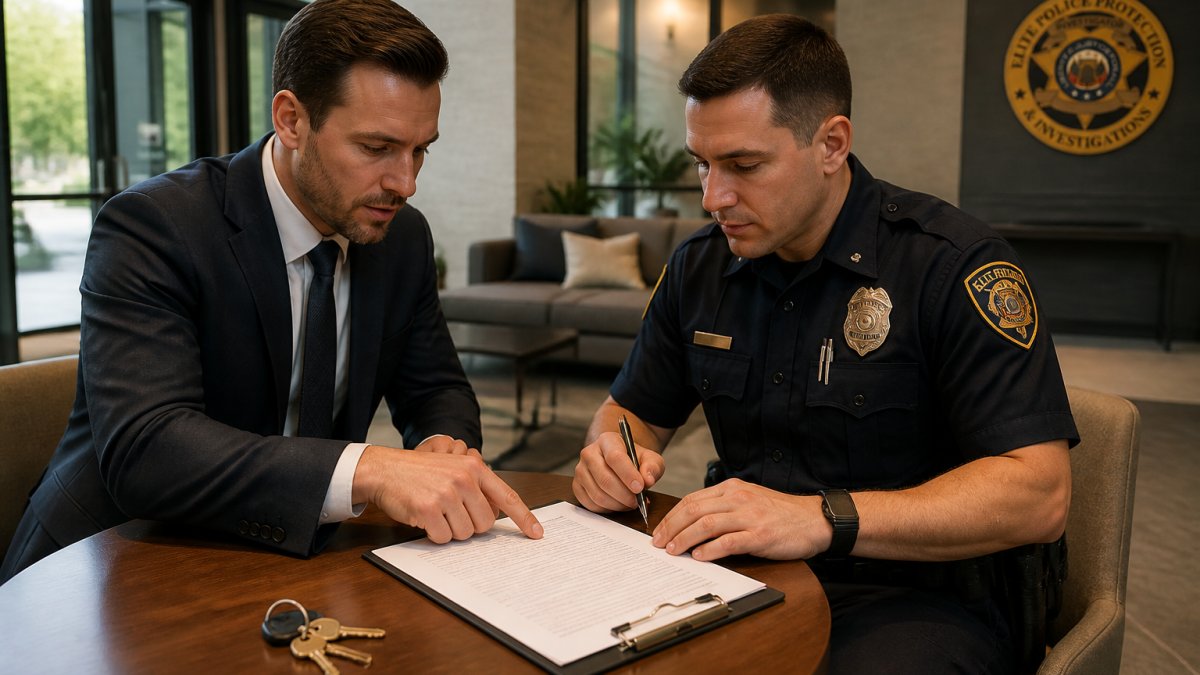
Off-duty officer contract requirements exist to allocate responsibility before anything goes wrong. Most agency off-duty employment policies require a written agreement or approved request form before the first shift, and the terms of that document, not a handshake with the officer, control what happens if the assignment goes sideways.
Clauses that belong in every off-duty agreement
A common pattern in agency-approved agreements is a short list of terms that do the real work. Confirm each of these is present, in writing, before scheduling:
- Scope of duties. Describe the post, fixed post, patrol, traffic control, screening, and the specific location. Vague scopes are the most common reason a department sends a request back for revision.
- Armed status. State whether the assignment is armed or unarmed and cite the agency approval that authorizes it. Armed status is usually a separate approval, not a default.
- Supervision and chain of command. Name who on the employer side gives task direction and confirm that the officer's police chain of command is unaffected. The employer directs the work; the agency directs the officer.
- Hours, minimums, and cancellation. Put the minimum billable hours, overtime triggers, holiday rates, and the cancellation window in the contract, not in a side email.
- Insurance and indemnification. Identify who carries general liability, auto liability for any police vehicle, and workers' compensation for the officer, and state whether the employer must name the agency as an additional insured.
- Incident reporting. Require the employer to notify the agency of any use-of-force, arrest, injury, or property-damage incident on the assignment, and set a reporting window.
- Termination. Give both parties a written way to end the assignment, and require notice to the agency's off-duty employment office.
Employer obligations that survive the contract
Employer obligations extend beyond the signature page. Most agencies require the requesting organization to maintain a safe work environment, provide accurate assignment details, and report incidents promptly. Some departments also require proof of insurance before approving an assignment. The Small Business Administration's guidance on business insurance is a useful starting point for understanding the coverage categories that typically apply.
Keep a compliance file for every assignment. At minimum, it should hold the agency approval, the signed agreement, proof of insurance, the officer's badge and identification details, hour logs, invoices, payment confirmations, and any incident reports.
Off-Duty Officer Liability and Insurance: Who Pays When Something Goes Wrong
Off-duty officer liability and insurance is the question that separates a well-run program from a risky one, and it is the area most agency pages leave thin. The outcome usually turns on one question: was the officer acting within the scope of the off-duty employment and within their police authority when the incident occurred?
A common mistake is assuming the agency's insurance covers everything. It usually doesn't. Employers should confirm in writing which party carries general liability, auto liability for patrol vehicles, and workers' compensation for the officer.
The coverage lines that actually matter
Four coverage questions decide most disputes. Get a written answer to each before the first shift:
- General liability. Does the employer's policy respond to bodily injury or property damage claims arising from the assignment, and does it exclude law-enforcement activities? Many commercial general liability forms contain exclusions that can surprise an employer after an arrest-related claim.
- Auto liability. If the officer uses a police vehicle or a personal vehicle on the assignment, confirm which policy is primary. Agency policies often restrict personal-vehicle use on off-duty assignments, and the auto coverage question is frequently overlooked.
- Workers' compensation. Confirm whether the officer is covered by the agency for the off-duty hours or whether the employer must extend coverage. The answer varies by agency and by state workers' compensation rules, and it is rarely safe to assume.
- Indemnification and additional insured. Indemnification language shifts the cost of defending a claim; additional-insured status gives the agency direct access to the employer's policy. These are separate protections, and agencies that require one often require both.
How risk is typically allocated
A common pattern is a three-way split. The agency retains responsibility for the officer's training, equipment, and police-authority decisions. The employer carries responsibility for the premises, lighting, crowd density, access control, and the conditions that made the assignment necessary. The contract allocates the residual risk through indemnification, insurance requirements, and additional-insured terms. Where the lines blur is when an employer gives an instruction that pulls the officer outside approved duties, such as directing an officer to eject a tenant in a civil dispute. That is the scenario most likely to void approval and push liability onto the employer.
Post-incident steps that protect the employer
Liability is often decided by what happens in the first hours after an incident. Notify the agency's off-duty employment office within the window the agreement requires. Preserve video, access logs, and witness contact information. File the employer's own incident report in addition to any police report. Do not ask the officer to characterize the incident for the employer's file, the agency controls the officer's statement. Finally, notify your insurer promptly; late notice is one of the most common reasons a claim that should be covered is denied.
Costs, Minimum Hours, and Payment Rules When Hiring Off-Duty Officers
Costs for off-duty officer assignments depend on the agency, the assignment type, and the officer's rank, so pricing should always be confirmed directly with the department or vendor rather than estimated. Most agencies set a minimum number of hours per assignment, often three or four, and bill at an hourly rate that includes an administrative fee.
Payment procedures matter too. Some agencies require payment through a centralized off-duty employment office, while others allow direct payment to the officer. Employers should keep records of hours worked, invoices, and payment confirmations, because those records are the first thing an auditor or insurer will ask for.
| Stage | What to Confirm | Why It Matters |
|---|---|---|
| Request | Assignment scope, dates, armed status | Drives agency approval |
| Approval | Written permission, conditions | Prevents unauthorized coverage |
| Contract | Insurance, indemnification, rates | Allocates liability |
| Assignment | Hours, supervision, incident reporting | Supports compliance |
| Closeout | Invoices, payment records, incident log | Defends against claims |
Conclusion: Building a Compliant Off-Duty Officer Program
The legal requirements for hiring off-duty officers come down to one idea: the agency controls the officer, and the employer controls the assignment. Get written approval, document every condition, and confirm insurance and indemnification before the first shift. Elite Police Protection helps property managers, developers, and event organizers build compliant off-duty officer programs. Get started with Elite Police Protection and put a documented, defensible security program in place.
Frequently Asked Questions
Do off-duty police officers have any authority while working private security?
An off-duty officer keeps sworn status but usually acts under the hiring agency's policies and state law limits. Most departments require officers to intervene in felonies or emergencies even during private work, and to identify themselves as officers when taking law-enforcement action. For routine security tasks like checking credentials or asking someone to leave, they act more like a private employee. The split matters for hiring off-duty officers because your contract should state which tasks are security work and which trigger police authority.
Can a business hire an off-duty officer directly, or must it use a department program?
It depends on the agency. Many departments run formal off-duty employment programs that handle requests, scheduling, and payment, and they require all private work to go through that channel. Others allow direct arrangements but still require written approval before the first shift. Hiring off-duty officers outside the approved process can void the officer's coverage and expose your business to risk, so confirm the agency's rule before signing anything.
Who is responsible for an off-duty officer's actions during a private assignment?
Responsibility is usually shared and defined by contract. The officer remains subject to department discipline, but civil claims often name the employer, the officer, and sometimes the agency. A written agreement should state indemnification, insurance minimums, and who handles defense costs. When hiring off-duty officers, ask for a certificate of insurance naming your business as additional insured and keep incident reports on file for every assignment.
Does hiring an off-duty officer require a permit or written agreement?
Most agencies require a written agreement and prior approval, and some municipalities add a separate permit for traffic control or amplified events. The agreement typically covers scope of work, hours, uniform and equipment rules, insurance, and payment terms. Skipping this step is one of the most common compliance failures when hiring off-duty officers, and it can leave you without coverage if an incident leads to a claim.
What insurance should a business require when hiring off-duty officers?
Ask for general liability and professional liability coverage with limits that match your event or site risk, plus a certificate naming your organization as additional insured. Confirm whether the officer or vendor carries workers' compensation and whether the agency's coverage applies during private employment. Off-duty officer liability and insurance terms belong in the contract, not a verbal agreement, because claims after an incident often turn on which policy responds first.