
 how-to
Police Security Services: How to Hire Off-Duty Officers
Table of Contents
- What Police Security Services Actually Provide
- Private Security vs Law Enforcement: Key Differences
- How to Hire Off-Duty Police for Your Property or Event
- Off-Duty Police Security Rates: What Drives the Cost
- Access Control, Roving Patrols, and Emergency Response
- Legal Liability and Insurance When Hiring Off-Duty Officers
- Technology Integration in Modern Police Security Services
- Frequently Asked Questions
Last Updated: September 29, 2026
What Police Security Services Actually Provide
Police security services place off-duty or retired law enforcement officers on private property, bringing real police training and a presence uniformed guards often lack. At Elite Police Protection, we staff these roles with active, retired, and prior law enforcement professionals, available 24/7.
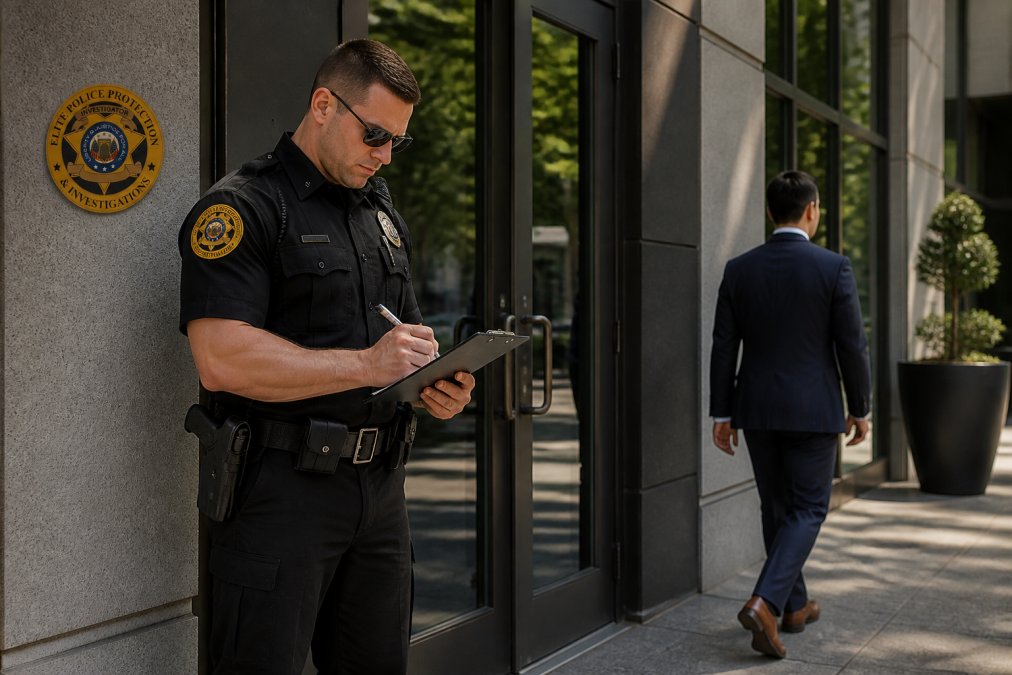
Here is what a typical engagement includes:
- Site security at offices, warehouses, and retail centers
- Event security for concerts, conferences, and private gatherings
- Executive protection for high-profile individuals
- Access control at building entrances and parking areas
- Roving patrols across large or multi-building properties
- Incident reporting with written documentation after every shift
Types of Coverage: Armed, Unarmed, and K9 Teams
Coverage comes in three forms, and the right choice depends on your risk level. Armed officers carry firearms and suit high-risk sites like banks and jewelry stores. Unarmed guards handle access control, crowd management, and front-desk security. K9 teams add a detection layer for narcotics, explosives, or a visible deterrent. Many properties need a mix, a retail center might use unarmed officers at entrances and an armed officer on roving patrols after dark.
Private Security vs Law Enforcement: Key Differences
Private security works for you. Law enforcement works for the public. That distinction drives everything else.
| Factor | Private Security | Law Enforcement |
|---|---|---|
| Who they work for | Your business | The public |
| Response scope | One property or event | Entire jurisdiction |
| Arrest authority | Limited, varies by state | Full |
| Cost to you | You pay directly | Tax funded |
| Focus | Prevention and deterrence | Investigation and enforcement |
How to Hire Off-Duty Police for Your Property or Event
Hiring off-duty police starts with a clear risk assessment. Define what you need protected before you call anyone:
- Assess your risk. Identify vulnerable points: entrances, loading docks, cash handling areas.
- Define the role. Armed or unarmed? Fixed post or roving patrol? How many hours?
- Set your schedule. Events need coverage before doors open and after they close.
- Check licensing. Confirm the provider and each officer are properly licensed and insured.
- Review insurance. Ask for a certificate of insurance before the first shift.
- Create a communication plan. Who do officers call in an emergency? What is the chain of command?
- Get it in writing. A written agreement should cover scope, hours, and liability.
Vetting, Licensing, and Insurance Checks
Every officer should clear a background check, and every provider should carry liability insurance. Ask to see both.
Off-Duty Police Security Rates: What Drives the Cost
Off-duty police security rates depend on the officer, the risk, and the hours. The biggest mistake buyers make is comparing hourly rates without understanding what is inside them, two identical-looking quotes can differ by thousands once overtime, minimums, and supervision are added. Main cost drivers:
- Armed vs. unarmed. Armed officers cost more due to firearm qualification and higher liability exposure.
- Time of day. Overnight, weekend, and holiday shifts carry premium rates; many off-duty officers work a second job after a full police shift.
- Duration. A one-off event costs more per hour than a standing weekly contract because the provider absorbs scheduling and onboarding costs on every booking.
- Location. High-crime areas, dense urban sites, and properties with prior incident history command higher rates due to rising workers' compensation.
- Special skills. K9 handlers, executive protection specialists, and certified officers cost more than a standard uniformed post.
- Number of officers. Multi-officer details add coordination and supervision costs.
The Line Items Most Buyers Miss
Hourly rate is only part of the invoice. Ask about these:
- Minimum shift length. Most providers bill a minimum, often four hours, even if the assignment ends early.
- Overtime. Shifts past eight or twelve hours may trigger overtime rates, blowing a budget on long events.
- Holiday premiums. Many providers charge a premium on federal holidays. Confirm the list before booking.
- Equipment and vehicle fees. Radios, body cameras, patrol vehicles, and K9 units may be billed separately.
- Cancellation terms. Late cancellations often carry a fee equal to the minimum shift.
- Supervision. Some providers bill a site supervisor on top of officer hours; others build it into the rate.
How to Budget for a Security Engagement
A practical budgeting process:
- Define the coverage window. Include setup, doors-open, event hours, and breakdown. Officers arrive before guests and stay until the site is clear.
- Estimate officer hours. Multiply officers by the coverage window, then add the minimum-shift buffer.
- Add a contingency. Events routinely run long; 10 to 20 percent of the labor estimate covers overtime and extended shifts.
- Price the equipment. Get radios, cameras, or patrol vehicle line items in writing.
- Compare total cost, not hourly rate. The lowest hourly rate often loses once minimums, premiums, and fees are added.
The Cost-Benefit Question: Private vs. Public Security
Most buyers never ask what the coverage actually prevents. A private security engagement is a risk-transfer purchase, not a commodity. The right comparison is not the officer's hourly cost but what an incident costs if the post is empty.
The cheapest quote is rarely the safest one. Providers that cut rates often cut corners on vetting, insurance, or training. One uninsured officer involved in an incident can leave your business covering the entire claim.
Budget for the full coverage window, not just the public hours. The difference between a quote that fits and one that surprises you is almost always in the line items most buyers never ask about.
Access Control, Roving Patrols, and Emergency Response
Access control decides who gets in. Roving patrols catch what fixed posts miss. Emergency response ties it together.
Legal Liability and Insurance When Hiring Off-Duty Officers
Liability is the part most buyers underestimate. When you hire private security, you take on real legal exposure, and the paperwork you sign before the first shift determines who pays after an incident.
The Legal Theories That Create Exposure
Claims against your business usually fall into a few categories:
- Negligent hiring. A plaintiff argues you failed to vet the officer or provider. Background checks matter before the first shift, not after.
- Negligent training and supervision. A plaintiff argues the officer was untrained or unsupervised. Post orders and documented training records are your defense.
- Negligent security. A plaintiff argues your property lacked reasonable security given foreseeable risks. Prior incident reports and police calls can establish foreseeability.
- Excessive force and false imprisonment. Claims that an officer used too much force or detained someone without authority. These turn on the officer's legal status and state citizen's arrest rules.
- Premises liability. Even if the officer acted correctly, your business can be named because the incident happened on your property.
The Officer's Legal Status Matters
An off-duty officer working a private shift generally acts as a private citizen, not a sworn officer on duty, which changes the legal standard applied to their actions. Rules vary by state and department policy, and some states grant broader authority to licensed officers in approved secondary employment. Ask your provider, in writing, how they classify the officer's status and what that means for arrest, detention, and use-of-force authority.
The Insurance Stack You Should Require
A single certificate of insurance is not enough. Ask every provider for:
- Commercial general liability (CGL). Covers bodily injury and property damage claims from the provider's operations. Confirm the policy is current and limits are adequate for your site.
- Professional liability (errors and omissions). Covers claims the provider failed to meet the expected standard, such as a missed patrol or failed access-control check.
- Workers' compensation. Covers the officer's own injuries on your property. Without it, an injured officer may look to your business.
- Automobile liability. Required if officers use vehicles on your property or patrol routes.
- Umbrella or excess liability. Adds a layer above primary policies for large events or high-risk sites.
Contract Terms That Transfer Risk
Insurance only helps if the contract points the claim at the right party. Key terms:
- Additional insured status. Your business should be named as an additional insured on the provider's CGL policy, letting you tender a claim directly to their insurer.
- Indemnification. The provider should defend and indemnify your business for claims from their negligence. Watch for mutual indemnification clauses that dilute this.
- Certificate of insurance with notice of cancellation. You want to know if coverage lapses mid-contract.
- Waiver of subrogation. Prevents the provider's insurer from suing your business after paying a claim.
- Limitation of liability. Some providers cap liability at fees paid, which can leave you holding the loss.
- Scope and post orders. The contract should reference written post orders. If scope is vague, the provider can argue the assignment excluded the task that led to the incident.
A Practical Vetting Checklist
Before the first shift, confirm:
- Each assigned officer has a documented background check and training record.
- The certificate of insurance names your business as additional insured.
- The contract includes indemnification and a waiver of subrogation.
- Post orders are in writing and attached to the agreement.
- The provider has a written incident-reporting process.
U.S. Department of Justice guidance on private security and liability
A certificate of insurance is a snapshot, not a guarantee. Ask for notice of cancellation and verify coverage directly with the provider's broker before high-risk events. A lapsed policy discovered after an incident is the same as no policy at all.
Liability is not a paperwork formality. The officer's legal status, the insurance stack, and the contract terms together decide who pays after an incident. Buyers who treat these as a checklist rather than a formality are the ones who avoid the surprise.
Technology Integration in Modern Police Security Services
Technology has changed how security teams operate. Modern police security services combine trained officers with tools that extend their reach.
The best security programs pair trained officers with systems that prove the work happened. Monitoring and reporting turn a service you hope is working into one you can verify.
Frequently Asked Questions
What is the difference between off-duty police and private security guards?
Off-duty police officers are sworn law enforcement personnel working a secondary assignment. Private security guards are civilians licensed by the state to observe, deter, and report. They can detain someone under citizen's arrest rules but do not carry police authority. For high-risk sites or events where quick legal intervention matters, off-duty officers offer a stronger deterrent. For general access control and patrol, licensed guards work well.
What are the legal requirements for hiring off-duty law enforcement?
Requirements vary by state and department. Most agencies require officers to get written approval before working secondary employment. Ask for a certificate of insurance before the first shift.
Do off-duty police officers have arrest powers while working private security?
In most jurisdictions, yes. Sworn officers generally retain their police authority 24 hours a day, even while working off-duty assignments. That means they can make arrests, issue citations, and respond to crimes on your property with full legal standing. This is one of the main reasons property managers and event organizers choose off-duty officers over standard guards. Confirm the specific rules with the officer's department, since policies vary.
How do off-duty police security rates compare to standard guard services?
Off-duty police security rates are typically higher than standard unarmed guard rates because you are paying for sworn officers with full police training and authority. Rates depend on the officer's rank, the assignment risk level, whether the role is armed, and the duration. Overtime rules and department administrative fees can also apply. Contact Elite Police Protection for a quote tailored to your site, schedule, and coverage needs.