
 listicle
Security Guard Services for Apartment Complexes: 2026 Guide
Table of Contents
- Security Guard Services for Apartment Complexes: Coverage Comparison
- Apartment Security Guard Duties: What Officers Actually Do on Shift
- On-Site Security Guards and 24/7 Coverage for Multifamily Communities
- Armed vs. Unarmed Security Guards: Choosing the Right Fit
- Apartment Complex Security Patrol: Mobile, Vehicle, and Foot Patrols
- Gated Community Security Guards: Access Control, Visitor Management, and Parking
- Apartment Security Guard Cost: Pricing Drivers and What You Pay For
- How Property Managers Should Evaluate a Security Provider
- Frequently Asked Questions
Last Updated: October 7, 2026
Security Guard Services for Apartment Complexes: Coverage Comparison
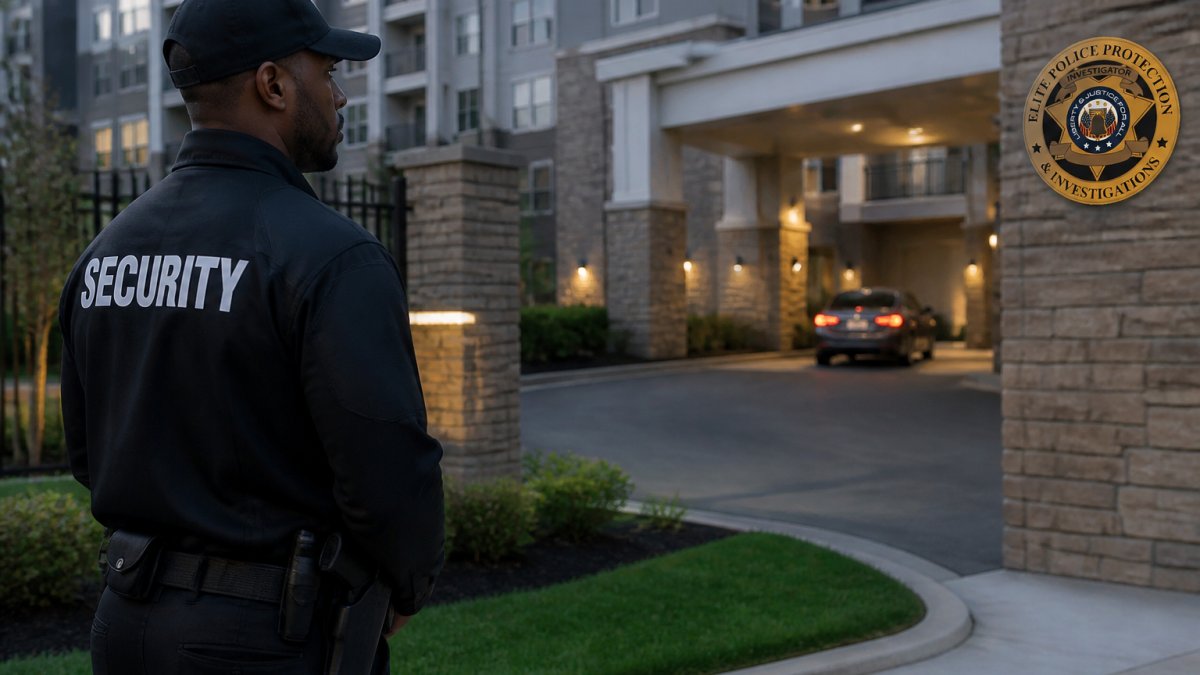
Apartment complex security is the coordinated use of on-site officers, patrols, monitoring, and access control to protect residents, staff, and property. At Elite Police Protection, we staff off-duty and retired law enforcement officers who understand residential security is a different job than commercial guarding.
Choosing security guard services for apartment complexes comes down to matching coverage to your risk profile: a gated high-rise with controlled entry needs something different from a low-rise community with open parking.
Quick Comparison: On-Site Guards, Patrols, and Monitoring
| Service Model | Coverage | Best For | Typical Schedule |
|---|---|---|---|
| On-site security guards | Fixed post, full attention to one property | High-rise buildings, gated communities, properties with prior incidents | 8-12 hour shifts, 24/7 options |
| Mobile patrol | Drive-through visits across multiple properties | Low-rise communities, scattered sites, budget-conscious managers | 2-5 visits per night |
| Vehicle patrol | Marked vehicle, visible perimeter presence | Large parking areas, long perimeters, deterrence-focused sites | Overnight and weekend coverage |
| Foot patrol | Walking rounds through buildings and grounds | Interior hallways, stairwells, amenity areas | Paired with on-site or mobile coverage |
| Access control and monitoring | Entry-point screening, camera review, dispatch | Controlled-access buildings, gated communities | 24-hour monitoring |
Most communities run a hybrid: on-site officer at peak hours, mobile patrol overnight, monitoring at entry points.
Apartment Security Guard Duties: What Officers Actually Do on Shift
Apartment security guard duties center on resident safety, property protection, and incident documentation through visible patrols, entry-point checks, and written reports managers can act on.
A typical shift covers:
- Foot patrols through hallways, stairwells, laundry rooms, and amenity areas
- Entry-point checks to confirm gates, doors, and access systems are functioning
- Parking enforcement for unauthorized vehicles, expired tags, and fire-lane violations
Documentation quality is what most guides miss. A guard who observes a problem but writes a vague report creates liability instead of reducing it. We train officers to record specific times, locations, and descriptions so reports hold up for managers or insurers.
On-Site Security Guards and 24/7 Coverage for Multifamily Communities
On-site security guards provide the strongest deterrent for multifamily communities because their presence is constant and attention undivided. For properties with recurring trespassing, package theft, or after-hours disturbances, a dedicated post outperforms periodic patrols.
24/7 coverage means shift coverage designed so no gap exists between handoffs. A common structure:
- Day shift (7 a.m. to 3 p.m.): access control, vendor screening, resident requests
- Swing shift (3 p.m. to 11 p.m.): peak foot traffic, parking enforcement, amenity monitoring
- Overnight shift (11 p.m. to 7 a.m.): perimeter checks, alarm response, quiet-hours enforcement
Field supervision matters: a provider that never sends a supervisor will see shift coverage drift, late arrivals, and inconsistent reporting. Ask how often supervisors visit and whether you'll receive those records.
Armed vs. Unarmed Security Guards: Choosing the Right Fit
Unarmed security guards are the right default for most apartment complexes. Armed officers make sense when a property has a documented history of violent crime, high-value assets, or a threat profile that justifies the added liability and cost.
The decision comes down to three questions:
- What does your incident history show? Repeated trespassing and noise complaints call for unarmed presence. Assaults, armed robbery, or gang activity may justify armed coverage.
- What does your insurance carrier say? Some policies require specific guard qualifications or restrict armed personnel on residential property.
- What do residents expect? Armed officers change the feel of a community. Some residents feel safer; others feel policed. Survey your residents before switching.
We staff both armed and unarmed officers, and we're direct about the tradeoff: armed guards cost more, carry more liability, and aren't necessary for most residential properties.
Apartment Complex Security Patrol: Mobile, Vehicle, and Foot Patrols
Mobile patrol sends an officer in a personal or marked vehicle to check multiple properties on a route.
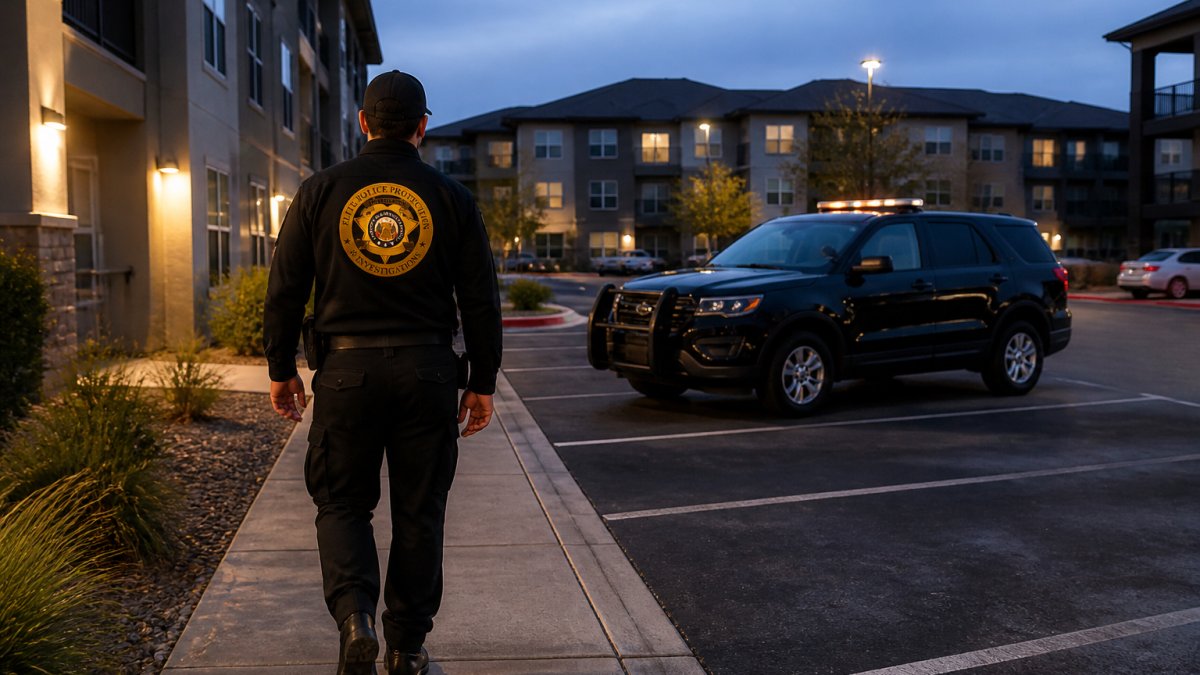
Vehicle patrol keeps a marked unit on or near one property.
Foot patrol puts an officer on the ground, walking hallways, stairwells, and amenity spaces.
Patrol frequency should vary. Predictable patrols let people time their activity around them; random intervals keep deterrence working.
Gated Community Security Guards: Access Control, Visitor Management, and Parking
Gated community security guards manage the entry points that make a gate more than decoration. A gate without staffing or monitoring is a suggestion, not a barrier, and residents notice when tailgating and unauthorized entry go unchecked.
Core duties at a gated property include:
- Visitor management: logging guests, verifying resident authorization, issuing temporary passes
- Access control: monitoring gates, garage entries, and pedestrian doors for propped or forced openings
- Parking enforcement: checking permits, towing unauthorized vehicles, keeping fire lanes clear
Resident privacy is the part most vendors handle poorly. Officers should verify access without collecting more personal information than necessary, and visitor logs should be stored securely and shared only with property management.
Apartment Security Guard Cost: Pricing Drivers and What You Pay For
Apartment security guard cost depends on coverage hours, guard type, property size, and shift structure. There is no single market rate, and any provider quoting a flat number before walking your property is guessing. Understand the mechanics well enough to compare scopes apples to apples.
The three numbers that drive almost every quote
Nearly every security proposal reduces to three inputs:
- Billable hours per week. Multiply posts by hours each post is staffed. One post staffed 24/7 is 168 hours per week; overnight only (11 p.m. to 7 a.m.) is 56. That single difference is the largest swing in your budget.
- The hourly billing rate for the guard classification. Armed officers bill higher than unarmed, supervisors higher than line officers. Rates also vary by market and by whether the officer is a direct employee or a subcontractor.
- The multiplier for overtime, holidays, and relief coverage. A post that must never go dark needs relief officers for callouts, vacations, and sick days. Providers build that into the rate or bill it separately.
Ask each vendor for the same three numbers in writing, weekly billable hours, blended hourly rate, and how relief coverage is billed. When quotes differ, the gap usually traces to one of those three lines, not "market conditions."
What actually moves the rate up or down
- Coverage hours: 24/7 staffing costs far more than overnight-only or weekend coverage. Dropping a post from 24/7 to overnight-only can cut billable hours by roughly two-thirds.
- Armed vs. unarmed: armed officers carry higher rates and higher insurance requirements. For most residential properties, unarmed is the correct default.
- Property size and layout: larger grounds, multiple buildings, and spread-out parking increase the time required to complete a patrol round, which increases the hours needed to cover the same post.
How to build a budget before you take bids
Start with your incident history and highest-risk hours, not a target dollar figure. A common pattern is to staff the hours when incidents cluster, often evenings and overnight, and use mobile patrol the rest of the day.
Write down three scenarios before you call vendors:
- Minimum: mobile patrol only, a set number of visits per night.
- Mid: one on-site post during peak hours plus mobile patrol overnight.
- Maximum: one or more on-site posts staffed around the clock.
Ask each vendor to price all three against your property. The comparison tells you what each incremental dollar buys, far more useful than a single quote you can't benchmark.
Why we don't publish flat rates
We don't publish flat rates because the right number depends on your property. A gated high-rise with controlled entry and a low-rise community with open parking are different jobs with different hour requirements. Request a walkthrough and written scope instead of comparing hourly quotes; the scope tells you what you're buying.
How Property Managers Should Evaluate a Security Provider
Evaluating a security provider means testing five things before you sign: licensing and insurance, guard vetting, supervision, reporting, and resident complaint handling. Price matters, but it's the last filter, not the first. What most vendor pages skip is what happens after signing, the assessment, deployment, and review cycle that determines whether the coverage you bought is the coverage you get.
Step 1: Assess your property before you talk to vendors
Walk your property the way an officer would, at the hours when problems occur. Document:
- Entry points: gates, garage doors, pedestrian doors, and any point that is routinely propped or tailgated
- Incident history: the last 12 months of police calls, trespassing reports, package thefts, and noise complaints, mapped by time of day
- Blind spots: stairwells, laundry rooms, trash enclosures, and parking levels with poor lighting or camera coverage
This assessment becomes the scope document you hand to every vendor, and the baseline you measure against later.
Step 2: Screen providers against hard requirements
Use this checklist when comparing vendors:
- Licensing and insurance: Confirm state licensing and ask for a certificate of insurance with general liability and workers' compensation limits
- Guard vetting: Ask how officers are screened, what training they complete, and whether they're employees or subcontractors
- Supervision: Request the field supervision schedule and sample supervisor visit logs
Step 3: Deploy with a defined trial period
For multifamily communities, we recommend a 30-day trial with weekly check-ins, giving you real data on shift coverage and report quality before a long-term contract. Watch for failure modes that don't show up in a sales pitch:
- Late arrivals and early departures that never get reported
- Patrol logs that look identical night after night
- Incident reports with no time stamps or vague descriptions
Step 4: Set measurable performance standards
A contract without service-level measures is a contract you can't enforce. Define these before deployment and review monthly:
- Post coverage: percentage of scheduled shifts actually staffed, with a target you and the provider agree on
- Patrol completion: percentage of scheduled patrol rounds completed and logged
- Response time: how quickly an officer responds to a resident or management request
Step 5: Review and adjust on a schedule
Coverage that fit in month one may not fit in month six. Review incident data quarterly and adjust post hours, patrol frequency, or the coverage model as your risk profile changes. A provider that resists that review is selling hours, not security.
Frequently Asked Questions
What do apartment security guards do on a typical shift?
Apartment security guard duties include patrolling entry points, parking areas, and common spaces; checking access control; documenting incidents; and responding to resident concerns. Guards also coordinate with local law enforcement on alarm response and dispatch coordination. At properties with gated access, they manage visitor management and verify credentials. The specific mix depends on the property's security plan, shift coverage, and whether the officer is armed or unarmed.
How much does an apartment security guard cost?
Apartment security guard cost depends on several variables: armed versus unarmed officers, shift length, patrol frequency, and whether you need 24/7 coverage or part-time presence. Pricing also varies by region and the level of training required. Because rates are property-specific, request a quote from your provider rather than relying on a generic per-hour figure. Elite Police Protection can build a cost estimate tailored to your community's size and risk profile.
What security services should an apartment complex consider?
Most multifamily communities benefit from a layered approach: on-site security guards for visible presence, mobile or vehicle patrols for perimeter security, access control and visitor management at entry points, parking enforcement, and alarm response with dispatch coordination. Gated communities may also need dedicated gate officers. A security assessment helps determine which combination fits your property's layout, resident population, and budget.
How can property managers evaluate a security guard company?
Start by checking licensing, insurance, and guard vetting procedures. Ask about training standards, field supervision, and how the company handles no-shows or shift coverage gaps. Request sample incident reports to assess documentation quality. Measurable performance standards, such as response time and patrol frequency, should be written into the contract. A provider that offers a client portal with real-time reporting makes ongoing oversight easier.
Do apartment security guards enforce community rules?
Guards can support rule enforcement, such as noise complaints or parking violations, but their primary role is safety and deterrence. They document incidents and report to property management rather than issuing fines or making policy decisions. Clear written guidelines from the property manager help guards know when to intervene, when to document, and when to call law enforcement. This protects both residents and the security provider.