
 listicle
Elite Security Baltimore: A 2026 Review of Professional Services
Table of Contents
- Elite Security Baltimore: What Sets Top Firms Apart
- How Much Does the Cost of Private Security Guards Run?
- Hiring Security Guard Services: Key Factors to Evaluate
- Finding Reliable Security Agencies Near Me
- Armed and Unarmed Protection: Which Is Right for Your Site?
- Executive Protection Services and K9 Security Solutions
- Regulatory Compliance and Technology Integration in Security
- Conclusion
- Frequently Asked Questions
Last Updated: October 3, 2026
Elite Security Baltimore: What Sets Top Firms Apart
Elite security Baltimore means more than a uniform at the door. It means officers who understand de-escalation, patrol strategy, and the specific risks your property faces. At Elite Police Protection, we staff sites with off-duty, retired, and prior law enforcement professionals, and that background changes how a shift actually runs.
Most property managers learn this the hard way. A guard who simply occupies a chair handles nothing. A guard trained in conflict resolution and situational awareness prevents incidents before they start.
This review breaks down what separates top-tier firms from the rest and how to evaluate any agency you're considering. Below, we'll show you exactly what to ask before you sign a contract.
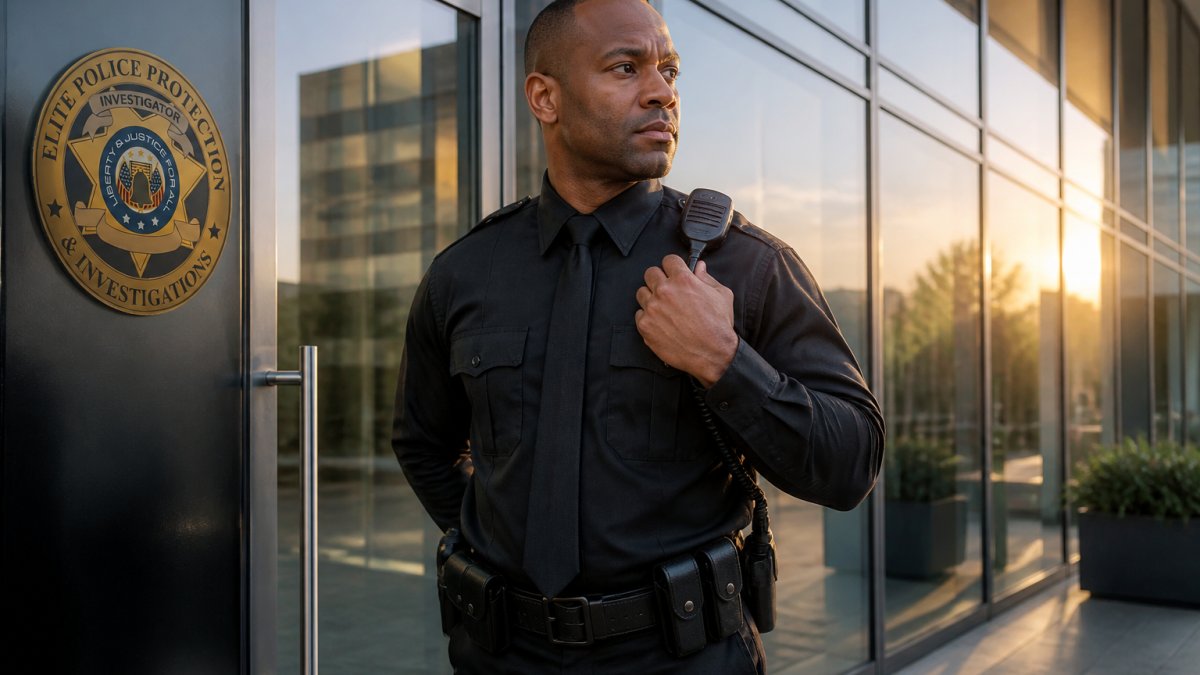
Elite security Baltimore is the practice of deploying trained, often law enforcement-experienced personnel to protect commercial, residential, and event sites across the metro area. The best firms combine visible deterrence with active risk assessment. A guard who logs patrols, documents incidents, and knows when to escalate is worth far more than one who doesn't.
How Much Does the Cost of Private Security Guards Run?
| Cost Factor | What Drives It Up | What Keeps It Lower |
|---|---|---|
| Armed vs. unarmed | Firearms-certified officers, higher insurance | Standard uniformed guards |
| Shift timing | Overnight, weekends, holidays | Weekday daytime shifts |
| Site risk level | High-traffic, high-incident properties | Low-incident properties |
| Specialized services | K9 teams, executive protection | Basic patrol coverage |
| Contract length | Short-term or one-off events | Annual agreements |
| Minimum shift | 4-hour minimums on short posts | 8- or 12-hour standing posts |
Why we don't publish a flat rate. A warehouse in an industrial park, a behavioral health facility, and a retail center with cash handling have completely different staffing models, different post orders, different risk profiles, different insurance exposure. A single published number would be misleading for at least two of those three. What we will do is walk your property, define the post orders, and give you a written rate broken down by the layers above so you can see exactly what you're paying for.
U.S. Bureau of Labor Statistics occupational outlook for security guards
Hiring Security Guard Services: Key Factors to Evaluate
Hiring security guard services comes down to five things: licensing, training, insurance, monitoring, and communication. Skip any one and you inherit the risk.
Start with licensing. Every officer should be properly credentialed under state regulations, and the agency itself must carry liability insurance. Ask for proof, not a promise.
Then look at how the firm manages its people. Elite Police Protection uses an advanced guard monitoring system with client portal access, so you can see approved reports and patrol data in real time. That transparency is rare.
- Confirm the agency's license and insurance coverage
- Ask how officers are screened and trained
- Request sample incident and patrol reports
- Verify 24/7 dispatch and emergency response
- Check how scheduling gaps and no-shows are handled
- Review the client portal or reporting system
- Get references from similar properties
The no-show question matters more than most buyers expect. A firm with real infrastructure and a deep bench covers callouts without leaving your gate unmanned.
Finding Reliable Security Agencies Near Me
Finding reliable security agencies near me starts with one filter: do they staff from a pool of experienced professionals, or do they hire whoever is available? That single distinction predicts almost everything about your experience.
Elite Police Protection draws on off-duty, retired, and prior law enforcement personnel. That means officers arrive with real field experience in conflict resolution and situational awareness, not just a training certificate.
When you evaluate agencies, ask directly: "How do you ensure we get qualified, trained people every single time?" A strong firm answers without hesitation. A weak one talks around it.
Armed and Unarmed Protection: Which Is Right for Your Site?
Armed protection suits high-risk environments: cash-handling retail, certain healthcare settings, and sites with a documented threat history. Unarmed officers fit most commercial, residential, and event settings where visible deterrence and de-escalation do the work.
The right choice depends on your risk assessment, not on a preference for "more security." Armed officers carry additional liability and require stricter training and insurance. Unarmed personnel often integrate more smoothly into customer-facing environments like lobbies and retail floors.
Many properties use a mix. A shopping center might staff unarmed officers at entrances and armed personnel for overnight coverage. A behavioral health facility typically leans unarmed with strong de-escalation training.
| Site Type | Recommended Approach | Why |
|---|---|---|
| Retail and shopping centers | Mixed armed/unarmed | Visible presence plus overnight deterrence |
| Healthcare facilities | Primarily unarmed | De-escalation focus, patient sensitivity |
| Warehouses | Armed overnight | Isolated sites, theft risk |
| Events | Unarmed with armed standby | Crowd management first |
| Executive settings | Armed executive protection | High-profile individual risk |
Executive Protection Services and K9 Security Solutions
Executive protection services cover high-profile individuals who need discreet, trained personnel, not a visible guard post. Elite Police Protection tailors these details to the principal's schedule, travel, and threat profile, using officers with law enforcement backgrounds.
K9 security solutions add a layer that human officers alone can't match. Trained K9 teams work well in large warehouses, distribution centers, and event venues where scent detection and visible patrol coverage both matter. The presence of a working dog changes behavior before anything happens.
Both services require the same discipline as any other security deployment: clear scope, documented protocols, and a firm that can staff consistently. A protection detail that falls apart mid-assignment is worse than no detail at all.
Regulatory Compliance and Technology Integration in Security
Two things separate a professional security operation from a person in a uniform: the paper trail behind the officer, and the digital trail behind the shift. Most firms are vague about both. Here's what to actually verify.
The compliance layer
Security guard agencies and individual officers are regulated at the state level, and the specific requirements vary. In this region, the Maryland State Police Licensing Division administers the security guard and agency licensing program, and agencies must maintain active licenses for both the business and each officer. When you evaluate a firm, ask for:
- Agency license number, verifiable through the state licensing authority, not just printed on a business card.
- Individual officer credentials, every officer on your post should hold a current guard card or equivalent credential, and armed officers should hold the additional firearms certification.
- General liability and workers' compensation insurance, request a certificate of insurance naming your property or company as an additional insured where appropriate.
- Background screening standards, ask what the agency screens for (criminal history, driving record for patrol roles, prior employment verification) and how often it re-screens.
- Use-of-force and de-escalation training records, especially for armed posts and healthcare or behavioral health settings.
A firm that hesitates on any of these is a firm that has something to hide. The questions take five minutes to answer if the agency is actually compliant.
The technology layer
Human presence deters; documentation proves. The agencies pulling ahead are the ones that pair officers with systems that generate a verifiable record of every shift. The categories worth asking about:
- Digital patrol verification, checkpoint scanning or GPS-stamped patrol logs that prove an officer actually walked the route, rather than a paper log filled in at the end of the shift.
- Incident reporting software, timestamped, photo-capable reports that reach the client within hours, not days.
- Client portal access, a login where you can pull approved reports, patrol data, and post orders on demand, without emailing a supervisor.
- Camera and access-control integration, whether the agency can coordinate with your existing CCTV and badge systems, or whether it operates blind to them.
- Remote monitoring and analytics, video analytics, alarm response coordination, and after-hours monitoring that extends coverage beyond the hours a guard is physically on site.
None of this replaces a trained officer. It makes the officer's work auditable, which is what protects you if an incident becomes a claim.
The questions that expose a gap
Ask any agency three things: How do you document a patrol? How fast can I see an incident report? And can I log in and pull records myself? If the answers involve paper logs, "we'll email you," and "call your account manager," you're looking at an operation that can't prove what it did on your property.
Maryland State Police Licensing Division, security guard and agency licensing
Conclusion
Choosing the right security partner is a decision about risk, not price. The firms that show up, document everything, and staff with experienced professionals protect your property and your liability exposure at the same time. Elite Police Protection combines off-duty and retired law enforcement personnel, 24/7 availability, an advanced guard monitoring system with client portal access, and trained K9 teams for demanding environments. Get started with Elite Police Protection and put a security operation behind your property that you can actually verify.
Frequently Asked Questions
What is elite police protection?
Elite police protection typically refers to security services provided by off-duty, retired, or prior law enforcement professionals. These officers bring advanced training in situational awareness, conflict resolution, and emergency response to private security roles. Firms like Elite Police Protection specialize in this model, offering armed and unarmed guards, executive protection, and K9 services for corporations, government agencies, and private individuals.
How much does it cost to get a security guard license in Maryland?
The cost to obtain a security guard license in Maryland varies based on the licensing class and required training. The Maryland State Police Licensing Division oversees the process, which includes fingerprinting, background checks, and training fees. For exact current fees and requirements, contact the Maryland State Police or visit their website.
What is the difference between armed and unarmed security guards?
Armed security guards carry firearms and have the authority to use lethal force in defense of life, while unarmed guards rely on observation, de-escalation, and communication. Armed officers typically require additional training, licensing, and insurance. The choice depends on your site's risk level: armed guards suit high-risk environments like financial institutions, while unarmed guards work well for retail, events, and office buildings.
How do I verify the credentials of a security guard company?
Start by checking the company's license with the Maryland State Police Licensing Division. Ask for proof of liability insurance and workers' compensation coverage. Request details on guard training programs, background check procedures, and supervision. A reputable firm like Elite Police Protection will provide documentation and references. Also confirm that guards are directly employed, not subcontracted, to ensure consistent quality.
Are security guard services available 24/7 for corporate clients?
Many professional security firms offer 24/7 coverage, including holidays and weekends. Elite Police Protection provides round-the-clock availability with a client portal for real-time reporting. When evaluating providers, ask about their scheduling process, backup coverage for call-offs, and how they maintain consistent staffing. This ensures your site remains protected without gaps.