 ultimate-guide
K9 Security Services for Warehouses: A 2026 Guide
Table of Contents
- How K9 Security Services for Warehouses Work
- Security Guard vs K9 Patrol Effectiveness: Key Differences
- K9 Explosive Detection Services and Threat Screening
- The Deterrence Factor: Reducing Theft and Unauthorized Access
- Warehouse Security Best Practices for K9 Integration
- Cost-Benefit Analysis and Legal Considerations
- Conclusion: Building a Layered Defense for Your Facility
- Frequently Asked Questions
Last Updated: September 4, 2026
Warehouses face a persistent challenge: traditional guard patrols deter some crime, but they cannot detect what is hidden. K9 security services for warehouses close that gap by pairing licensed handlers with dogs trained to screen for explosives, narcotics, and unauthorized persons. This guide from Elite Police Protection explains how these teams operate, where they outperform standard guards, and what it takes to integrate them into a facility’s security plan.
How K9 Security Services for Warehouses Work
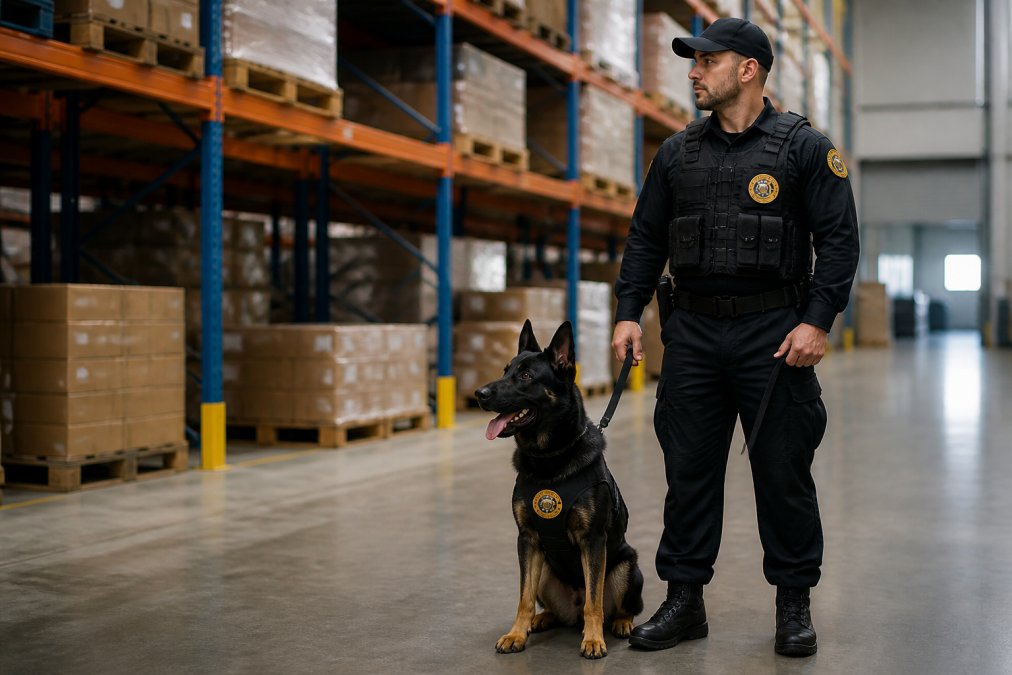
K9 security services for warehouses operate on a simple principle: a certified dog and its handler function as a single mobile detection and deterrence unit. The handler, typically a licensed professional with law enforcement or military background, controls the dog's movements and interprets its alerts. The dog contributes scent detection capabilities that far exceed any electronic sensor.
Patrol assignments are structured around the facility's risk profile. A typical shift involves perimeter sweeps, interior inspections of loading docks, and random checks of trailers and storage zones. Handlers log each patrol through a guard monitoring system, giving management real-time visibility into coverage. According to guidance from the American Society for Industrial Security on canine operations, effective K9 programs integrate the dogs into the facility's broader security protocols rather than treating them as a standalone measure.
The dogs themselves are trained for specific functions. Explosive detection dogs screen cargo and vehicles for threat materials. Narcotics dogs target contraband that often funds organized theft rings. Patrol dogs are trained to apprehend suspects and control crowds. Most warehouse operations combine these roles based on the commodities stored and the threat environment.
Security Guard vs K9 Patrol Effectiveness: Key Differences
Guards document and report, while K9 teams detect and deter. A dog hears, smells, and senses what a guard cannot perceive, a multiplication of capability, not a replacement.
Would-be intruders scout facilities before attempting entry. When they observe a canine unit, the perceived risk of confrontation increases substantially. Warehouses that deploy visible K9 patrols typically report fewer unauthorized access attempts during off-hours.
Operationally, the differences are pronounced:
- Detection capability: Dogs screen air, cargo, and vehicles; guards rely on visual inspection
- Response speed: A K9 team can pursue and contain a fleeing suspect; a lone guard typically must wait for law enforcement
- Coverage efficiency: One handler-dog team covers a large perimeter faster than two guards on foot
- Cost structure: K9 teams carry higher hourly rates but reduce the need for multiple static posts
For high-risk environments like pharmaceutical warehouses or facilities storing high-value electronics, the detection capability alone justifies the added expense. For low-risk storage, standard guard services may suffice.
K9 Explosive Detection Services and Threat Screening
K9 explosive detection services address bombs and incendiary devices used as tools of extortion, sabotage, or terrorism. Warehouses are attractive targets because they hold concentrated value and have complex access points that are difficult to fully secure.
An explosive detection dog screens for vapors and particulates emitted by commercial and military-grade explosives. The dog is trained to sit or paw at the source of the scent, giving a passive alert that the handler can act on without triggering a device. This capability is used for:
- Screening inbound trailers and cargo containers before they enter the yard
- Sweeping executive offices or VIP areas during high-profile visits
- Checking packages and mail for suspicious contents
- Conducting pre-shift sweeps of loading docks and racking aisles
The training standard matters. A dog certified through a recognized program such as the National Narcotic Detector Dog Association or ATF guidelines has demonstrated reliability in controlled tests. Handlers must maintain proficiency through regular training scenarios, typically weekly, to keep the dog's alerts sharp.
The Deterrence Factor: Reducing Theft and Unauthorized Access
A patrol dog is a psychological barrier that changes criminal calculus. Most warehouse theft is opportunistic, carried out by insiders or trespassers who weigh the odds of getting caught. A visible canine unit tips those odds decisively.
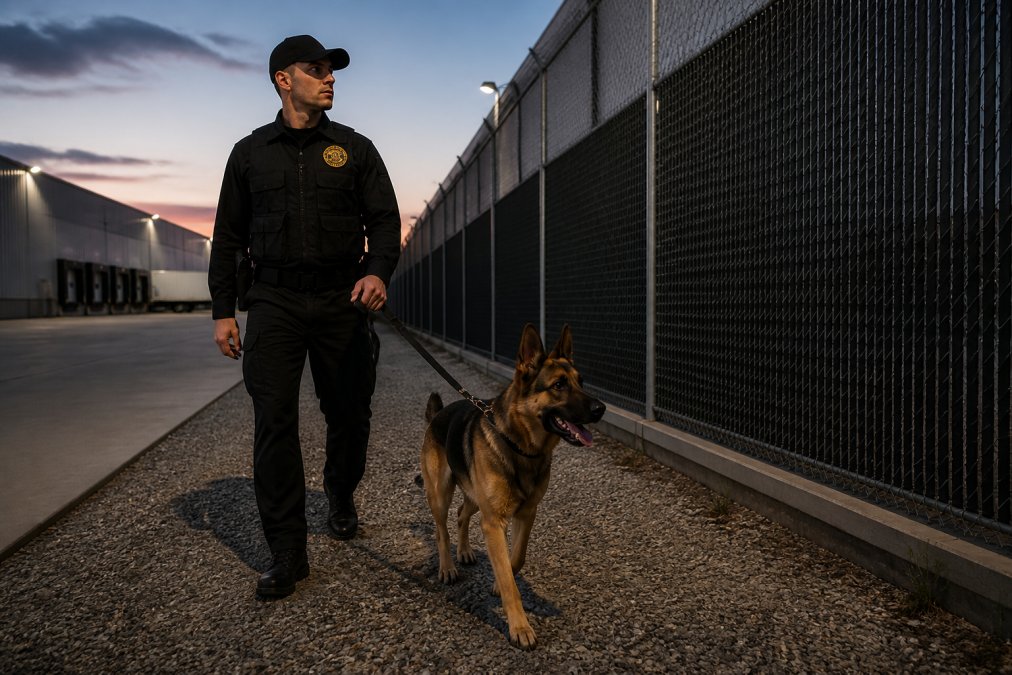
A facility with only cameras and a lone guard is a target of opportunity. A facility with a K9 team patrolling the yard is a problem to be avoided. Many distribution centers schedule high-visibility patrols during shift changes and loading windows, when pilferage potential spikes.
Employee theft is a leading cause of warehouse shrinkage, and staff who know a dog is on site are less likely to test the system. Handlers trained in observation can spot behavioral cues that precede theft attempts, adding a layer passive security cannot match.
Warehouse Security Best Practices for K9 Integration
A K9 team is only as effective as the system around it. The most successful deployments treat the dog as one sensor in a networked security architecture, not a standalone patrol.
Mapping K9 Patrols to Your Facility's Physical Layout
Start by creating a patrol map based on your facility's actual risk geography. Most warehouses share common high-risk zones:
- Loading docks and trailer yards: The primary point of cargo transfer and the most common site for external theft
- High-value storage racks: Areas holding electronics, pharmaceuticals, or other shrink-prone inventory
- Perimeter fencing and gate entries: The first line of defense against unauthorized access
- Trash compactors and disposal areas: A frequent channel for internal theft where stolen goods leave the facility
Assign patrol frequencies based on risk, not convenience. A loading dock with 50 trailer movements per day warrants multiple random checks per shift; a low-traffic zone might need one sweep every two hours. Document the map and update it whenever the layout changes.
Integrating K9 Operations with CCTV and Access Control
Warehouse technology is the force multiplier for K9 teams:
CCTV handoff protocols. When a handler identifies a suspicious person or vehicle, the operations center assigns camera coverage to track the subject while the handler moves to intercept, creating a documented video record for prosecution and liability defense.
Access control event correlation. If a dog alerts on a trailer, the access control system can show who entered it, when, and with what credentials, often identifying internal theft patterns that would otherwise go unnoticed.
Geofencing and patrol verification. Modern guard monitoring systems, including the one used by Elite Police Protection, support geofenced checkpoints. The handler's mobile device logs each checkpoint automatically, providing real-time verification of coverage and eliminating falsified patrol logs.
Communication Protocols and Escalation Procedures
The K9 handler is the on-scene commander during an incident, requiring a clear communication chain:
- Immediate alert: The handler notifies the security operations center of the alert or apprehension
- Camera lock: The operations center assigns dedicated camera coverage to the incident location
- Law enforcement notification: The center contacts local police with the handler's location and a description of the situation
- Management notification: A designated facility manager is alerted according to the escalation matrix
- Documentation: The handler submits an incident report within one hour of resolution
Every step should be defined in writing before the first shift. Ambiguity in escalation procedures is a common source of security failures and liability exposure.
Environmental Considerations for Dog Welfare and Performance
A K9 team working a 12-hour shift is only effective if the dog is physically capable:
- Temperature extremes: Dogs are highly susceptible to heat stress. In summer months, handlers must have access to shaded rest areas and water stations. Many facilities designate a climate-controlled break room for the dog.
- Noise exposure: Forklifts, machinery, and loading equipment create sustained noise that can fatigue a dog's hearing. Rotate the dog between active patrol and quiet rest periods.
- Surface hazards: Warehouse floors with chemical residues, sharp debris, or extreme temperatures can injure paw pads. The handler should inspect patrol routes for hazards and have a first-aid kit specific to the dog.
A provider that cannot articulate its environmental safety protocols is not prepared for warehouse work. Ask for written SOPs for heat stress, cold weather, and injury response.
Measuring Program Effectiveness
Integration requires ongoing measurement. Track these metrics monthly:
- Alert accuracy rate: Percentage of dog alerts that result in a confirmed finding
- Patrol completion rate: Percentage of scheduled checkpoints actually logged
- Incident response time: Time from alert to handler arrival at the scene
- Shrinkage trend: Monthly inventory variance compared to the pre-K9 baseline
Review these metrics quarterly. A program that is not measurably reducing incidents or improving response times is not earning its keep.
Cost-Benefit Analysis and Legal Considerations
Building a Cost-Benefit Model for Your Facility
A practical approach starts with modeling your current loss exposure:
- Annual shrinkage rate: Pull your last 12 months of inventory records. The National Retail Federation's annual survey consistently places warehouse and distribution shrinkage at 1% to 2% of inventory value for most operators. On a $10 million inventory, that is $100,000 to $200,000 in annual losses.
- Theft incident frequency: Document how many theft events, attempted break-ins, or unauthorized access incidents occurred in the past year. Include both internal and external events.
- Average loss per incident: Divide your total shrinkage by the number of documented incidents. A single trailer theft of high-value electronics can easily exceed $50,000.
A typical contract for a patrol and detection team runs $75 to $200 per hour depending on certification and region. A standard deployment of 40 hours per week at $125 per hour costs roughly $260,000 annually, steep until compared against a single catastrophic loss or recurring shrinkage.
If the program reduces annual shrinkage by 30% or more, it pays for itself in most mid-size operations. A facility losing $150,000 annually that cuts losses to $90,000 saves $60,000, still short of the program cost, but reduced insurance premiums and lower guard headcount often close the gap.
Insurance Implications and Premium Adjustments
Insurance carriers evaluate risk on documented mitigation measures. Some commercial property and inland marine policies offer premium credits of 5% to 10% for facilities with verified canine patrol coverage, particularly for high-value cargo endorsements.
To claim this credit, you will need documentation from your provider:
- Current certification records for each dog
- Handler training logs and background verification
- Incident response reports from the past 12 months
- Proof of the provider's liability coverage (typically $1 million to $2 million per occurrence)
Present this documentation to your broker during renewal. Carriers are more receptive when the risk reduction is quantifiable and documented.
Legal Liability: Use of Force and Vicarious Liability
The legal framework is governed by state laws on use of force, premises liability, and vicarious liability. Two areas demand attention:
Use of force standards. A dog deployed to apprehend a suspect is a use of force under most state statutes and federal case law. The standard is reasonableness under the circumstances, as established in Graham v. Connor (1989). Handlers with prior law enforcement training are better equipped to make split-second force decisions within legal boundaries.
Vicarious liability. Under respondeat superior, a warehouse operator can be held liable for a security contractor's actions if the contractor is deemed to be acting on the facility's behalf. The contract must include:
- Indemnification clauses protecting your facility from dog-related incidents
- Proof of the provider's general liability and animal liability coverage
- Clear statements that the handler is the provider's employee, not yours
- Hold-harmless agreements for incidents arising from handler negligence
A common mistake is assuming the provider's insurance covers your facility. It does not unless the contract names your facility as an additional insured. Require a certificate of insurance before the first shift.
State-Level Regulatory Considerations
Most states regulate security agencies through a department of public safety or similar agency. Requirements vary, but common elements include:
- State licensure for the security agency itself
- Registration of individual handlers
- Background checks and fingerprinting
- Continuing education requirements for handlers
Some states impose specific requirements for security dogs, including rabies vaccination verification and proof of training. Your provider should produce state credentials on request. If they cannot, that red flag outweighs any cost savings.
Evaluation Checklist for Legal and Financial Due Diligence
| Evaluation Factor | What to Ask the Provider | Why It Matters |
|---|---|---|
| Certification | Are dogs certified by a recognized body? | Uncertified dogs produce unreliable alerts |
| Handler background | Is the handler prior law enforcement or military? | Experience reduces liability and improves judgment |
| Insurance | What coverage applies to dog-related incidents? | Protects your facility from vicarious liability |
| Additional insured status | Will your facility be named on the policy? | Without it, the provider's policy may not cover you |
| State licensure | Can you provide current state credentials? | Verifies legal operation in your jurisdiction |
| Reporting | Can you access patrol logs in real time? | Verifies that contracted hours were actually worked |
| Training frequency | How often are dogs re-certified? | Maintains detection accuracy over time |
A K9 program is a financial commitment and a risk-management investment. Facilities that treat it as such, with documented baselines, clear contracts, and verified credentials, see measurable returns.
Conclusion: Building a Layered Defense for Your Facility
K9 services are not right for every facility, but for operations holding high-value inventory, handling sensitive materials, or facing repeated theft incidents, they are often the missing layer in an otherwise solid security program.
The decision requires honest assessment of your risk profile, budget, and willingness to manage a more complex operation. For those that commit, the payoff is measurable shrinkage reduction and stronger defense against threats from opportunistic theft to coordinated criminal activity.
Elite Police Protection provides K9 teams staffed by off-duty and prior law enforcement professionals, available 24/7 to support warehouse and distribution center security. Their advanced guard monitoring system gives you real-time access to patrol data, so you know your coverage is real. Get started with Elite Police Protection and build a security layer that actually deters, detects, and protects.
Frequently Asked Questions
What are the primary benefits of using K9 security services in a warehouse?
K9 units provide a visible deterrence factor that reduces theft and unauthorized access. Their superior senses allow for rapid screening of vehicles, cargo, and large areas for hidden contraband or explosives. Unlike static guards, a K9 patrol covers more ground efficiently, especially in large distribution centers, and the presence of a dog often de-escalates confrontations, improving overall safety for staff and assets.
How do K9 units differ from traditional static security guards?
Static guards are effective for access control and monitoring cameras, but K9 units add a mobile, high-impact detection layer. A dog's olfactory capabilities can identify narcotics or explosives that humans and most technology miss. K9 patrols are also a stronger psychological deterrent. For best results, combine both: use guards for fixed posts and K9 teams for perimeter sweeps, random patrols, and specific threat detection assignments.
What certifications should a professional K9 security team possess?
Look for licensed handlers with verifiable training records and K9 teams certified through recognized organizations. Handlers should have backgrounds in law enforcement or military working dog programs, ensuring they understand legal protocols and liability. Ask about the specific certifications for explosive detection or narcotics screening, and confirm the provider carries adequate liability insurance covering canine operations on your premises.
How does a K9 unit integrate with existing warehouse security technology?
K9 units work alongside CCTV, access control systems, and alarm networks. Use technology to direct the team to triggered zones or suspicious activity flagged by analytics. The handler can document patrols via a mobile reporting system, which integrates with your security operations center. This combination allows you to verify patrol frequency and gives you real-time data on incident prevention, bridging the gap between physical deterrence and digital monitoring.
This article was written using GrandRanker