
 ultimate-guide
Executive Protection Services for Corporations: 2026 Guide
Table of Contents
- What Executive Protection Services for Corporations Include
- Why Corporate Risk Assessment for Executives Comes First
- How to Hire Executive Protection for Corporations
- Executive Protection Best Practices for Corporate Programs
- What Drives the Cost of Executive Protection Services
- How Off-Duty Law Enforcement Strengthens Executive Protection
- Conclusion
- Frequently Asked Questions
Last Updated: September 14, 2026
What Executive Protection Services for Corporations Include
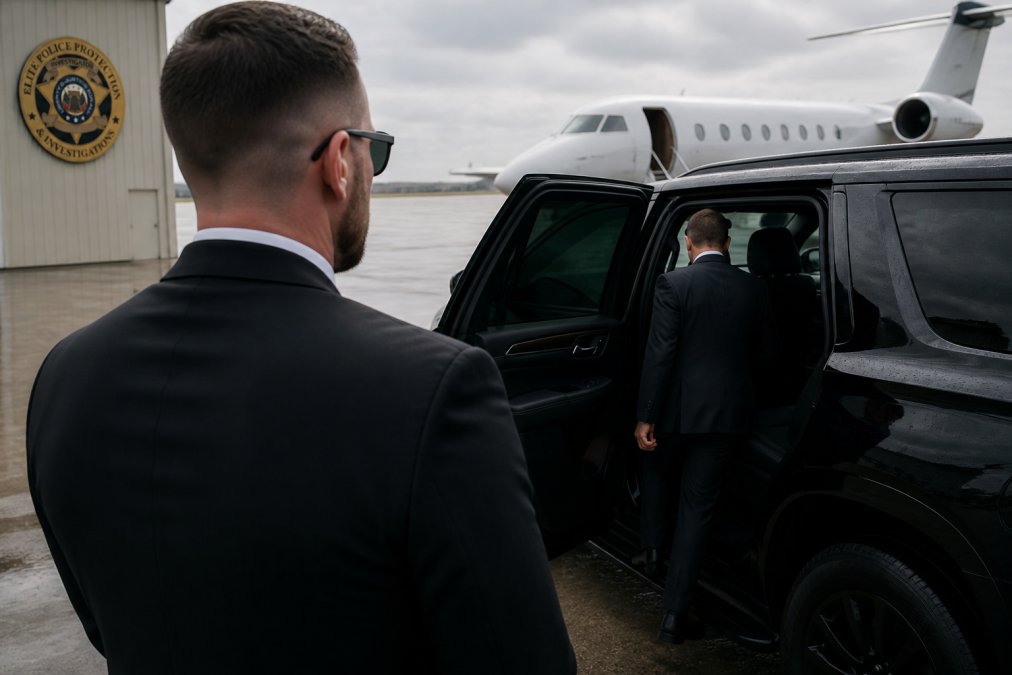
Executive protection services for corporations combine close protection, secure transportation, advance work, and residential security into one coordinated program built around a specific person's risk profile. At Elite Police Protection, we build these programs on personnel with prior law enforcement backgrounds, because that experience shapes how threats get recognized before they escalate.
The work is broader than most people assume. A protection detail is only one layer. The rest is planning, logistics, and intelligence that never becomes visible to the principal or the public.
Close Protection and Secure Transportation
Close protection places trained agents alongside an executive during movements, meetings, and public appearances. Agents work armed or unarmed, in business attire or a more visible uniform, depending on the setting and the client's preference.
Secure transportation covers the vehicle side: route selection, driver training, and contingency planning for the moment a primary route becomes unusable. Good teams rehearse alternates in advance rather than improvising in the moment.
Advance Work and Residential Security
Advance work means scouting a location before the principal arrives. Agents map entry and exit points, coordinate with venue staff, and identify where an approach could happen.
Residential security extends the program to the executive's home, often the least protected point in their routine. Coverage typically includes access control reviews, camera placement, and posted or roving officers during high-exposure periods.

Why Corporate Risk Assessment for Executives Comes First
Corporate risk assessment for executives determines what level of protection a person actually needs, and it should happen before anyone is assigned to a detail. Skipping it is the most common mistake we see. Companies buy guards when what they need is a plan.
A proper assessment looks at the executive's public profile, travel patterns, industry-specific threats, and any history of concerning communications. It also weighs the business context: layoffs, litigation, or a controversial project can raise exposure for specific people overnight.
The output should be a written profile that ranks risk and matches resources to it. A CEO facing organized protest activity needs a different program than a CFO with no public presence. Treating them the same wastes money on one and leaves the other exposed.
How to Hire Executive Protection for Corporations
Hiring executive protection for corporations starts with verifying who will actually be standing next to your executive, not who is signing the contract. Many firms sell on brand recognition and staff assignments with whoever is available. Ask directly how personnel are vetted, trained, and replaced when someone calls out.
Ask for the specific backgrounds of the agents who would cover your account. Prior or retired law enforcement experience matters because it comes with training in de-escalation, observation, and legal boundaries that a short certification course does not replicate.
Questions to Ask Every Provider
Use these as a checklist before you sign anything:
- What is the law enforcement or military background of the agents assigned to us?
- Who is our named point of contact, and how fast do they respond after hours?
- How do you document incidents, and can we access those reports in real time?
- What happens if an assigned officer calls out? Who covers the shift?
- Can you staff multiple locations consistently, or only one site?
- What insurance and liability coverage do you carry?
- Do you provide a written risk assessment, or only guard coverage?
Executive Protection Best Practices for Corporate Programs
Executive protection best practices come down to consistency and documentation. A program that looks strong on paper falls apart when coverage gaps appear, so build redundancy into scheduling from day one.
- Keep a single point of contact who knows the executive's full schedule
- Rotate the same small team so agents learn the principal's normal patterns
- Log every movement and incident, even routine ones
- Review the risk profile quarterly, not once a year
- Coordinate with local law enforcement before major public events
- Train the executive's staff on what to report and how
Documentation is where many programs quietly fail. If an incident happens and no one can produce a clear record, you lose both the legal footing and the ability to improve. Look for providers that give clients direct portal access to approved reports and patrol data rather than monthly summaries.
What Drives the Cost of Executive Protection Services
The cost of executive protection services depends on coverage hours, the number of agents per detail, the executive's risk level, and travel requirements. There is no single standard rate, and any provider quoting a flat figure without an assessment is guessing.
Higher-risk assignments that require armed agents, multiple vehicles, or advance teams cost more than a single unarmed officer. Overnight and weekend coverage adds cost. So does geography: a program spanning several locations needs more personnel and tighter coordination.
The honest answer is that pricing should follow the assessment, not precede it. For a current quote, contact Elite Police Protection directly rather than comparing generic rate cards, which rarely reflect what a specific program actually requires.
How Off-Duty Law Enforcement Strengthens Executive Protection
Off-duty law enforcement officers bring something a standard security guard does not: real-world command experience and familiarity with how incidents actually unfold. That background shows up in situational awareness and conflict resolution long before a situation turns physical.
Personnel with prior, retired, or off-duty law enforcement experience tend to read a crowd, spot a pre-attack indicator, and de-escalate without force more reliably than officers trained only for static posts. For corporations, that translates into fewer escalations and cleaner incident documentation.
Coverage also matters as much as credentials. A program is only as strong as its weakest shift, so 24/7 availability with a monitoring system that tracks officer check-ins keeps the standard consistent across every hour of the week.
Conclusion
The gap between a security contract and a real protection program shows up on the worst day, not the best one. Corporations that assess risk first, verify their personnel, and document everything end up with coverage that holds when it matters.
Elite Police Protection builds corporate protection programs around off-duty, retired, and prior law enforcement professionals, with 24/7 availability, an advanced guard monitoring system that gives clients portal access to approved reports, and K9 teams for environments that call for them. Uniformed or business-attired armed and unarmed officers let a program match the setting without losing presence.
Get started with Elite Police Protection and put a protection program in place that your executives and your legal team can both stand behind.
Frequently Asked Questions
What is included in executive protection services for corporations?
Corporate executive protection typically covers close protection agents, secure transportation, advance route planning, residential and office security assessments, and travel risk management. Many programs also include protective intelligence monitoring, event security for board meetings or public appearances, and coordination with local law enforcement. The scope is built around each principal's risk profile, travel schedule, and public exposure. Providers like Elite Police Protection staff these details with off-duty, retired, or prior law enforcement professionals who carry the training and situational awareness the role demands.
Why do corporations need executive protection for their leadership?
Executives face threats that range from targeted harassment and stalkers to protest activity, kidnapping risk during international travel, and opportunistic crime near offices or residences. A single incident can disrupt operations, expose the company to liability, and put employees at risk. Protection programs also cover non-violent scenarios: aggressive former employees, contentious shareholder meetings, and public events where emotions run high. Having trained personnel on standby reduces the chance that a routine situation escalates into a crisis.
How do you determine the level of executive protection required?
The starting point is a corporate risk assessment for executives that examines the principal's public profile, travel patterns, industry, prior incidents, and any specific threats. From there, providers recommend a tier: low-profile advance work and secure drivers, a single close protection agent, or a full detail with multiple agents and vehicles. Risk is not static. A merger announcement, layoffs, or a viral social media moment can raise the level temporarily. Reassess at least annually and any time the executive's visibility changes significantly.
What is the difference between a bodyguard and executive protection?
A bodyguard reacts to threats in the moment. Executive protection is proactive: advance teams scout routes and venues, protective intelligence monitors open-source and internal signals, and agents coordinate with local police and venue security before the principal arrives. Executive protection best practices also include residential assessments, travel planning, and post-incident reporting. The distinction matters when hiring because a firm that only supplies guards will not deliver the planning, intelligence, and documentation that a corporate program requires.
How does off-duty law enforcement enhance corporate security?
Off-duty and retired law enforcement officers bring academy training, firearms proficiency, de-escalation experience, and familiarity with report writing and evidence handling. That background matters when an incident leads to a police report, an insurance claim, or courtroom testimony. Departments also require officers to maintain continuing education and physical standards. For corporations, this means the person protecting a CEO or investigating a workplace threat already understands the legal and procedural side of the job, not just the physical one.
What are the legal considerations for corporate executive protection?
State licensing rules for security personnel vary, and armed agents need the proper permits in every jurisdiction where they operate. Corporations should confirm the provider carries general liability and workers' compensation insurance, and ask for certificates before signing. Investigations must follow lawful methods so evidence holds up in court. Written agreements should define scope, use-of-force policies, and reporting obligations. Executive protection best practices include documenting every incident and retaining records in case of litigation or regulatory review.
How much do executive protection services cost?
The cost of executive protection services depends on the number of agents, hours of coverage, travel requirements, and whether the detail is armed or unarmed. A single agent for local ground travel costs far less than a multi-agent detail with advance work and international logistics. Ongoing retainers usually price lower per hour than one-off assignments. Elite Police Protection does not publish flat rates because every program is scoped individually. Contact the firm directly for a quote based on your executives, locations, and coverage schedule.
Can one provider cover multiple corporate locations?
Yes, but confirm staffing depth before signing. A provider with a large roster of off-duty and retired law enforcement officers can staff multiple sites, events, and executive movements without pulling from one assignment to cover another. Ask how the firm handles call-offs, overtime, and last-minute requests. Elite Police Protection offers 24/7 availability and a guard monitoring system with client portal access, so property managers and corporate security teams can verify coverage and review reports across every location from one dashboard.