 ultimate-guide
7 Close Protection Officer Duties That Keep Principals Safe
Last Updated: November 3, 2026
Quick Summary
A close protection officer is a security professional trained to protect a principal from physical attack, kidnapping, harassment, theft, and unwanted attention through advance planning, situational awareness, and coordinated response. The role focuses on harm prevention rather than reaction, with officers planning movements and managing threats before they develop.
- A static guard protects a place, while a close protection officer protects a person wherever they go.
- The assignment lifecycle runs from brief and intelligence review through advance work, movement, coverage, and debrief.
- Threat assessment scores each risk by likelihood and impact, then assigns a mitigation with an owner and trigger.
- Situational awareness and discretion matter as much as physical capability for a close protection officer.
- Whether officers are armed depends on the assignment, the principal's preferences, and state licensing rules.
Table of Contents
- What a Close Protection Officer Actually Does
- Close Protection Officer Responsibilities: A Day on Assignment
- Threat Assessment and Advance Planning
- Close Protection Officer Skills That Matter Most
- Close Protection Officer Qualifications and Training
- Are Close Protection Officers Armed?
- Legal Boundaries and Professional Conduct
- Hiring a Close Protection Team for Your Organization
- Frequently Asked Questions
What a Close Protection Officer Actually Does
A close protection officer is a security professional trained to protect a principal from physical attack, kidnapping, harassment, theft, and unwanted attention through advance planning, situational awareness, and coordinated response. Elite Police Protection deploys close protection officers drawn from off-duty, retired, and prior law enforcement professionals, and the difference between that role and a standard guard shift is the difference between planning a route and standing at a post.
The core purpose is harm prevention, not reaction. A close protection officer spends most of an assignment thinking two moves ahead: where the principal will walk, who will be within arm's reach, and what the exit looks like if something goes wrong.
Close Protection vs. Bodyguard vs. Static Guard
The three roles get blurred in conversation, but they are different jobs.
- Close protection officer: works directly around a principal, plans movements in advance, and manages threats before they develop.
- Bodyguard: a looser term, often used for one-on-one physical coverage without the planning layer.
- Static guard: holds a fixed post such as a door, lobby, or gate, with a defined perimeter and limited movement.
A static guard protects a place. A close protection officer protects a person, wherever that person goes. For the broader corporate picture, see our guide to executive protection for corporate executives.
Close Protection Officer Responsibilities: A Day on Assignment
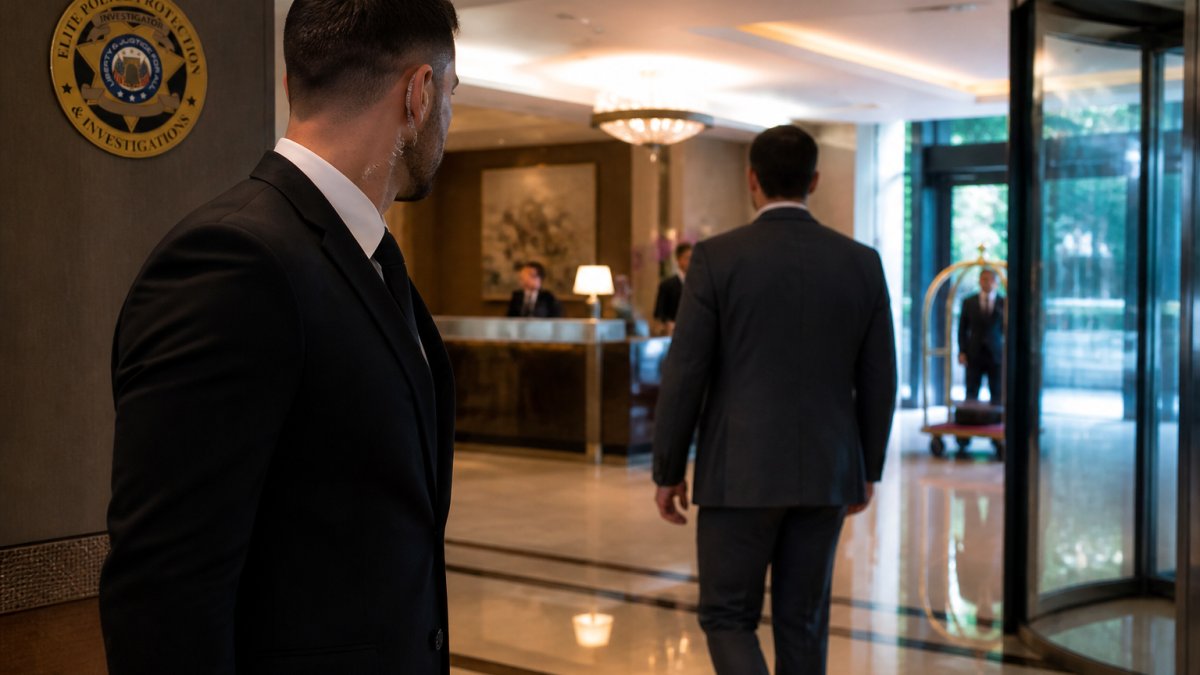
A typical day runs from pre-dawn planning to a post-event debrief. The officer arrives before the principal, walks the route, checks the venue, coordinates with venue staff and law enforcement where needed, then stays within a defined distance throughout the day.
Step-by-Step: The Assignment Lifecycle
- Brief and intelligence review. Confirm the principal's schedule, known concerns, and any recent threats or unwanted attention.
- Advance work. Walk the route, check the venue, identify access control points, and map evacuation options.
- Team briefing. Assign positions, communications channels, and contingency plans for the day.
- Movement. Travel with the principal using planned routes, with alternates held in reserve.
- On-site coverage. Maintain situational awareness at the venue, control access, and manage the principal's exposure.
- Extraction and debrief. Move the principal out on plan, then document what worked and what needs adjusting.
Coordinating With the Principal and the Team
The lifecycle only works if the officer and the principal are aligned before the day begins.
Within the team, roles are assigned rather than assumed. A common pattern is a team leader who owns the plan and the decisions, a detail officer who stays closest to the principal, and a driver or advance officer who owns movement and route changes.
Watch out: a detail that never briefs the principal on the plan often finds the principal breaking the plan without knowing it, which puts the officer in the position of correcting the client in public.
Communications and Contingencies
Communications protocols should be tested during the advance, not during the event. The team confirms radio coverage in the venue, a backup channel, and a code for extracting the principal without drawing attention. Contingency plans are rehearsed at the level of triggers: what condition causes a reroute, what condition causes an evacuation, and who makes the call. When the triggers are agreed in advance, the response is faster and the principal is moved with less confusion.
After the Assignment
The debrief closes the loop. The officer documents what worked, what did not, and what should change on the next assignment, and preserves any incident records that may be needed later. That documentation is also how a provider demonstrates plan compliance and readiness to a client, which matters more than an incident-free day on its own.
Threat Assessment and Advance Planning
Threat assessment is the discipline of deciding, before the day starts, which risks are real and which are noise. The work follows a repeatable sequence rather than a gut call, and the sequence is what separates a protective plan from a hopeful one.
How Officers Assess Threats
A practical assessment moves through four steps:
- Identify the principal's exposure. Map where the principal will be, who will know about it, and how public the schedule is. A private office day and a red-carpet appearance expose the principal in completely different ways.
- Collect and sort incoming information. Review the principal's profile, recent communications, public statements, media coverage, and any prior incidents or unwanted attention. The goal is to separate a credible concern from background noise.
- Score each risk by likelihood and impact. A low-likelihood, high-impact event such as a targeted attack gets a different response than a high-likelihood, low-impact event such as an aggressive autograph seeker. Scoring forces the officer to prioritize instead of treating every event as equally dangerous.
- Assign a mitigation to each prioritized risk. Mitigation can be a route change, added coverage, a screening point, a communications protocol, or a decision to cancel or reschedule. Every mitigation should have an owner and a trigger.
A common mistake is treating every event as equally dangerous. In practice, an executive's routine office day and a public appearance carry very different exposure, and the protective detail should scale accordingly. Readers who want the full method can learn how to conduct a personal security risk assessment step by step.
What Advance Planning Covers
Advance planning is the physical expression of the assessment. It covers route planning, movement planning, venue assessment, and evacuation planning. For each movement, the officer confirms the primary route, at least one alternate, and an emergency response option. For each venue, the officer checks access control points, the principal's path through the space, and where the principal can be moved if something goes wrong.
Watch out: an advance that only walks the primary route and skips the alternates leaves the detail improvising at the worst possible moment.
A Worked Example
Consider a principal with a public speaking engagement at a hotel ballroom. The assessment might flag a credible online threat as low likelihood but high impact, and an expected crowd of autograph seekers as high likelihood but low impact.
Contingency planning sits underneath all of it: for every planned movement, the officer holds at least one alternate and one emergency response option, and the team knows the trigger for switching between them.
Close Protection Officer Skills That Matter Most
The skills that separate a strong close protection officer from an average one are mostly invisible. Situational awareness tops the list: the ability to read a room, spot a change in behavior, and act before a threat becomes physical. Communications and liaison run close behind, because the officer coordinates constantly with the principal, the protective team, venue staff, and law enforcement.
Discretion matters as much as physical capability. High-profile clients, executives, celebrities, and families hire protection to reduce attention, not attract it. Professional conduct, calm under pressure, and the judgment to de-escalate rather than confront are what keep a detail effective over months rather than one event.
Close Protection Officer Qualifications and Training
Many close protection officers come from law enforcement or military backgrounds. Training in the field commonly covers protective formations, defensive driving, first aid, firearms where applicable, threat assessment, and legal boundaries around use of force.
Certification and licensing requirements vary by state, so verify what applies where you operate. A qualified officer should be able to explain their training, their licensing, and their decision-making process without hesitation. For a deeper look, read the full breakdown of private security guard training requirements.
Are Close Protection Officers Armed?
Some are, some are not, and the answer depends on the assignment, the principal's preferences, and state licensing rules. Armed close protection officers carry firearms and must meet the licensing and training requirements that apply in their jurisdiction. Unarmed officers focus on awareness, de-escalation, and evacuation.
The right choice is a risk decision, not a default. A principal with a low public profile may need awareness and discretion more than visible force. A principal facing a specific, credible threat needs a different posture entirely. Elite Police Protection fields both armed and unarmed officers, uniformed or business-attired.
Legal Boundaries and Professional Conduct
A close protection officer's authority is narrower than most people assume. Private officers are not police: they act on the same citizen authority as anyone else, plus whatever the property owner or client authorizes on private premises. Use of force must be reasonable, proportionate, and defensible, and any detention or search carries legal exposure if handled carelessly.
Documenting incidents properly, preserving evidence correctly, and coordinating with law enforcement all depend on understanding the legal side of the work. Professional conduct also means knowing when to step back: protecting a principal's reputation is part of the job, and a heavy-handed response can do more damage than the threat it stopped.
| Situation | Officer's Move | Why It Matters |
|---|---|---|
| Unwanted attention from a fan or stranger | Position between principal and subject, redirect, extract | Prevents escalation without contact |
| Credible threat identified in advance | Reroute, increase coverage, notify law enforcement | Avoids confrontation entirely |
| Physical attack underway | Evacuate principal first, contain only as needed | Principal safety outranks everything |
| Incident after the fact | Document, preserve evidence, report | Protects the client legally |
Hiring a Close Protection Team for Your Organization
Hiring comes down to three questions: who is actually showing up, what are they trained to do, and who is accountable when something goes wrong. Ask for the officer's background, licensing, and training record, not just the firm's brochure. Readers weighing a hire can also review how much it costs to hire a private bodyguard before contacting a provider. Confirm insurance and liability coverage in writing.
At Elite Police Protection, our officers come from off-duty, retired, or prior law enforcement backgrounds, with 24/7 availability and an advanced guard monitoring system that gives clients portal access to approved reports and patrol data. For current pricing, pricing depends on the scope of the assignment, so visit the Elite Police Protection website for a quote.
Frequently Asked Questions
What are the main responsibilities of a close protection officer?
A close protection officer handles threat assessment, advance planning, route and venue security, and real-time situational awareness to prevent harm to the principal. Daily work includes coordinating with the protective detail, running security briefings, controlling access at events, and planning evacuation routes. The focus stays on prevention and early intervention rather than reacting after an incident.
What skills does a close protection officer need?
Strong situational awareness, calm decision-making under pressure, and clear communication top the list. Officers also need physical fitness, defensive driving, and the discretion to blend into different environments. Good close protection officer skills include reading body language, managing crowds, and coordinating with law enforcement without escalating situations.
Are close protection officers armed?
It depends on the assignment and state law. Close protection officers may carry firearms where the assignment and licensing allow, and may work unarmed where weapons are restricted. Armed or not, the role centers on avoidance, de-escalation, and getting the principal to safety.
What qualifications do close protection officers need?
Qualifications for close protection work commonly include state security licensing and training in first aid and defensive driving. Requirements vary by state, so verify what applies where you operate.
The role of a close protection officer is easy to describe and hard to do well: plan ahead, stay aware, act early, and stay within the law. If your organization needs protection that matches the risk rather than a generic guard post, Elite Police Protection can build a detail around your principal, your venues, and your schedule. Get started with Elite Police Protection and put trained, accountable protection around the people who matter most.