 ultimate-guide
How to Perform Uniformed Security Guard Duties Step by Step
Last Updated: November 1, 2026
Quick Summary
Security guard duties for uniformed officers center on patrolling assigned areas, controlling access and screening visitors, monitoring cameras and alarm systems, and responding to incidents with detailed written reports. Guards observe, deter and report, while their legal authority stays limited to what state law and the contract allow.
- Patrol assigned areas on varied timing, checking doors, gates, lighting and high-risk points like loading docks.
- Verify identity against the visitor list, record name, time in and purpose, and escort visitors if post orders require it.
- Verify every alarm before assuming danger, then log it, including false triggers.
- Call 911 and the supervisor first in medical, fire and disturbance incidents, and do not step between combatants.
- Write factual reports in 24-hour time, separating what was seen from what was heard and avoiding opinion.
Table of Contents
- What a Uniformed Security Guard Is Responsible For
- Step 1: Patrolling Assigned Areas and Property
- Step 2: Controlling Access and Screening Visitors
- Step 3: Monitoring CCTV, Alarms and Security Systems
- Step 4: Responding to Incidents and Writing Reports
- Writing a Security Guard Job Description Template That Matches the Duties
- Hiring Armed vs Unarmed Guards for Your Site's Duties
- Booking Trained Guards for Your Next Shift
- Frequently Asked Questions
Uniformed security guard duties and responsibilities come down to a handful of repeatable tasks: patrol, control access, watch the systems, and report what happens. Elite Police Protection staffs uniformed officers for property managers, construction sites and retail centers, and the steps below outline the core duties a guard typically performs on shift. Security guard duties are not a list you memorize once; they change with the site, the hours and the risk.
What a Uniformed Security Guard Is Responsible For
A uniformed security guard is a visible, trained presence whose job is to protect people and property, deter crime and respond when something goes wrong.
Core responsibilities usually include routine patrols of assigned areas, access control and visitor screening, monitoring cameras and alarm panels, and observing and reporting suspicious activity. Guards are also expected to document everything in daily activity logs and written incident reports.
Step 1: Patrolling Assigned Areas and Property
Patrol is the backbone of most uniformed posts. The guard follows a set route covering the perimeter, parking areas, entrances, stairwells and any restricted spaces, checking doors, gates and lighting along the way.
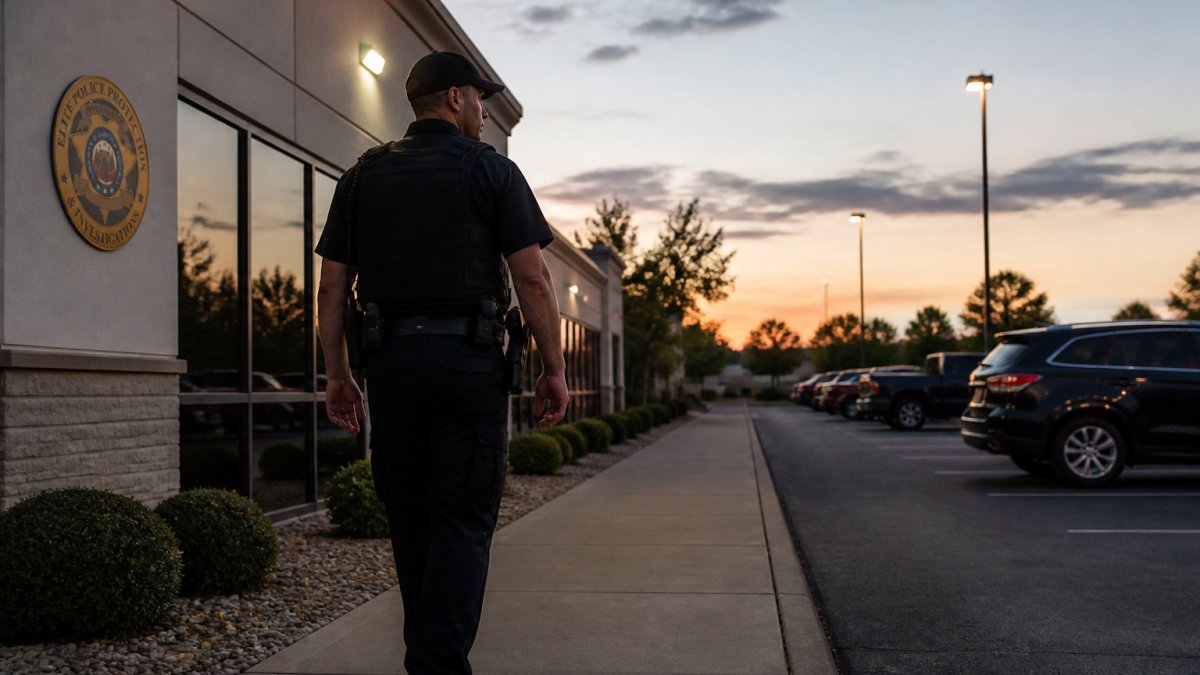
During each round, look for doors that are propped or unlocked, broken fencing, lights that have failed, graffiti, or people where they should not be. Record each checkpoint, including time and anything unusual.
Step 2: Controlling Access and Screening Visitors
Access control is where a guard prevents problems before they start. Confirm identity against the approved visitor list or badge system, record the visitor's name, time in and purpose, and issue a visitor badge where the client requires one.
Screening is not the same as searching. Unless the client has authorized it and local law permits it, a guard should check credentials and ask questions, not go through a person's belongings.
Step 3: Monitoring CCTV, Alarms and Security Systems
Many guards spend part of every shift at a monitoring station watching camera feeds, alarm panels and access-control screens.
When an alarm triggers, verify it before assuming the worst. Check the zone on the panel, look at the relevant camera, and if needed dispatch a patrol to confirm. Log every alarm, whether it was a false trigger from a faulty sensor or a genuine event.
Step 4: Responding to Incidents and Writing Reports
When an incident occurs, the guard's first duties are safety, containment and notification. Assess whether anyone is hurt, call emergency services if the situation requires them, and notify the supervisor or client contact on the post orders. Stay within your training and the scope of your role; a guard's job is usually to observe, deter, de-escalate and report, not to chase suspects or make arrests unless the law and the contract clearly allow it.
Legal limits and use-of-force boundaries
A uniformed guard is a private citizen with a contract, not a police officer. Authority varies by state and by licensing status; consult the governing statute for your location. Detention and arrest powers are narrow. Citizen's arrest authority is narrow and varies by state; check your state's statute before any guard attempts one. Use of force is limited to what a reasonable person would use to defend themselves or another from imminent harm; it is never a tool for recovering property or enforcing a client policy.
Response sequences by incident type
A written sequence removes hesitation. The patterns below are common across posts; adapt them to the site's post orders.
- Medical emergency: Confirm the scene is safe, call 911, send a second guard to meet EMS at the entrance, keep the area clear, do not move the person unless they are in immediate danger, and start an incident log with the time of the call and the time EMS arrived.
- Fire or smoke: Pull the alarm if the panel has not already triggered, call 911, direct occupants to the marked exits, do not use elevators, and account for the post's keys and radios before leaving the station.
- Trespassing: Confirm the person is not authorized, ask them to leave once in plain language, note the time and description, and call law enforcement if they refuse. Do not physically block a doorway or grab the person.
- Theft in progress: Observe from a safe distance, note description, direction of travel and vehicle plate if visible, call 911 and the client contact, and do not pursue off the property. Most retailers direct guards to observe and report rather than intervene.
Writing a report that survives review
Reporting is the step that often separates a competent guard from a weak one. A good incident report records who, what, when, where and how, in plain factual language, without speculation or opinion. Write it promptly while details are fresh, and keep it factual enough that it could be read by a police officer, an attorney or an insurance adjuster.
Concrete standards that hold up:
- Use 24-hour time and the site's own location names ("north loading dock," not "the back").
- Quote direct statements in quotation marks and attribute them.
- Separate what you saw from what you were told; label hearsay as hearsay.
- Note camera coverage and whether footage was preserved, plus the name of anyone who requested it.
- Avoid conclusions ("the subject was intoxicated"); describe observations ("the subject had slurred speech and smelled of alcohol").
Shift handover
Before leaving post, brief the incoming guard on open incidents, keys and equipment issued, camera or alarm faults, and any unresolved access issues. Sign the pass-down log and confirm the incoming guard has read the post orders for the shift. Unresolved issues that carry past the shift should be escalated to the supervisor in writing, not left for the next guard to discover.
The table below summarises the response sequence the article gives for common incident types.
| Incident | First actions | Who to call |
|---|---|---|
| Medical emergency | Confirm scene is safe, send second guard to meet EMS | 911 |
| Fire or smoke | Pull alarm if not triggered, direct occupants to marked exits, avoid elevators | 911 |
| Trespassing | Ask person to leave once in plain language, note time and description | Law enforcement if they refuse |
| Theft in progress | Observe from safe distance, note description and direction of travel | 911 and client contact |
| Disturbance or fight | Separate verbally if safe, clear bystanders, do not step between combatants | 911 |
Writing a Security Guard Job Description Template That Matches the Duties
A job description should mirror the duties above rather than generic language. A useful template includes the post location, shift hours, the core duties listed as concrete tasks, required training and licensing, and the reporting expectations.
State the qualifications the role actually needs, including required licensing in your state, any firearm certification if the post is armed, communication and de-escalation skills, and the ability to write clear reports.
Hiring Armed vs Unarmed Guards for Your Site's Duties
Whether a post should be armed or unarmed depends on the risk profile and what the duties actually require. You can compare armed and unarmed security guard services for Maryland businesses to see which fits your site. Unarmed uniformed guards are often sufficient for patrol, access control, monitoring and deterrence at sites with low violence risk. For a deeper comparison of uniformed versus unarmed guards for effectiveness, see that article.
How the duties change with the weapon
The presence of a firearm changes the job, not just the equipment. An armed guard typically carries a duty weapon, spare magazines, a holster with retention, and often a baton or OC spray if the state permits; the uniform adds an external carrier and the visible sidearm that signals a higher level of response. That visibility cuts both ways: it deters more effectively at a cash-handling site, but it can escalate a routine contact at a retail store or a healthcare lobby.
Licensing, insurance and liability
Firearm certification is state-specific. Firearm certification requirements vary by state; check your state's licensing authority for current rules. Liability exposure rises with the weapon: an armed guard's decision to draw or fire will be reviewed against the state's use-of-force standard and the provider's policy, and the client's contract should spell out indemnification and insurance limits. None of this is a reason to avoid armed coverage when the risk justifies it, but it is a reason to document the risk assessment that led to the decision.
Matching guard type to post duties
Match the guard type to the duties on your post orders. If the main tasks are visible presence and reporting, an unarmed guard with strong training may be the right fit. If the post involves large cash transfers, a documented threat, or a location with a history of violent incidents, an armed guard with current certification and a written use-of-force policy is the more defensible choice.
Booking Trained Guards for Your Next Shift
Reliable coverage starts with clear post orders that spell out the duties, the hours and the reporting requirements. Share those with your security provider before the first shift so the guard knows exactly what the site needs.
Elite Police Protection provides uniformed security guards for property management companies, construction sites and retail centers. You can apply now for staffing or review the full range of security services we offer to find the right coverage for your site.
Frequently Asked Questions
What are the primary responsibilities of a uniformed security guard?
A uniformed security guard's core responsibilities are to protect people and property, patrol assigned areas, control access and screen visitors, monitor CCTV and alarm systems, deter theft and vandalism, and observe and report suspicious activity. Duties vary by site, so the post orders for each location define the exact tasks. Guards also keep daily activity logs and written incident reports so the client has a record of what happened and when.
What is the difference between armed and unarmed security guard duties?
Unarmed guards focus on observation, access control, patrols, and reporting, and they rely on presence and communication to deter problems. Armed guards carry firearms only where permitted by state law and their license, and their duties often include higher-risk assignments such as cash transport or sites with elevated threat levels. Both types follow the same core reporting and conduct standards. The right choice depends on the risk assessment for your property, not on a default preference.
What training is required to perform security guard duties?
Requirements are set by each state; check your state's licensing authority for current rules. Armed positions usually require additional firearms training and qualification. Many clients also require first aid, CPR, and site-specific orientation. Ask your provider for proof of current licensing and training records for every officer assigned to your site.
How do security guards handle emergency situations?
In an emergency, a guard's first priority is life safety: calling 911, giving clear location details, and assisting with evacuation or first aid where trained to do so. Guards then secure the scene, preserve evidence, and document times and observations. They do not use force beyond what the law allows, and they do not attempt citizen's arrests outside the limits of state law. Post orders should spell out who to call and in what order for each type of incident.