 how-to
How to Conduct a Personal Security Risk Assessment
Last Updated: October 26, 2026
Quick Summary
A personal security risk assessment is a structured process for finding the threats you actually face, the weak points that expose you to them, and the steps that reduce your risk the most. It runs through six steps, from threat mapping to a finished security risk assessment template.
- Score each credible threat on 1-to-5 likelihood and impact scales, then multiply for a risk score.
- Anything scoring 12 or higher gets attention first; anything at 6 or below can wait.
- Do the home inspection at dusk, when lighting problems are easiest to spot.
- Run the full checklist quarterly and the physical section monthly.
- If you are in danger right now, stop the assessment and call 911.
Table of Contents
- Why a Personal Security Risk Assessment Starts With You
- Step 1: Run a Personal Threat Assessment
- Step 2: Identify Vulnerabilities and Exposure Points
- Step 3: Complete a Home Security Risk Assessment
- Step 4: Score Each Risk and Set Priorities
- Step 5: Build Your Personal Security Assessment Checklist
- Step 6: Fill In a Security Risk Assessment Template
- When to Bring In a Professional Security Consultant
- Frequently Asked Questions
Why a Personal Security Risk Assessment Starts With You
A personal security risk assessment is a structured process for finding the threats you actually face, the weak points that expose you to them, and the steps that reduce your risk the most.
Most people skip this work. They buy a camera, add a deadbolt, and call it done. That is not an assessment. That is shopping.
A real assessment tells you where you are exposed before something goes wrong, and where you are already fine so you stop spending money there. Below are six steps.
The Difference Between Organizational and Personal Assessments
Corporate security reviews protect assets, operations, and liability. A personal security risk assessment protects you, your household, and the people close to you.
That shift changes the questions. A business asks what a breach costs and can absorb a loss; you ask what happens to your family if someone follows you home.
Personal assessments also carry a privacy problem: your home address, daily routine, and family details are the raw material of the analysis.
Step 1: Run a Personal Threat Assessment
A personal threat assessment starts with one question: who or what could realistically cause you harm? Answer honestly, not dramatically. The goal is a short list of threats credible for you specifically, ranked by how much they deserve your attention and money.
Start with categories, then narrow down:
- People you know. Former partners, estranged relatives, a neighbor with a grudge, someone you have had a restraining order against.
- People you don't know. Burglars, car thieves, scammers, opportunistic criminals, someone who fixates on you after a brief interaction.
- Your work. Public-facing roles, executive positions, cash handling, late shifts, jobs that put your name and photo online.
Personal Threat Modeling: Credible vs. Generic Threats
Most guides stop at the category list. The harder, more useful step is threat modeling: deciding which possibilities actually apply to you. A threat is credible when capability, motive or opportunity, and real exposure all line up. If any one is missing, it drops down your list.
Run each candidate threat through these filters:
- Capability. Could the person or group actually do this? A sophisticated cybercriminal is a different threat than a teenager checking car doors.
- Motive and opportunity. Is there a reason someone would target you, and a realistic chance they would encounter you or your property? A public-facing job creates motive and opportunity that a remote job does not.
- Your exposure. How often are you actually in the situation? A threat you meet daily matters more than one you meet twice a year.
- Your risk tolerance. Two people with identical exposure can reasonably prioritize differently. Someone who has already been stalked will weight personal-safety threats higher. That is not irrational, it is calibration based on lived experience.
Adapt the Assessment to Your Life Situation
The same framework produces different answers depending on your circumstances. Use these as starting points, then edit them for your own life.
- Living alone. Weight break-in, medical emergency, and package theft higher. Add a check that someone would notice if you did not answer for a day.
- Traveling. Weight hotel-room security, transit crime, and location sharing higher. Review who can see your travel posts before you leave.
- Public-facing work. Weight doxxing, unwanted contact, and workplace-adjacent harassment higher. Your name and photo being searchable is itself an exposure.
Mapping Your Threats by Likelihood and Impact
Score each credible threat on two 1-to-5 scales: likelihood (how often the threat occurs in your situation) and impact (how bad the outcome would be).
| Threat | Likelihood (1-5) | Impact (1-5) | Risk Score |
|---|---|---|---|
| Package theft from porch | 4 | 2 | 8 |
| Phishing email leading to account takeover | 4 | 4 | 16 |
| Vehicle break-in overnight | 3 | 3 | 9 |
| Stalking by a known person | 2 | 5 | 10 |
| Home burglary while away | 2 | 5 | 10 |
Multiply the two numbers to get a risk score, the simple formula used in most risk matrices, and fine for personal use. Anything scoring 12 or higher gets attention first; anything at 6 or below can wait. Fill in your own rows and you have a working risk matrix.
If you hold a public-facing role or travel with visible assets, our guide on ways to improve executive security covers protective habits that go beyond a home checklist.
Step 2: Identify Vulnerabilities and Exposure Points
Vulnerabilities are the gaps that let a threat succeed. A threat is what might happen. A vulnerability is why it would work.
Walk through your day and list every point where you are exposed:
- Entry points. Doors, windows, garage doors, basement access, sliding glass.
- Access control. Who has keys, codes, and spare remotes? How often do you change codes?
- Surveillance. Are cameras covering the actual approaches, or just the front step?
For a deeper walkthrough of this step, see our guide on how to assess security vulnerabilities.
Step 3: Complete a Home Security Risk Assessment
A home security risk assessment is a physical inspection of your property, inside and out, done with the mindset of someone trying to get in.
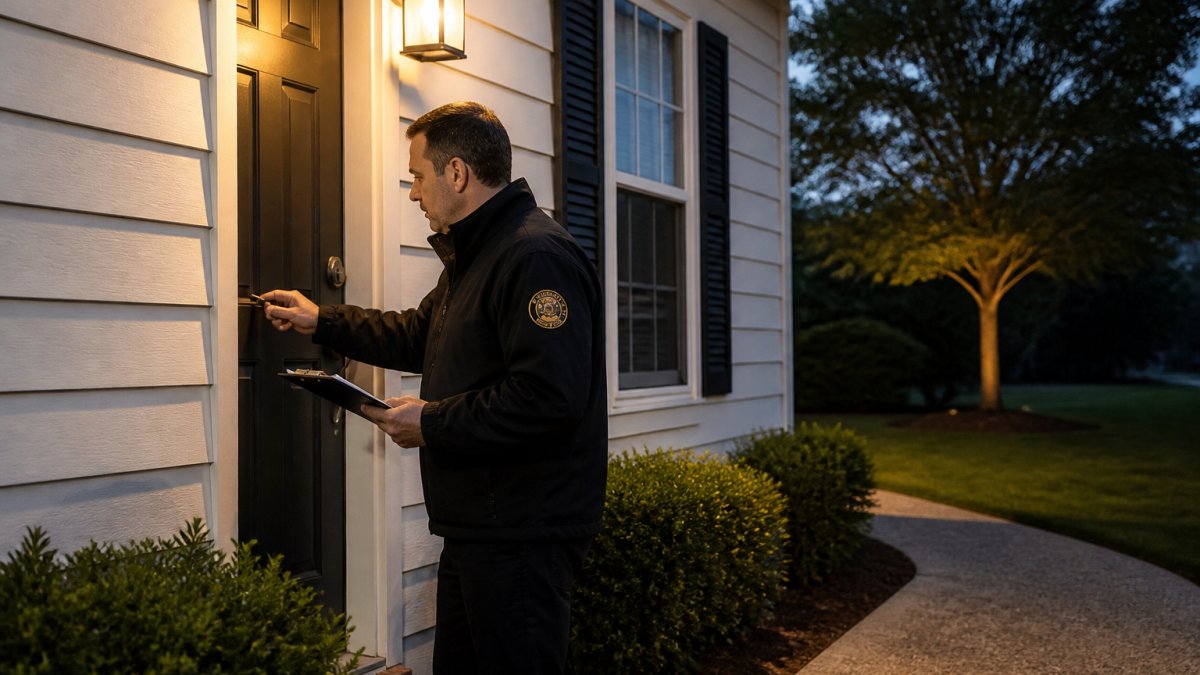
Work the perimeter first, then move inward:
- Check every exterior door for strike plate strength and deadbolt throw.
- Test window locks, including second-floor windows near porches or trees.
- Look for hiding spots: overgrown shrubs, stacked pallets, unlit alcoves.
Then repeat the exercise for any property you own but do not live in.
Step 4: Score Each Risk and Set Priorities
Now combine the two halves. For each threat from Step 1, note the vulnerabilities from Steps 2 and 3 that would let it succeed. Score each pairing.
Use a simple three-tier scale after the math:
- High (12-25). Fix now. These get money and attention this week.
- Medium (6-11). Fix within a month. Schedule the work.
- Low (1-5). Monitor. Revisit at your next periodic review.
One more concept worth knowing: residual risk. After you install a control, some risk remains. A deadbolt reduces break-in risk but does not eliminate it. Note the residual risk so you are not lulled into thinking a problem is fully solved.
Step 5: Build Your Personal Security Assessment Checklist
A personal security assessment checklist turns your findings into repeatable habits. Build one master list, then run it on a schedule.
Physical security
- All exterior doors have working deadbolts with full throw
- Window locks function on every accessible window
- Motion lights trigger on all approaches
Access control
- Key and code list reviewed and trimmed
- Codes changed after any contractor, sitter, or tenant change
- Spare keys accounted for
Digital
- Two-factor authentication on email, banking, and social accounts
- Unique passwords on primary accounts
- Location sharing reviewed on all devices
Routine
- Daily patterns varied where practical
- Mail and deliveries handled when away
- Emergency contacts current
Run the full checklist quarterly. Run the physical section monthly. That is your periodic review, and it is what keeps the assessment from going stale.
Step 6: Fill In a Security Risk Assessment Template
A security risk assessment template keeps your findings in one place and makes the next review fast.
Use this structure:
Section 1: Scope and date. What you assessed (home, vehicle, digital accounts, work travel) and when.
Section 2: Threat register. Columns for threat, likelihood, impact, risk score, and notes.
Section 3: Vulnerability notes. What you found at each exposure point, with photos where useful.
Section 4: Controls in place. What already works.
Section 5: Action plan.
| Action | Risk Addressed | Priority | Owner | Due |
|---|---|---|---|---|
| Add strike plate reinforcement to rear door | Burglary | High | Self | This week |
| Enable two-factor on email and bank | Account takeover | High | Self | This week |
| Trim shrubs along side yard | Burglary | Medium | Self | This month |
| Add motion light to driveway | Vehicle break-in | Medium | Self | This month |
Section 6: Review log. Date each review and note what changed.
Keep this document private.
When to Bring In a Professional Security Consultant
A self-assessment has limits, and knowing them is part of doing the assessment well. The triggers below can help identify when to seek help from a qualified professional, or emergency services.
Immediate Danger: Call 911 First
If you are in danger right now, or a threat is imminent, stop the assessment and call 911. A risk assessment is a planning tool for situations that are not currently happening, not a substitute for emergency response. The same applies if you discover evidence of an in-progress crime, a break-in, or someone inside your home: leave, get to safety, and call 911 rather than investigating.
Credible Threats and Stalking or Harassment
A credible threat from a known person, stalking, repeated unwanted contact, harassment, threats delivered in person or online, is the clearest signal to bring in help. Two things matter more than any home-security upgrade:
- Document everything. Save messages, voicemails, emails, and photos with dates and times.
- Involve law enforcement early. Report the conduct and ask what options exist under your state's stalking and harassment laws. Do not wait for an incident to escalate before creating a record.
When a Professional Assessment Adds Real Value
Beyond immediate threats, call a professional when the risk score is high and the fix is beyond a checklist:
- A public-facing role that makes you identifiable and reachable
- Repeated incidents at a property you own or manage
- A facility, event, or site with multiple entry points and real liability
If your concern is primarily digital, a qualified cybersecurity professional or identity-theft resource is often the better first call than a physical-security firm. Match the specialist to the threat.
Our officers are retired or prior law enforcement professionals, available 24/7. We provide uniformed and business-attired armed and unarmed officers, executive protection for high-profile individuals, and K9 teams for events and facilities. Clients get portal access to approved reports and patrol data.
If you are weighing the cost of professional protection, our breakdown of what it costs to hire a private bodyguard answers that question directly. You can also review the full range of security services we provide or read who we are and how we staff our teams before you call.
For general guidance on risk analysis as a discipline, the HHS guidance on risk analysis outlines how the process should be structured. The ONC security risk assessment tool shows a wizard-based approach that translates well to personal use.
Frequently Asked Questions
How do you prepare a personal security risk assessment?
Start by listing the people, property, and information you need to protect. Then identify realistic threats, note where you are exposed, and rate each risk by likelihood and impact. Write it down using a simple template so you can track changes. You should repeat it after any major change such as a move, a new job, or a break-in.
What should a personal security assessment checklist include?
A useful personal security assessment checklist covers four areas: physical security (locks, lighting, entry points, alarm systems, surveillance), digital security (passwords, two-factor authentication, account privacy), daily routines (commute, travel, social media posting), and emergency plans (contacts, meeting points, documentation). Review each item once a quarter and update the checklist whenever your circumstances change, such as a new vehicle, a home office, or a family member moving in.
How often should you review a personal security risk assessment?
Review your security risk assessment after any significant change: a move, a new job, a break-in, a breakup, or a public dispute. Keep notes from each review so you can see whether your risk level is rising or falling over time.
When should you hire a professional security consultant?
Bring in a professional when the risk exceeds what you can reasonably assess alone: repeated break-ins, threats from a known person, a public-facing role, or a multi-site property.