 comparison
Allied Universal Alternatives for Business Security
Table of Contents
- Why Businesses Switch From National Security Providers
- Security Guard Company Comparison: What Sets Providers Apart
- How to Choose a Security Company That Fits Your Risk Profile
- Off-Duty Police Security for Businesses: Trained Law Enforcement vs. Standard Guards
- Business Security Guard Services: From Event Coverage to 24/7 Facility Protection
- Specialized Security Solutions: K9, Executive Protection, and Investigations
- Evaluating Contract Terms, Liability, and Service Reliability
- Frequently Asked Questions
Last Updated: October 18, 2026
Why Businesses Switch From National Security Providers
Large national security providers dominate through size and brand recognition, but size isn't always an advantage. When a company manages thousands of accounts across dozens of states, individual attention becomes impossible. Your property gets whoever's available that week, response times slip, account managers rotate every few months, and you're a number in a massive system.
That's exactly why businesses are looking for an Allied Universal alternative for business security. The shift isn't about price alone, it's about control, reliability, and getting security personnel who actually understand your specific vulnerabilities.
Companies that switch report consistent frustrations: no-shows that force backup plans, generic post orders that don't fit actual risks, investigators without legal expertise, and contracts written entirely in the provider's favor, locking you in for years while guaranteeing nothing about staffing quality or response reliability.
Elite Police Protection operates differently. We staff accounts with off-duty and retired law enforcement professionals, not rotating bodies from a massive pool. Your account gets consistent personnel who know your property, your risks, and your expectations. That continuity changes everything, from incident response to threat assessment accuracy.
Security Guard Company Comparison: What Sets Providers Apart
When evaluating security provider alternatives, you're really comparing three distinct models: national conglomerates, regional specialists, and law enforcement-focused firms.
National providers excel at geographic reach and administrative infrastructure, with established insurance and legal frameworks. But they prioritize volume, moving contracts through a system as efficiently as possible, making service quality secondary to operational efficiency.
Regional providers occupy the middle ground: they know local regulations and have relationships with area law enforcement, and their account management is more personal than national chains. But they often lack the specialized expertise, K9 teams, executive protection training, investigative credentials, that complex risks demand.
Law enforcement-focused providers like Elite Police Protection bring something different: personnel with actual law enforcement backgrounds. These aren't security guards who went through a training program. They're off-duty officers, retired detectives, and former federal agents. That distinction matters when you're facing genuine threats, not just general deterrence.
The practical difference shows up in incident response. A standard guard calls 911 and waits. An off-duty officer assesses the threat, de-escalates if possible, documents evidence for prosecution, and coordinates with responding law enforcement as a peer, the difference between incident containment and professional threat management.
Key comparison factors:
- Personnel quality: National providers use rotating staff; law enforcement firms maintain consistent, vetted professionals
- Specialization: National providers offer general guarding; focused firms provide K9, executive protection, investigations
- Account management: Large firms assign rotating account managers; specialized firms maintain dedicated relationships
- Contract flexibility: National providers lock long-term; alternatives often allow quarterly adjustments
- Response capability: Standard guards follow protocols; law enforcement backgrounds enable real threat assessment
| Comparison Factor | National Providers | Regional Specialists | Law Enforcement-Focused |
|---|---|---|---|
| Personnel Consistency | Rotating staff | Semi-consistent | Dedicated professionals |
| Incident Response | Protocol-based | Local knowledge | Threat assessment & de-escalation |
| Specialized Services | Limited | Moderate | K9, investigations, executive protection |
| Contract Terms | Rigid, long-term | Moderately flexible | Flexible, performance-based |
| Cost Model | Volume-based | Mid-range | Premium for expertise |
How to Choose a Security Company That Fits Your Risk Profile
Choosing the right security company starts with honest assessment of your actual threats, not generic industry standards. A retail shopping center faces different risks than a behavioral health facility. A warehouse distribution center needs different capabilities than an apartment community.
Start by identifying your specific vulnerabilities. Is theft your primary concern, or do you face higher-risk situations, aggressive individuals, trespassing, workplace violence? Are you protecting people, property, or both? Do you operate 24/7 or need coverage during specific hours?
Next, evaluate what capability you actually need. Many businesses pay for armed officers when uniformed presence would suffice, while others cut costs with minimal staffing when their risk profile demands trained professionals.
Ask potential providers direct questions about their personnel: What's their background screening process? Do they conduct ongoing training? What percentage of staff have law enforcement experience? Can they provide references from similar facilities?
Verify their accountability systems: real-time monitoring, client portal access to reports, incident documentation, and evidence that holds up in court.
Contract terms matter more than most businesses realize. Can you terminate with 30 days notice, or are you locked in for years? What happens if they can't fill a shift, do you have backup coverage?
Elite Police Protection builds security plans around your actual risk profile. We start with a site assessment that identifies real vulnerabilities, not assumptions. We staff with personnel whose backgrounds match your risk level.
Off-Duty Police Security for Businesses: Trained Law Enforcement vs. Standard Guards
The difference between off-duty law enforcement and standard security guards shows up most clearly during high-stress situations. A trained officer has de-escalation experience, threat assessment training, and legal authority that standard guards lack.
Standard security guards receive certification through state-mandated training programs, typically 8-40 hours of classroom instruction covering basic security principles, emergency procedures, and legal limitations. Many receive this and nothing more.
Off-duty law enforcement professionals bring years of active duty experience: real emergencies, split-second decisions under pressure, and coordination with responding officers.
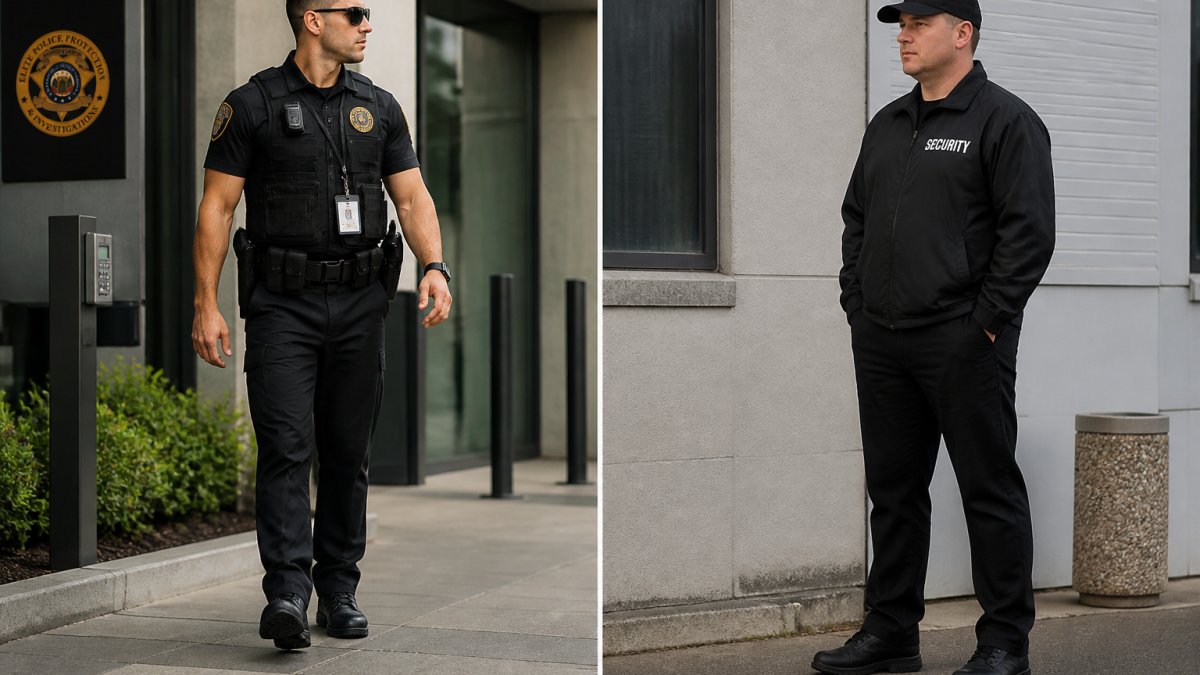
Consider a workplace violence scenario. A standard guard calls 911 and evacuates. An off-duty officer assesses whether the threat is immediate, de-escalates if possible, protects staff, and preserves evidence for law enforcement.
Executive protection demands similar distinctions.
For businesses facing higher-risk situations, behavioral health facilities, healthcare settings, executive protection, or properties in high-crime areas, the investment in law enforcement-trained personnel typically pays for itself through reduced incidents and better incident management.
Elite Police Protection staffs accounts with off-duty, retired, or prior law enforcement professionals. Every officer brings real-world experience, legal training, and the judgment that comes from handling actual emergencies.
Business Security Guard Services: From Event Coverage to 24/7 Facility Protection
Business security guard services range from short-term event coverage to permanent facility protection. The scope determines what you actually need.
Event security requires different capabilities than ongoing facility protection.
24/7 facility protection demands consistency and deep knowledge of your property. Guards need to know normal operations to identify abnormal activity, plus your emergency procedures, critical assets, and vulnerable areas.
Many businesses use hybrid approaches: permanent core staff for ongoing protection, supplemented by temporary personnel for events or peak periods. This maximizes consistency while maintaining flexibility.
Facility types create different requirements:
Apartment communities need access control, package monitoring, and common area patrols. Threats are typically lower-level, trespassing, package theft, unauthorized guests, but affect resident safety and satisfaction.
Retail shopping centers face theft, aggressive customers, and general deterrence needs. Visible security presence is critical. Response to incidents must be quick.
Warehouses and distribution centers need perimeter security, loading dock monitoring, and theft prevention. The scale of operations demands efficient coverage patterns.
Healthcare and behavioral health facilities face the highest-risk situations. Staff and patient safety depend on trained personnel who can de-escalate volatile situations, recognize mental health crises, and coordinate with emergency responders.
Bars and restaurants need aggressive crowd management and de-escalation skills. Weekend nights create predictable high-risk periods.
Construction sites require perimeter security, equipment protection, and access control. Temporary nature means staffing must be flexible.
Elite Police Protection customizes security guard services to each facility type. We assess your specific vulnerabilities, design appropriate coverage patterns, and staff with personnel trained for your particular risks.
Specialized Security Solutions: K9, Executive Protection, and Investigations
Beyond standard guarding, specialized security services address specific, higher-risk situations. These require expertise that general security providers rarely develop.
K9 security services use trained dogs for threat detection, perimeter security, and evidence location. Properly trained K9 teams provide capabilities that technology cannot match. A dog can detect explosives, narcotics, or concealed threats that cameras miss. They provide visible deterrence, few people challenge a trained security dog.
K9 teams require specialized training, veterinary care, and handler expertise. Most national providers don't maintain them, the overhead is too high for their volume model. Specialized firms invest because clients with genuine threats demand them.
Executive protection protects high-profile individuals from targeted threats. This includes threat assessment, secure transportation, venue security, and counter-surveillance. Executive protection demands judgment, discretion, and legal expertise. It's not about looking intimidating, it's about identifying threats before they materialize and responding appropriately when they do.
Private investigations gather evidence for legal proceedings, employment disputes, fraud investigations, and background verification. Quality investigations require understanding of evidence law, chain of custody, and admissibility standards. An investigator who doesn't understand legal requirements can gather evidence that's worthless in court, a common complaint.
Elite Police Protection provides all three services. Our K9 teams are trained for diverse environments. Our executive protection specialists have federal and law enforcement backgrounds. Our investigators understand evidence law and can produce findings that hold up in legal proceedings.
Evaluating Contract Terms, Liability, and Service Reliability
Most businesses focus on pricing when comparing security provider alternatives. That's a mistake. Contract terms, liability, and service reliability matter far more.
Contract terms determine your flexibility and the provider's accountability. National providers typically lock you in for 2-3 years with automatic renewal and early termination penalties.
Better alternatives include quarterly review periods, 30-day termination clauses, and performance guarantees. Your contract should specify staffing requirements, minimum training level, background check standards, consistency of personnel.
Liability and insurance protect your business if something goes wrong.
Your property management company or business carries ultimate liability for what happens on your premises. You need a security provider whose insurance complements yours, not one that creates gaps.
Service reliability is where most national providers fail. They promise staffing but can't guarantee it. Shifts get filled with whoever's available. No-shows force you to improvise coverage. Account managers change quarterly.
Ask for specific reliability metrics: What's their average staffing fill rate? How often do they have no-shows? What's their account manager tenure? Can they provide references from similar facilities?
Elite Police Protection provides consistent staffing through our advanced monitoring system and dedicated personnel. Your account gets the same professionals consistently, they know your property, your risks, your procedures.
Elite Police Protection delivers that difference through off-duty law enforcement professionals, specialized services like K9 and executive protection, and accountability. Our site assessments identify real vulnerabilities.
Frequently Asked Questions
What are the main differences between a security provider alternative and a national chain like Allied Universal?
Alternatives often specialize in staffing, service customization, and accountability. Many deploy off-duty law enforcement or retired officers with advanced training rather than entry-level security personnel. Specialized providers typically offer direct account management, faster response to staffing gaps, and tailored security assessments, services larger national firms may handle through standardized processes. You also gain visibility into guard qualifications and real-time access to patrol data through dedicated client portals.
How do I know a security company will actually show up and staff my location reliably?
Ask about staffing fill rates, backup protocols, and account management structure before signing. Request references from businesses with similar coverage needs and ask directly how they handle last-minute absences. Providers specializing in off-duty law enforcement or retired officers typically have lower turnover and higher reliability because these personnel treat security as a professional career, not temporary work. Confirm they maintain a local roster and have documented contingency plans for emergencies.
What should I look for when comparing security guard companies for my property management portfolio?
Evaluate guard training and certification, response protocols for incidents, insurance and liability coverage, technology integration (real-time reporting, patrol tracking), and geographic service capacity. Ask about background screening standards, post orders customization, and how they handle multi-location coordination. Request a security assessment to identify vulnerabilities specific to your properties. Verify that the provider can scale across your portfolio consistently without quality degradation at any location.
Can I hire off-duty police officers or retired law enforcement for my business security?
Yes. Many specialized security providers staff exclusively with off-duty, retired, or prior law enforcement professionals. These officers bring advanced conflict resolution, threat assessment, and incident response skills developed through police training. They are often armed or equipped to carry weapons depending on your state's regulations and your facility's needs. Verify that the provider holds proper licensing, that officers carry current certifications, and that liability insurance covers off-duty law enforcement activities at your location.
What specialized security services should I ask about beyond standard guard coverage?
Inquire about K9 services for detection and deterrence, executive protection for high-profile personnel, private investigations with admissible evidence standards, threat assessments, and access control expertise. Ask whether they offer post orders customization, real-time incident command during events, and advanced monitoring systems with client portal access. These services address specific vulnerabilities and can reduce liability by demonstrating a comprehensive, risk-aware security posture to insurers and regulators.