 how-to
How to Hire Off-Duty Police: A Complete Guide
Table of Contents
- What It Means to Hire Off-Duty Police
- What You'll Need Before You Start the Request Process
- How to Hire Off-Duty Police: The Step-by-Step Process
- Off-Duty Police Security Rates: What Affects the Cost
- Hiring Off-Duty Police for Private Events
- Off-Duty Police Liability and Insurance Requirements
- Common Mistakes to Avoid When Booking Off-Duty Officers
- Conclusion
Last Updated: August 25, 2026
Hiring off-duty police officers for private security is one of the most consequential decisions an event organizer or property manager can make. The process involves jurisdiction-specific rules, service agreements, liability considerations, and scheduling logistics that most organizers don't discover until something goes wrong. This guide covers every stage, from understanding what off-duty officers actually are to the tax paperwork nobody warns you about.
What It Means to Hire Off-Duty Police
Off-duty police officers are sworn, certified law enforcement professionals who work secondary employment assignments during their personal time, outside their primary department duties. They retain full peace officer authority, meaning they can make arrests, carry their service weapon, and exercise law enforcement powers during their off-duty assignment, depending on the jurisdiction.
Off-Duty Officers vs. Private Security Guards
The difference between off-duty officers and private security guards comes down to legal authority and training depth. A licensed security guard is a civilian with state-mandated training hours, typically ranging from 8 to 40 hours depending on state requirements. An off-duty police officer has completed a full law enforcement academy, field training, and ongoing certification requirements, and carries the full authority of a sworn peace officer.
Private security guards can observe, report, and detain in limited circumstances. Off-duty officers can arrest, respond to active threats with trained force, and command scenes in ways that private security simply cannot. For high-stakes environments, including bars and restaurants, behavioral health facilities, and large-scale events, that gap in authority and training is the deciding factor.
| Factor | Off-Duty Police Officer | Private Security Guard |
|---|---|---|
| Legal authority | Full peace officer powers | Limited civilian authority |
| Arrest powers | Yes | Detention only, in most states |
| Weapons | Service weapon (department-approved) | Varies by license and state |
| Training background | Law enforcement academy + field training | 8-40 hours state minimum |
| Uniform | Official police uniform | Company-issued uniform |
| Best for | High-risk events, crowd control, enforcement | Routine patrols, access control |
What You'll Need Before You Start the Request Process
Prepare the following before contacting any jurisdiction or licensed provider:
- Event or site details: Full address, venue type, expected attendance, layout, and access points needing coverage
- Date and time window: Including setup and breakdown periods
- Nature of the event: Alcohol service, age restrictions, public vs. private access, prior incident history
- Number of officers needed: Based on preliminary risk assessment
- Proof of event permits: Many jurisdictions require confirmation before approving officer deployment
- Certificate of insurance: Some departments require minimum general liability coverage before authorizing secondary employment assignments
According to the International Association of Chiefs of Police guidelines on off-duty employment, departments must establish written policies governing secondary employment, and those policies vary significantly from one agency to the next. Knowing your jurisdiction's specific rules before reaching out will save significant back-and-forth.
How to Hire Off-Duty Police: The Step-by-Step Process
The process differs depending on whether you go directly through a police department or through a licensed security provider that employs off-duty and retired officers. Both paths are legitimate. The right choice depends on your timeline, event complexity, and how much administrative coordination you want to manage yourself.
Step 1: Contact the Jurisdiction or a Licensed Provider
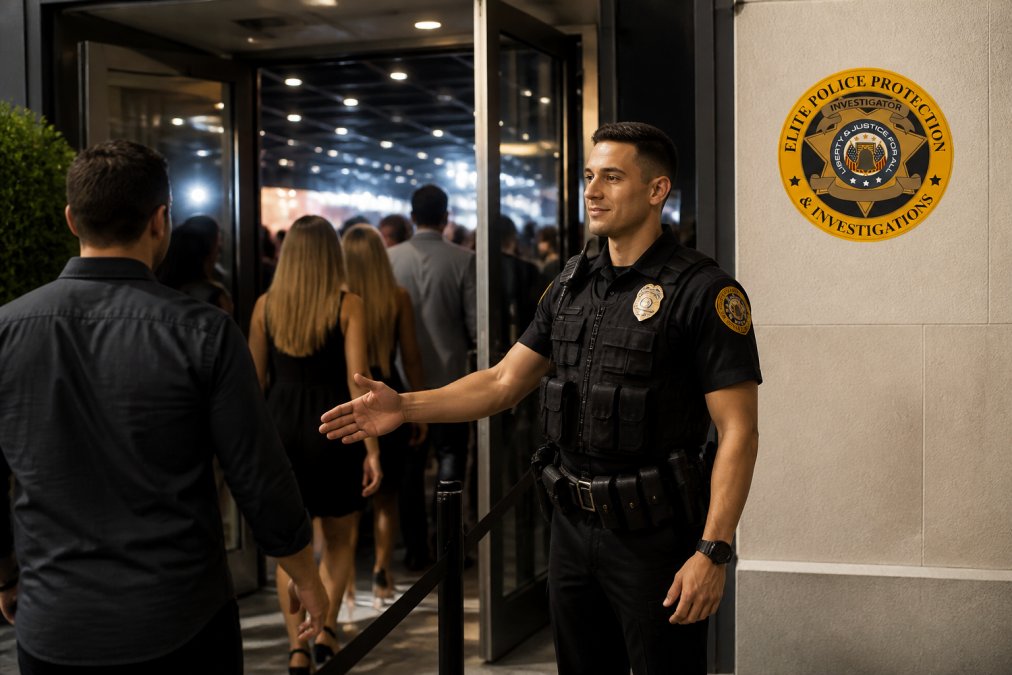
Identify whether the department in your area operates a centralized scheduling portal or requires direct contact with their secondary employment coordinator. Many larger departments now offer a web-based service or toll-free number. Smaller jurisdictions may route requests through the chief's office or a designated authorized personnel contact.
If working through a licensed provider like Elite Police Protection, this step is handled for you. The provider maintains established relationships with off-duty officers and manages scheduling, compliance, and deployment logistics.
Step 2: Submit Your Application and Event Details
Application submission typically requires a completed service request form with event details, the number of uniformed officers requested, deployment dates and hours, and specific duties expected. Some jurisdictions require a background check on the requestor or a review of the event's permit status before approving the assignment.
Be specific about duties. Crowd control, traffic management, perimeter security, and on-site supervisor roles each carry different expectations and may require different officer-to-attendee ratios.
Step 3: Review the Service Agreement and Scheduling
Once approved, you'll receive a service agreement outlining the hourly rate, minimum hours, cancellation policy, and conditions for modification or termination. Pay close attention to:
- Minimum hourly requirements: Most jurisdictions and providers require a minimum of 4 hours per officer per assignment
- Cancellation fees: Short-notice cancellations, typically within 24-48 hours, often trigger a fee equivalent to the minimum hours owed
- Officer substitution policies: What happens if the scheduled officer becomes unavailable
Step 4: Confirm Deployment and On-Site Logistics
Forty-eight hours before the event, confirm deployment details with your contact. Provide the officer or on-site supervisor with an emergency contact list, site map, access credentials, and a clear briefing on expectations. Establish a check-in and check-out protocol for verified service records.
Off-Duty Police Security Rates: What Affects the Cost
Off-duty police security rates are not standardized nationally. Pricing depends on the jurisdiction, the department's secondary employment policy, the type of event, and whether you're contracting directly or through a licensed provider. Contact Elite Police Protection or the relevant jurisdiction directly for current rate information.
Several factors consistently influence cost:
- Jurisdiction and department policy: Some departments set fixed rates; others allow officers to negotiate within a range
- Event type and risk level: High-risk events with alcohol service or large crowds typically command higher rates
- Minimum hours: Most assignments carry a 4-hour minimum, regardless of actual event duration
- Number of officers: Multi-officer deployments may be structured differently than single-officer assignments
- Scheduling lead time: Last-minute requests often carry a premium
According to the U.S. Bureau of Labor Statistics Occupational Employment data, police and detectives earn a median hourly wage that reflects their training and authority level. Off-duty rates typically exceed that baseline to account for the secondary employment context and administrative fees.
Hiring Off-Duty Police for Private Events
Private events represent the largest single use case for off-duty officer deployments. The request process follows the same general path as public events, but documentation requirements and liability structure differ in important ways.

Types of Events That Commonly Use Off-Duty Officers
Common event categories include bars and nightclubs, retail centers and shopping malls, construction sites, healthcare and behavioral health facilities, apartment communities, and private parties and corporate events.
Event Risk Assessment: Matching Coverage to Your Needs
Event risk assessment evaluates the likelihood and potential severity of security incidents at a specific event to determine appropriate officer deployment levels. A thorough assessment prevents both under-coverage, which creates liability exposure, and over-coverage, which wastes budget.
Key variables include:
- Expected attendance and crowd density
- Alcohol service and hours of service
- Public vs. private access
- Historical incident data for the venue or event type
- Proximity to other venues or public spaces
- Event duration and late-night hours
Off-Duty Police Liability and Insurance Requirements
Off-duty police liability depends on whether the officer is deployed under a department-administered program, a third-party service agreement, or an independent arrangement. Under most department secondary employment policies, officers acting within the scope of their authorized assignment retain qualified immunity protections as sworn officers. However, if an officer acts outside the scope of the approved assignment or violates department policy, liability may shift to the event organizer, the venue, or both.
The International Association of Chiefs of Police model policy on off-duty employment recommends that all secondary employment assignments be conducted under a written agreement that clearly defines the scope of duties and the chain of command.
For event organizers, the practical requirements are:
- General liability insurance: Most departments and providers require a minimum coverage level before approving deployment
- Additional insured endorsement: Your policy may need to name the officer's department or the contracted service provider as an additional insured
- Certificate of insurance on file: Keep a copy before, during, and after the event
Tax and W-9 Implications When Contracting Officers
When you hire off-duty police directly through a department-administered program, the department typically handles payroll and tax withholding. When you contract independently, you may be classified as the employer for tax purposes, which triggers W-9 collection and 1099 reporting obligations.
The IRS classification of the working relationship, employee vs. independent contractor, determines your withholding obligations. According to IRS guidance on worker classification, the key factors are behavioral control, financial control, and the type of relationship between the parties.
Working through a licensed provider like Elite Police Protection eliminates this exposure entirely. The provider handles classification, tax documentation, and compliance.
Common Mistakes to Avoid When Booking Off-Duty Officers
Most problems trace back to the same handful of errors:
- Booking too late: Many jurisdictions and providers require 5-10 business days minimum lead time
- Underestimating minimum hours: Budget for at least 4-5 hours per officer, including setup, briefing, and breakdown
- Skipping the service agreement review: Cancellation fees, substitution policies, and scope limitations are critical
- No on-site supervisor designation: For multi-officer deployments, designate a point of contact to avoid confusion during incidents
- Assuming jurisdiction portability: An officer authorized for secondary employment in one city may not be authorized in a neighboring jurisdiction
- Ignoring insurance requirements: Showing up without the required certificate of insurance can result in the officer being unable to deploy
The administrative side is where most hires actually fail. The officer shows up. The paperwork doesn't.
Securing the right coverage for your event or property requires more than finding an available officer. It requires a provider that manages the compliance, scheduling, and liability structure so you're protected before, during, and after the assignment. Elite Police Protection specializes in off-duty, retired, and prior law enforcement professionals, available 24/7 with advanced guard monitoring and client portal access so you always know who's on site and what's happening. Apply Now to discuss your security requirements and get a tailored deployment plan.
Frequently Asked Questions
How much does it cost to hire an off-duty police officer?
Off-duty police security rates vary depending on the jurisdiction, the officer's rank, minimum hourly requirements, and whether the deployment involves traffic management or crowd control. Most departments and licensed providers set a minimum number of hours per shift. Because pricing depends on location, event type, and staffing needs, contact a provider directly for an accurate quote rather than relying on generic figures.
Are off-duty police officers still authorized to make arrests?
Yes. An off-duty officer remains a certified peace officer under their jurisdiction's authority. They carry their department-issued credentials, and in most states retain full arrest powers while working secondary employment. That said, their specific authority can depend on whether they are working under a department-sanctioned program or through a licensed private security provider. Always confirm the officer's authorization status before finalizing your service agreement.
What insurance requirements apply when hiring off-duty officers?
Most jurisdictions and licensed providers require the hiring party to carry general liability insurance, often with a minimum coverage threshold, and to name the officer or agency as an additional insured. Some departments also require a certificate of insurance before approving the service request. Confirm these requirements early in the process, since missing documentation is one of the most common reasons a request gets delayed or denied.
How far in advance should I request off-duty police services?
For most events, submitting your application at least two to four weeks in advance is advisable. Large events, holiday weekends, or deployments requiring multiple officers may need even more lead time due to scheduling portal availability and department approval processes. Last-minute requests are sometimes accommodated, but they limit your options and may result in higher cancellation fees if plans change.
This article was written using GrandRanker