 blog
Hiring Security for Behavioral Health Facilities
Table of Contents
- Why Hiring Security for Behavioral Health Facilities Is Different
- Hospital Security Officer Qualifications That Actually Matter
- Behavioral Health Security Training for High-Acuity Units
- De-Escalation Training for Security Guards in Clinical Settings
- Hospital Security Staffing Models and Coverage Levels
- How to Evaluate and Select a Behavioral Health Security Provider
- Coordinating Security with Clinical Teams and Emergency Protocols
- Measuring Security Program Performance and Avoiding Common Hiring Mistakes
- Frequently Asked Questions
Last Updated: October 13, 2026
Why Hiring Security for Behavioral Health Facilities Is Different
Hiring security for behavioral health facilities is not the same as staffing a warehouse or a retail center.
Most security firms train guards for deterrence and access control. That model breaks down on a psychiatric unit, where the job is closer to observation and calm intervention than confrontation.
Below, we break down the qualifications, training, staffing models, and evaluation criteria that separate a safe behavioral health security program from a liability.
Hospital Security Officer Qualifications That Actually Matter
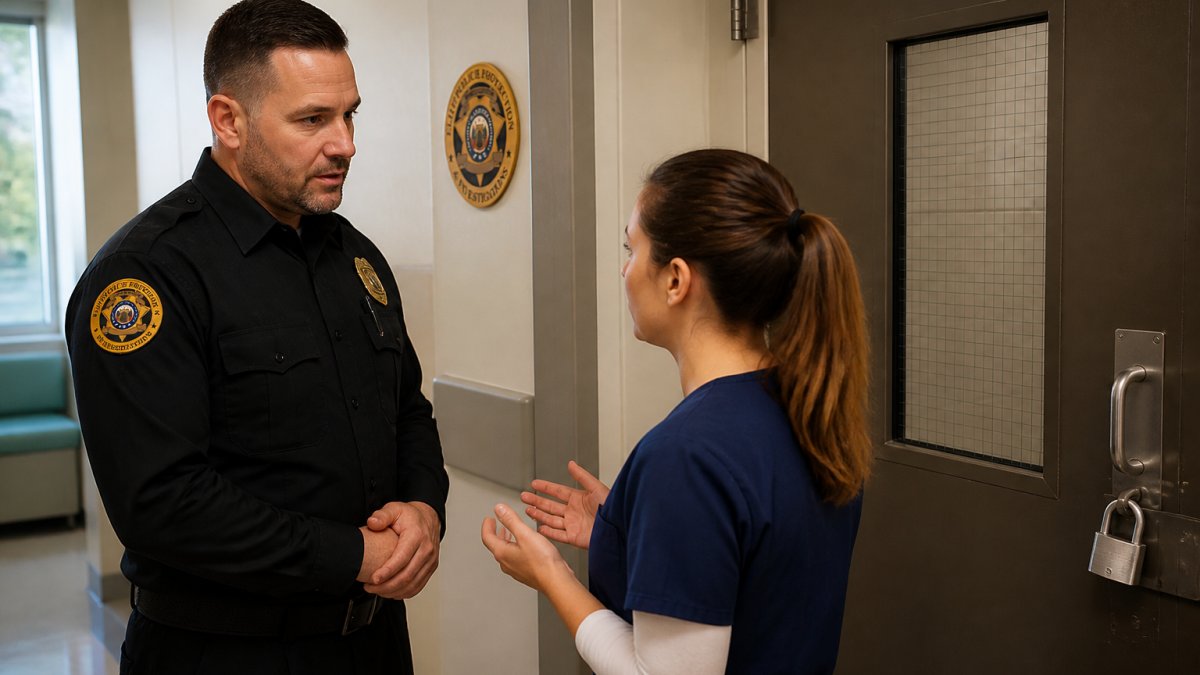
The qualifications that matter most are temperament, communication skill, and documented experience in a clinical or institutional setting, not just a clean background check.
A hospital security officer needs to read a room before it turns volatile.
Look for these baseline qualifications:
- Prior experience in a hospital, mental health care facility, or institutional setting
- Current security license and basic security officer training
- CPR and first aid certification
- Clear written and verbal communication
- Physical ability to respond without unnecessary force
Screening, Credentialing, and Competency Checks
Screening goes beyond a background check. A thorough process verifies licensure, checks for prior use-of-force complaints, and tests how a candidate actually responds under pressure.
Competency checks should include scenario-based evaluation. Ask a candidate to describe how they would handle a patient refusing to return to their room. The answer tells you more than any résumé line.
Behavioral Health Security Training for High-Acuity Units
Behavioral health security training must cover crisis intervention, trauma-informed care, and the specific protocols of the unit the officer will work, and it should be documented, not assumed. The distinguishing factor between a general guard and a behavioral health officer is not the uniform, it is the curriculum behind it.
Generic guard training does not prepare anyone for an inpatient psychiatry setting. High-acuity units need officers who understand psychiatric diagnoses well enough to anticipate behavior without judging it.
What a Behavioral-Health-Specific Curriculum Should Include
A defensible curriculum goes beyond a topic list. Ask providers to show you the actual modules, the hours allocated to each, and how competency is tested. A workable structure typically includes:
- Crisis intervention and verbal de-escalation, scenario-based practice, not lecture only, with officers demonstrating techniques under evaluation.
- Trauma-informed care principles, recognizing how prior violence, neglect, or institutional harm shapes a patient's response to authority figures.
- Psychiatric diagnosis awareness, practical orientation to conditions officers will encounter, including psychosis, mania, delirium, and substance withdrawal, so behavior is anticipated rather than judged.
- Restraint and seclusion policy limits, the facility's own policy, plus the legal boundaries on when physical intervention is permitted and what must be documented.
- Emergency response and code protocols, the unit's specific codes, alarm activation, and the escalation chain to clinical staff.
- Documentation and incident reporting, objective, factual writing that will hold up in a review or a legal proceeding.
- Patient rights and privacy, how federal privacy rules and patient rights protections apply to what an officer may observe, share, or record.
Hours, Competency, and Recertification
Training depth is measured in hours and in demonstrated competency, not in a certificate of attendance. Most behavioral health facilities find that a meaningful onboarding curriculum runs well beyond a single shift, with refreshers at least annually and after any significant incident.
Recertification matters because skills decay. CPR and first aid certifications carry defined expiration periods, and de-escalation skills need periodic reinforcement. Build recertification dates into your contract so they are tracked rather than discovered during an incident review.
Why This Differs From Standard Guard Training
State-mandated security officer training is built around deterrence, access control, and observation, appropriate for a warehouse or a retail floor. On a psychiatric unit, the officer's primary tool is communication, and the primary risk is an escalation that turns into a restraint, an injury, or a legal claim. Training that does not address that distinction leaves the officer and the facility exposed.
De-Escalation Training for Security Guards in Clinical Settings
De-escalation training for security guards teaches verbal and nonverbal techniques that reduce tension before physical intervention becomes necessary. In a clinical setting, that skill protects patients and staff alike.
The core principle is simple: slow the situation down. Officers who project calm, keep their hands visible, and give the patient space and choices defuse far more incidents than officers who move in fast.
Trauma-Informed Care and Use-of-Force Safeguards
Trauma-informed care means recognizing that many patients have experienced violence, neglect, or institutional harm, and adjusting approach accordingly. Use-of-force safeguards put hard limits on when and how an officer may physically intervene.
Those safeguards should be written into your contract, not left to officer discretion. Define what counts as a reportable use of force, require documentation for every incident, and build in a review process. Patient rights and privacy rules apply on every unit, and officers must understand them.
Hospital Security Staffing Models and Coverage Levels
Hospital security staffing models range from a single officer on a day shift to 24/7 coverage with relief officers, and the right model depends on unit acuity, census, and facility layout. There is no universal number.
The practical approach is to build coverage from risk, not from a per-hour rate. Map your facility's highest-risk hours first, then design shifts around them.
| Staffing Model | Coverage | Best For |
|---|---|---|
| Single-officer day shift | Business hours only | Low-acuity outpatient clinics |
| Extended coverage | 12-16 hours per day | Facilities with evening intake |
| 24/7 coverage | Round-the-clock, rotating shifts | Inpatient and high-acuity units |
| 24/7 plus relief | Full coverage with backup | Multi-unit or multi-site facilities |
Coverage Math: Turning Hours Into Positions
A common mistake is to assume that 24/7 coverage means one officer. It does not. A single post staffed around the clock requires enough officers to cover the schedule, plus relief for vacation, sick time, and turnover.
Start with three inputs:
- Post hours, how many hours per day the post must be staffed.
- Days per week, whether the post runs seven days or five.
- Relief factor, the additional coverage needed for time off, training, and turnover.
Multiply post hours by days, divide by the annual hours one officer can work, then add relief. That gives you a defensible headcount to compare against any provider's proposal.
Shift Design and Officer Consistency
Most facilities find that evening and night shifts carry the highest incident risk, so coverage should be weighted toward those hours rather than spread evenly.
Where budget is constrained, a common pattern is to staff a single officer during low-risk daytime hours and add a second officer or a roving patrol during peak intake and evening periods, rather than cutting coverage uniformly across the day.
Cost Planning: Total Labor Cost, Not Hourly Rate
Cost planning starts with your coverage requirement, not a per-hour rate. The hourly rate a provider quotes is only one component of total cost. A complete comparison should account for:
- Base labor, the officer hours required by your coverage model.
- Overtime and relief, the premium hours created by vacation, sick leave, and turnover.
- Supervision and management, the field supervisor time that keeps quality consistent.
- Training and onboarding, the hours spent before an officer is competent on your unit.
- Insurance and liability coverage, general liability and professional coverage carried by the provider.
- Technology and reporting, monitoring systems, portal access, and incident reporting tools.
Two proposals with the same hourly rate can differ substantially once these components are included. Pricing depends on coverage level, shift count, and site requirements, so we quote each facility individually, but the framework above lets you compare any two proposals on equal terms.
How to Evaluate and Select a Behavioral Health Security Provider
Evaluate a provider on training, supervision, monitoring technology, and references from comparable facilities, and treat any gap in those four areas as a disqualifier.
Start with a simple scoring process. Rate each provider from 1 to 5 on training depth, supervision model, reporting access, and clinical experience, then weight the criteria that matter most to your facility.
- Does the provider document training completion for every officer?
- Can they show supervision and patrol verification systems?
- Do they provide real-time access to reports and patrol data?
- Will they share references from behavioral health clients?
- Is their insurance and liability coverage documented?
At Elite Police Protection, our clients get an advanced guard monitoring system with portal access, so facility leadership can review approved reports and patrol data in real time.
Coordinating Security with Clinical Teams and Emergency Protocols
Security works best when it operates as part of the clinical team, not as a separate force standing in the hallway.
That means attending shift handoffs, knowing which patients are on heightened observation, and following the same emergency protocols the clinical staff follow.
Establish one clear rule: clinical staff direct care, security supports it. Officers who understand that boundary avoid the friction that ruins working relationships on a unit.
Measuring Security Program Performance and Avoiding Common Hiring Mistakes
Measure performance with incident data, response times, and staff feedback, reviewed on a regular schedule rather than once a year.
Track the number of incidents, how often de-escalation succeeded without physical intervention, and how staff rate the officers they work with. Rising incident counts or falling staff confidence are early warnings.
The recurring hiring mistakes we see:
- Hiring on price instead of capability
- Skipping scenario-based competency checks
- Failing to verify training documentation
- Rotating officers so often that no one knows the unit
- Leaving use-of-force limits out of the contract
Behavioral health facilities carry risks that generic security cannot address, and a guard without the right training adds to the danger instead of reducing it.
Frequently Asked Questions
Do mental hospitals have security guards?
Yes. Psychiatric units and mental hospitals typically staff security officers around the clock because behavioral health settings carry risks that general hospital floors do not: elopement attempts, self-harm, and aggression during acute episodes. Security teams handle patrols, monitoring, visitor screening, and incident response, while clinical staff lead care. Many facilities use a mix of in-house officers and contracted guards, and some rely on off-duty or retired law enforcement for higher-acuity units. The exact staffing depends on patient volume, unit layout, and state licensing requirements for the facility.
What qualifications should a behavioral health security officer have?
Look for a valid state security license, prior experience in a hospital or institutional setting, and documented training in de-escalation and trauma-informed care. CPR and first aid certification matter, and so does the ability to stay calm under pressure. Many strong candidates come from law enforcement or military backgrounds, but that alone is not enough; they need to show they can work inside a treatment model rather than a pure enforcement model. Ask about progressive responsibility in past roles and how they handled a real behavioral crisis.
Should behavioral health facilities hire in-house security or contract guards?
In-house teams give you direct control over training and culture but carry higher overhead for benefits, scheduling, and liability coverage. Contract firms, especially those staffed by off-duty or retired law enforcement, can deploy trained officers faster and absorb scheduling gaps. The practical answer depends on your size: smaller facilities often get better coverage and cost predictability from a contract, while large hospital systems with multiple units may justify a hybrid model. Whichever you choose, verify insurance, screening standards, and documented training before signing.
How much does behavioral health facility security cost?
Pricing depends on coverage hours, shift differentials, officer credentials, and whether you need armed or unarmed officers. Facilities with 24/7 coverage and high-acuity units pay more than those with daytime-only presence. Because rates vary by region and contract terms, request a quote based on your specific floor plan, patient volume, and shift schedule rather than relying on a generic hourly figure. Elite Police Protection can walk through your facility and build a staffing plan with transparent pricing before you commit.