
 ultimate-guide
Are Hospital Security Guards Armed? Key Facts for 2026
Table of Contents
- Hospital Security Guard Requirements: What Armed and Unarmed Officers Must Have
- Hospital Security vs Police Authority: Where the Legal Lines Are Drawn
- Legal and Liability Considerations for Armed Hospital Security Programs
- Benefits of Armed Hospital Security in High-Risk Departments
- Risk Assessment: Which Hospitals Actually Need Armed Officers
- Non-Lethal Alternatives and De-Escalation Training for Hospital Security
- Frequently Asked Questions
Last Updated: September 21, 2026
Hospital Security Guard Requirements: What Armed and Unarmed Officers Must Have
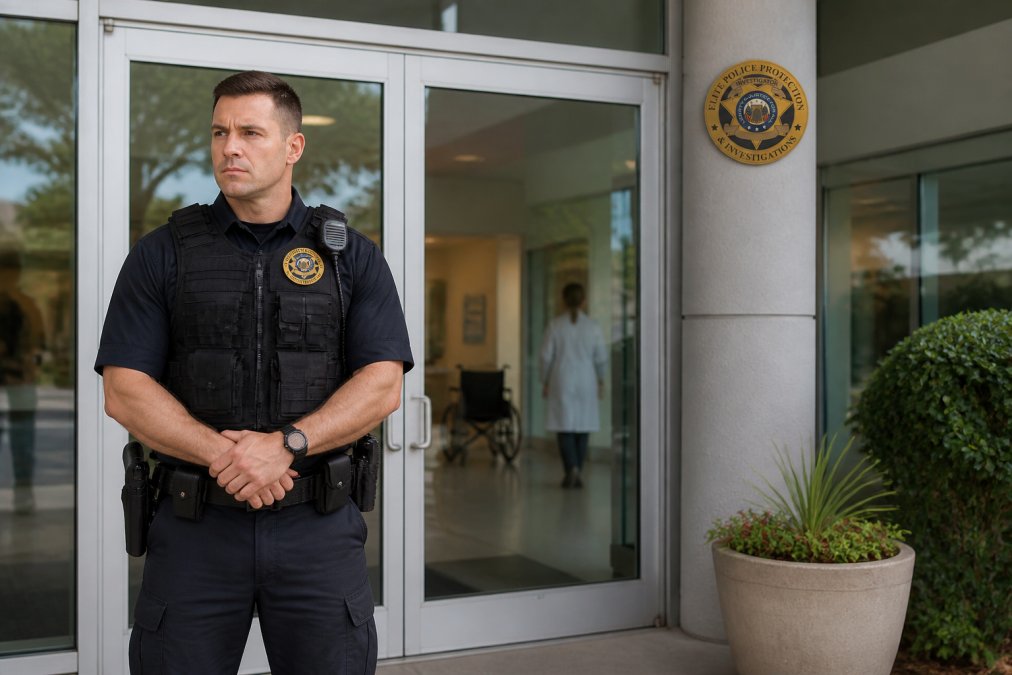
Are hospital security guards armed? The answer depends on the facility, the state, and the specific risk profile of each department. Some hospitals staff armed security officers in emergency departments and behavioral health units, while others rely exclusively on unarmed guards trained in de-escalation techniques. Elite Police Protection works with healthcare facilities and sees this decision play out differently at nearly every site.
| Requirement | Unarmed Officers | Armed Officers |
|---|---|---|
| State license | Required | Required |
| Firearm permit | Not applicable | Required |
| Training hours | 8-40 hours | 40-80+ hours |
| Annual qualification | Not required | Required |
| Use of force policy | Basic | Comprehensive |
| Liability insurance | Standard | Enhanced coverage |
State Licensing and Certification
Most states require security guards to hold a license through a state regulatory board or the department of public safety. Armed security guard licensing typically involves additional background checks, fingerprinting, and proof of firearm training completion. Requirements differ by state, so administrators should verify local regulations before staffing decisions.
Firearm Training and Annual Qualification
Armed hospital security officers generally must complete firearm training covering weapon handling, marksmanship, and lethal force decision-making. Many states mandate annual requalification at a shooting range. Some facilities add scenario-based training that simulates hospital environments, which is where the real value shows up.
Hospital Security vs Police Authority: Where the Legal Lines Are Drawn
Hospital security officers are not police officers. They cannot arrest suspects, conduct searches, or use the same level of force available to sworn law enforcement. Their authority typically extends only to detention and citizen's arrest within the bounds of state law.
Arrest Powers and Detention Limits
Security personnel can generally detain someone suspected of a crime until police arrive, but the detention must be reasonable in duration and scope. Holding someone too long, using excessive restraint, or searching without consent can trigger civil rights claims. Hospital security protocols should clearly define when to detain and when to call law enforcement.
Legal and Liability Considerations for Armed Hospital Security Programs
Bringing firearms into a healthcare setting raises liability exposure that unarmed programs don't face. Hospitals must weigh the protective value against the risk of accidental discharge, weapon retention failures, or use-of-force incidents that result in patient injury. What most guides skip is the specific legal and insurance machinery that turns this from a philosophical debate into a line-item cost.
The Legal Theories That Drive Claims
When an armed officer injures a patient, visitor, or employee, plaintiffs typically pursue one of four theories:
- Negligent hiring, the hospital or contract security firm failed to screen for disqualifying history (prior use-of-force complaints, failed psychological evaluations, unresolved criminal charges).
- Negligent training, the officer was issued a firearm but never qualified on weapon retention, shoot/don't-shoot scenarios, or hospital-specific engagement rules.
- Negligent supervision, no post-incident review, no body-worn camera audit, no supervisory ride-along after a complaint.
- Respondeat superior, the employer is vicariously liable for acts committed within the scope of employment, which generally includes an officer's use of force while on post.
Insurance: How Armed Programs Change the Math
This is the piece most articles omit. Hospitals rarely carry a standalone "security guard" policy. Coverage usually flows through one of three channels, and each responds differently when a firearm is involved:
| Coverage Type | Typical Trigger | How Armed Status Affects It |
|---|---|---|
| General liability (CGL) | Bodily injury on premises | Insurers may add a firearms exclusion or require a separate endorsement |
| Professional liability / E&O | Negligent security services | Underwriters ask whether officers are armed and demand training documentation |
| Workers' comp | Officer injury | Armed officers face higher exposure in weapon-retention and physical-altercation claims |
Overview of negligent security liability concepts
Use of Force Policy and Documentation
Every armed security program needs a written use of force policy that defines escalating response levels, typically from verbal presence, to soft empty-hand control, to hard control, to less-lethal tools, to deadly force as a last resort. The policy should map each level to the specific circumstances that justify it in a hospital context, where patients may be disoriented, medicated, or in psychiatric crisis rather than criminally intent.
Documentation requirements that hold up under scrutiny:
- Every incident involving physical force, weapon display, or restraint gets a written report, not just discharges.
- Reports capture time, location, witnesses, de-escalation attempts made, and the specific policy level authorized.
- Body-worn camera footage is retained per the facility's retention schedule (state laws vary on minimum retention periods).
- A supervisory review is completed within a defined window, 24 to 72 hours is common.
The Unique Angle: Armed Presence and the Standard of Care
Here's what the SERP largely ignores. Once a hospital arms its security force, it may be held to a higher standard of care in negligent-security claims. Plaintiffs' attorneys argue that a facility which chose to deploy firearms assumed a heightened duty to train, supervise, and control them. In practical terms, the decision to arm can expand the universe of claims a hospital must defend, not just the severity of any single claim.
Benefits of Armed Hospital Security in High-Risk Departments
Armed officers provide deterrence in environments where unarmed guards may not be enough. Emergency departments, behavioral health units, and facilities in high-crime areas often benefit from an armed response capability.
Risk Assessment: Which Hospitals Actually Need Armed Officers
A formal threat assessment should drive the decision, but "formal" means a repeatable framework, not a gut check. Hospitals with high emergency department volumes, history of staff assaults, or elevated community violence may justify armed protective services. Smaller facilities with low incident rates often achieve adequate security through unarmed guards, access control, and strong security protocols.
A Four-Factor Framework
- Incident history (12-24 months). Count staff assaults, patient-on-patient violence, weapons brought onto the premises, and police responses. A facility averaging multiple police responses per week is in a different risk tier than one averaging a few per quarter.
- Department-level exposure. The emergency department and behavioral health units concentrate risk. If those two areas generate the majority of your incidents, a targeted armed post may be justified even if the rest of the campus is calm.
- Community context. Local violent crime rates, proximity to a trauma center designation, and whether the facility sits in a jurisdiction with slow police response times all shift the calculus.
- Physical environment. Number of unlocked entrances, presence of a metal detector, camera coverage, and the ability to lock down units quickly. Strong environmental controls reduce the marginal value of an armed officer.
The 90-Day Incident Log
Pair the log with staff feedback. Nurses and techs often know which shifts and units feel unsafe long before the incident data catches up. A short anonymous survey can surface risk the numbers miss.
State and Local Legal Variation: The Factor Most Guides Skip
Even a facility that scores "high risk" can't simply decide to arm its guards. State law governs whether and how armed security can operate on hospital grounds, and the rules vary widely. Key variables to verify with counsel:
- Licensing category. Some states issue a single guard license; others split armed and unarmed into separate credentials with different training hours and renewal cycles.
- Firearm permits. Whether the officer's personal concealed-carry permit satisfies the employer's requirement, or whether a separate armed-guard endorsement is needed.
- Hospital-specific restrictions. Some states restrict firearms in certain healthcare settings (particularly behavioral health and substance-treatment facilities) regardless of the guard's license.
- Use-of-force statutes. Citizen's arrest and detention authority differ by state, which directly shapes what an armed officer can lawfully do before police arrive.
- Local ordinances. Municipal rules on security uniforms, vehicle markings, and firearm storage can add requirements on top of state law.
Matching the Model to the Risk
Document the rationale for whichever model you choose. If a claim ever arises, a written, dated risk assessment showing why the staffing level was reasonable is one of the strongest defenses a hospital can produce.
Non-Lethal Alternatives and De-Escalation Training for Hospital Security
Non-lethal devices give hospitals a middle path. TASERs, pepper spray, and batons provide defensive options without the lethality of a firearm. Many facilities equip unarmed guards with these tools while reserving armed officers for specific high-risk posts.
Frequently Asked Questions
Are hospital security guards armed in all states?
No. Whether hospital security guards carry firearms depends on state law, hospital policy, and the specific facility's risk assessment. Some states require armed officers in certain high-risk departments like emergency rooms, while others leave the decision entirely to the hospital. There is no single federal mandate. Hospital administrators should verify their state's security guard licensing requirements and consult legal counsel before deploying armed personnel.
What qualifications do you need to be a hospital security guard?
Hospital security guard requirements vary by state, but most employers require a high school diploma, a clean criminal background check, and completion of a state-approved security training program. Armed hospital security officers typically need additional firearm training, psychological evaluation, and annual qualification. Many hospitals prefer candidates with prior law enforcement or military experience. Some facilities also require CPR certification and de-escalation training before assigning officers to patient-facing roles.
Do hospital security guards have the same authority as police?
No. Hospital security guards, whether armed or unarmed, are private citizens with limited authority. They can detain someone under citizen's arrest laws if a felony occurs, but they cannot conduct searches, issue citations, or make arrests the way sworn law enforcement can. The difference between hospital security vs police authority matters for liability: security officers must follow their facility's use of force policy and state regulations, not police procedures. Many hospitals contract off-duty police officers when full police powers are needed.
Why do some hospitals choose unarmed security over armed guards?
Hospitals often choose unarmed guards to reduce liability exposure, avoid intimidating patients, and lower insurance premiums. Behavioral health units and pediatric facilities frequently prefer unarmed officers because firearms can escalate situations involving patients in crisis. Unarmed guards focus on de-escalation techniques, access control, and threat assessment. Some facilities use a hybrid model: unarmed officers for general patrol and armed officers stationed only in emergency departments or high-risk areas.