 how-to
Hiring Private Investigators for Corporate Security
Table of Contents
- Why Companies Hire Private Investigators for Corporate Security
- What Corporate Investigation Services Actually Cover
- Private Investigator Licensing and Credentials to Verify
- How to Vet and Select an Investigative Firm
- Private Investigator Cost per Hour and Engagement Terms
- Workplace Investigation Services: The Engagement Process and Deliverables
- Legal Compliance, Privacy, and Evidence Admissibility
- Frequently Asked Questions
Last Updated: October 12, 2026
Why Companies Hire Private Investigators for Corporate Security
Hiring private investigators for corporate security means bringing licensed professionals into a business to uncover fraud, theft, misconduct, or risk that internal teams cannot resolve alone.
Internal cameras and HR policies catch obvious problems. They miss the quiet ones: a warehouse worker skimming inventory over six months, a vendor billing for work never done, a manager sharing bid details with a competitor.
Common Corporate Use Cases and Investigation Scope
Most businesses hire investigators for a handful of recurring problems:
- Suspected internal theft or inventory loss
- Workers' compensation fraud
- Vendor or contractor billing fraud
- Employee misconduct and harassment claims
- Pre-employment background checks for sensitive roles
Scope shapes cost and timeline: a background check takes days, while a multi-site theft investigation can run for weeks.
What Corporate Investigation Services Actually Cover
Corporate investigation services cover the fact-finding a business needs when internal tools fall short: surveillance, interviews, records review, and evidence documentation.
Internal theft, fraud, and workplace misconduct sit at the core, money or property leaving your business through an employee or insider.
Surveillance, background checks, and due diligence protect you before a problem starts.
Legal support and evidence handling ensure every finding survives scrutiny in court or arbitration.
Internal Theft, Fraud, and Workplace Misconduct
A common mistake is waiting too long. By the time a business calls us, losses often stretch back months. Early action limits damage and preserves evidence.
Investigators typically:
- Review financial records and inventory logs
- Interview witnesses and suspects
- Place covert surveillance where needed
- Document every finding with timestamps and chain-of-custody notes
Surveillance, Background Checks, and Due Diligence
Many businesses hire investigators to check a candidate's background before giving them access to cash, keys, or sensitive data, or to screen a potential partner. Surveillance follows a clear legal line: investigators can observe public activity but cannot trespass or wiretap without proper authority.
Private Investigator Licensing and Credentials to Verify
Private investigator licensing and credentials vary by state, so verify them before hiring anyone. Most states require a license; some require specific experience or training hours.
Here is what to check:
- A current state license number you can confirm with the licensing board
- Proof of insurance, including general liability and errors coverage
- Prior law enforcement or investigative experience
- Any relevant certifications or specialized training
Ask for the license number directly, then confirm it yourself. Verify the individual investigator assigned to your case, not just the company, you are trusting them with sensitive internal matters.
How to Vet and Select an Investigative Firm
Vetting an investigative firm comes down to licensing, relevant experience, clear communication, and a written scope of work.
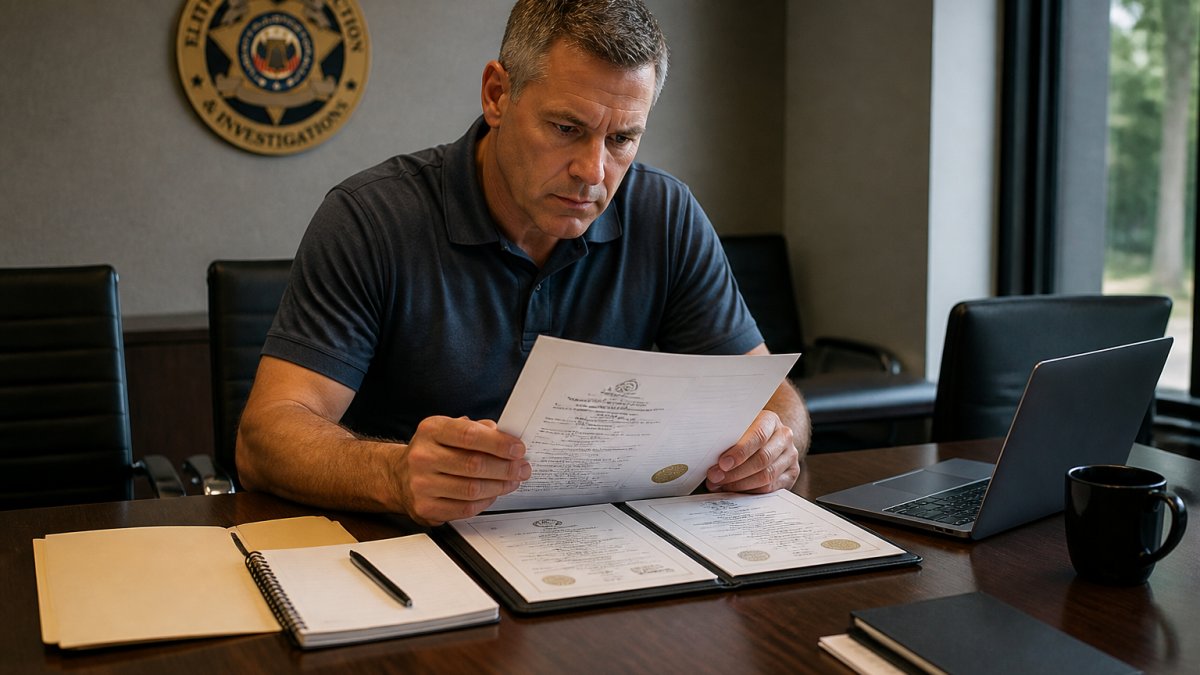
Start with industry experience. A firm handling divorce cases may not understand inventory shrinkage or vendor fraud.
Look at how they communicate: you want regular updates, not radio silence followed by a bill.
Get everything in writing, scope, deliverables, timeline, and fees, before work begins.
Evaluating Methods, Reporting, and Conflicts of Interest
Most buyers focus on price and license, but problem firms often pass those checks and fail on softer criteria. What separates a strong firm from a weak one:
- Method transparency. A reputable firm will explain, at a high level, how they plan to gather facts, records review, interviews, surveillance, or open-source research, without revealing tactics that would compromise the case. If they refuse to describe any approach at all, that is a warning sign.
- Reporting quality. Ask to see a redacted sample report. Look for clear findings, sourced evidence, timestamps, and a separation between fact and inference. A report that reads like a narrative with no citations will not survive a deposition or an arbitration hearing.
- Conflicts of interest. Ask whether the firm has worked for your competitors, your vendors, or anyone adverse to your business. A firm that has represented the other side of a dispute may be disqualified or, at minimum, should disclose the relationship in writing.
- Subcontracting. Many firms use contract investigators for surveillance. Ask who will actually perform the work, whether they are employees or subcontractors, and how their work is supervised and quality-checked.
- Insurance and bonding. Confirm general liability and errors-and-omissions coverage, and ask for a certificate of insurance naming your business as an additional insured where appropriate.
Questions to Ask Before You Sign
Use this checklist when you talk to a firm:
- What is your state license number, and can I verify it?
- How many corporate cases like mine have you handled?
- Who specifically will work my case, and what is their background?
- Will any part of the work be subcontracted, and to whom?
- What is the scope of work, and what falls outside it?
If a firm dodges these questions, move on.
Matching the Firm to the Case Type
Different corporate problems call for different skill sets, a surveillance expert may be mediocre at forensic accounting. Match the firm to the work:
- Internal theft and inventory loss: look for retail or warehouse experience, interview training, and familiarity with loss-prevention systems.
- Vendor or billing fraud: look for financial records review, forensic accounting partnerships, and experience testifying about documentary evidence.
- Workplace misconduct and harassment: look for HR-adjacent investigation experience and a clear understanding of how to structure interviews that withstand EEOC scrutiny.
- Due diligence and pre-merger vetting: look for open-source research, corporate records, and litigation history capabilities across multiple jurisdictions.
- Executive protection and threat assessment: look for prior law enforcement or protective services backgrounds and coordination with local authorities.
Ask each firm which of these is their core strength. A firm that claims equal mastery of all five is not being straight with you.
Private Investigator Cost per Hour and Engagement Terms
Private investigator cost per hour depends on case type, investigator experience, and location. Corporate work often runs higher than general surveillance because it demands more skill, documentation, and sometimes testimony. Ask each firm for a written estimate tied to a defined scope, and compare engagement structure, not just the headline rate.
Common Billing Models
Most firms use one or more of these models. Knowing which you are offered helps you compare proposals fairly:
| Billing Model | How It Works | Best For | Watch Out For |
|---|---|---|---|
| Hourly with minimums | Billed per hour, often in 2-, 4-, or 8-hour blocks | Surveillance, unpredictable cases | Minimums that exceed actual work performed |
| Flat fee per task | Fixed price for a defined deliverable (e.g., one background check) | Background checks, records pulls | Scope creep if the task expands |
| Retainer plus hourly | Upfront deposit drawn down as work proceeds | Ongoing or multi-phase investigations | Non-refundable retainers; slow reconciliation |
| Contingency or success fee | Payment tied to recovery or outcome | Rare in corporate work; common in some asset cases | Ethical and licensing issues in many states |
| Project-based cap | Not-to-exceed budget for a defined scope | Budget-sensitive engagements | What happens when the cap is hit mid-investigation |
Expenses, Retainers, and Approval Thresholds
Hourly rates rarely tell the whole story. Ask how the firm handles:
- Travel and mileage. Surveillance often involves hours in a vehicle. Confirm whether travel time is billed at the full rate or a reduced rate.
- Equipment and database fees. Records searches, license plate lookups, and skip-trace databases carry per-query costs. Ask whether these are passed through at cost or marked up.
- Subcontractor rates. If surveillance is subcontracted, the firm may bill you at a higher rate than it pays the subcontractor. That is normal, but the markup should be disclosed.
- Retainer refundability. Some firms apply the retainer to the final invoice; others treat it as a non-refundable commitment fee. Get this in writing.
- Expense approval thresholds. Ask for a written rule: any single expense over a set dollar amount requires your prior approval.
How to Compare Proposals Without a Universal Rate
There is no standard hourly rate for corporate investigative work, a rural solo investigator and a major-metro firm will quote very different numbers for the same task. Instead of chasing the lowest rate, compare proposals on:
- Scope specificity. A proposal that lists discrete tasks, deliverables, and a timeline is easier to compare than one that says "investigate the matter."
- Assumptions and exclusions. What is the firm assuming about access to records, witness cooperation, and site conditions? What is explicitly out of scope?
- Reporting cadence. How often will you receive updates, and in what format?
- Termination terms. Can you stop the engagement mid-case? What happens to the retainer and to work already performed?
- Deliverable ownership. Who owns the final report and underlying evidence, and will the firm provide copies in a usable format?
A higher hourly rate with tight scope, clear reporting, and strong documentation is often cheaper than a low rate that bills loosely and delivers a thin report.
For current rates on our investigative services, contact Elite Police Protection directly for a quote tailored to your case.
Workplace Investigation Services: The Engagement Process and Deliverables
Workplace investigation services follow a defined process from first call to final report. Knowing the steps keeps the case on track.
- Initial consultation. You describe the problem. The firm asks questions and outlines options.
- Scope agreement. Both sides sign off on tasks, timeline, and fees.
- Investigation. The team gathers records, conducts interviews, and runs surveillance if needed.
- Interim updates. You get progress reports at agreed intervals.
- Final report. You receive findings, evidence, and recommendations.
Deliverables usually include a written report, supporting documentation, and, when relevant, court testimony.
Legal Compliance, Privacy, and Evidence Admissibility
Legal compliance separates a professional investigation from a liability.
A few rules of thumb:
- Public observation is generally allowed
- Trespassing and illegal recording are not
- Evidence must have a clear chain of custody
- Interviews should follow proper procedures
The Fair Credit Reporting Act guidelines govern how background checks must be handled for employment purposes.
The Society for Human Resource Management offers practical guidance on structuring workplace investigations that hold up to legal review.
If a case may end up in court, admissibility matters from day one.
Corporate security problems rarely solve themselves, and the longer you wait, the more ground you lose.
Frequently Asked Questions
How do you hire a private investigator for a corporate investigation?
Start by defining the scope: what you need investigated, the timeline, and the outcome you want. Then verify the firm's state licensing, check that investigators have law enforcement or corporate investigative experience, and confirm they carry liability insurance. Ask for a written engagement letter that spells out deliverables, reporting cadence, and confidentiality terms. A firm that provides corporate investigation services should walk you through the legal boundaries of surveillance, interviews, and evidence handling before work begins.
What should a company look for when choosing a private investigator?
Prioritize three things: credentials, relevant experience, and legal literacy. Confirm the investigator holds a current state license where required, has handled cases similar to yours (internal theft, fraud, workers' comp, due diligence), and understands chain of custody and evidence admissibility. Ask whether they carry professional liability insurance. A firm that cannot produce licensing documentation or explain its investigative methodology is not worth the risk.
How can a company verify a private investigator's license and experience?
Check your state's licensing board or regulatory agency for the investigator's license number and standing. Ask for the license number in writing, then verify it independently rather than trusting a business card. For experience, request case summaries (redacted) that match your investigation type, and ask about the investigator's background in law enforcement or corporate security.
What information should a company provide before an investigation begins?
Provide a clear written brief: the concern or incident, relevant dates and locations, names of involved parties, any prior internal findings, and the specific outcome you need (evidence for termination, insurance claim, litigation support). Share applicable policies, access protocols, and any legal constraints your counsel has identified. The more precise your brief, the faster an investigator can scope the work and the more accurate the cost estimate. Withhold nothing that could affect legal strategy.