
 how-to
Private Investigator Cost Per Hour 2026: What to Expect
Table of Contents
- How Private Investigator Cost Per Hour Works in 2026
- Hourly Rates vs. Flat Fees: Which Billing Model Fits Your Case
- Private Investigator Retainer Fee: What You Pay Upfront
- Factors Affecting Private Investigator Fees
- Private Investigator Surveillance Cost: Why Fieldwork Adds Up
- Hidden Costs and Expenses Beyond the Hourly Rate
- Cost-Saving Strategies and Legal Fee Recovery
- Frequently Asked Questions
Last Updated: September 26, 2026
How Private Investigator Cost Per Hour Works in 2026
Understanding the private investigator cost per hour 2026 starts with one simple fact: most licensed investigators bill between two and four hours minimum, even for short jobs. This guide breaks down how that billing actually works, so you can budget with confidence.
Private investigator cost is the amount a licensed investigator charges for time spent on your case, usually split between an hourly rate and a separate retainer. A standard investigation involves fieldwork, evidence gathering, and a written report, and each stage eats into billable hours.
Here's what most guides get wrong. They quote a single hourly number and stop there.
Hourly Rates vs. Flat Fees: Which Billing Model Fits Your Case
The billing model you choose changes your total cost far more than the hourly rate itself. Hourly billing suits open-ended work like surveillance. Flat fees suit defined tasks like a background check.
| Billing Model | Best For | Risk |
|---|---|---|
| Hourly rate | Surveillance, fieldwork, open cases | Total can grow |
| Flat fee | Background checks, skip tracing | Scope creep |
| Retainer + hourly | Ongoing investigations | Upfront cost |
Private Investigator Retainer Fee: What You Pay Upfront
A private investigator retainer fee is an upfront deposit that funds the first block of billable work. The investigator draws against it as hours accrue, then asks for a replenishment when the balance drops below an agreed threshold.
Most practitioners structure retainers in one of three ways:
- Flat retainer: a single deposit that covers a defined scope (for example, a fixed number of surveillance hours). When the scope is met, the case closes.
- Draw-down retainer: a deposit that functions like a prepaid balance. Every hour, mile, and database pull is subtracted until the balance hits the replenishment trigger.
- Evergreen retainer: a minimum balance the client must maintain at all times. When the balance dips, the client tops it back up to the floor before work continues.
How the Draw-Down Actually Works
A typical draw-down looks like this. You pay a deposit before work begins. The investigator logs time in increments (often quarter-hour or tenth-hour), plus reimbursable expenses like mileage and database fees. Each entry reduces the balance. When the balance reaches the replenishment threshold stated in the agreement, work pauses until you add funds.
What to Confirm Before You Pay
- Refundability of unused funds. Some agreements refund the remaining balance when the case closes; others convert it to a credit or treat it as non-refundable. Get this in writing.
- Replenishment trigger. Ask for the exact dollar figure or percentage that prompts a top-up request.
- Expense treatment. Confirm whether mileage, database pulls, and equipment are drawn from the retainer or billed separately after it is exhausted.
- Minimum block. Many investigators bill a two- or three-hour minimum per task, and that minimum is drawn from the retainer even if the task finishes early.
- Termination clause. Know how to stop the engagement and how the remaining balance is handled if you do.
Contract Transparency Checklist
Most ranking pages skip the service agreement entirely. That is where surprise billing lives. Before signing, confirm the agreement states:
- The hourly rate, the minimum block, and whether the minimum is per task or per day.
- Which expenses are billable and at what rate (mileage, database access, equipment, report writing, travel time).
- The retainer amount, the replenishment trigger, and the refund policy on unused funds.
- The scope of work in writing, what is included and what triggers a change order.
- How scope changes are priced and who approves them.
- The reporting cadence and whether report preparation is billed.
- The termination process and final reconciliation of the balance.
Factors Affecting Private Investigator Fees
Several factors affect private investigator fees, and no two cases price the same. Case complexity, location, and investigator experience drive most of the difference.
Case Complexity, Location, and Investigator Experience
Complex cases need more hours. A simple records check takes far less time than a multi-day infidelity investigation with night surveillance.
- Case complexity: more moving parts, more hours
- Location: travel and overhead raise the rate
- Experience: specialists and ex-law enforcement cost more
- Specialized services: expert testimony and litigation support add cost
Private Investigator Surveillance Cost: Why Fieldwork Adds Up
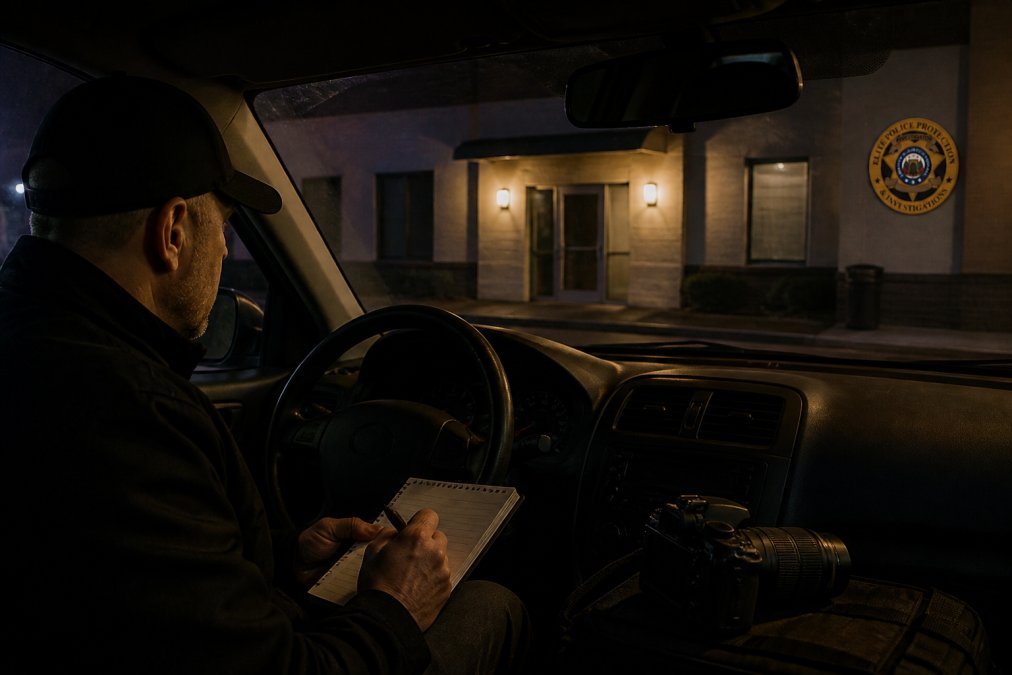
Surveillance is the most expensive line item on most invoices. A private investigator sitting in an unmarked car at night, watching a building entrance with a notepad and camera on the passenger seat, is billing every hour they wait.
Hidden Costs and Expenses Beyond the Hourly Rate
The hourly rate is rarely the full bill. Hidden costs and expenses often add a meaningful chunk to the final total.
Watch for these:
- Travel expenses and mileage reimbursement
- Surveillance equipment rental or usage fees
- Data retrieval and database access charges
- Investigative report preparation time
- Expert testimony and court appearance fees
- Consultation fee for the initial meeting
Cost-Saving Strategies and Legal Fee Recovery
You can lower your bill without cutting corners. The lever is not the hourly rate, it is the number of billable hours the investigator has to spend. Every hour you remove from the front end is an hour you do not pay for.
Organize Your Own Evidence First
The single biggest cost saver is arriving at the consultation with your own materials already organized. Investigators bill for the time it takes to sort through a client's scattered screenshots, texts, and documents. If you hand over a clean, dated, labeled file, you cut that sorting time to near zero.
- Compile a timeline of events with dates and times.
- Export text threads and social media posts with timestamps intact, rather than screenshots of screenshots.
- Label photos and videos with date, time, and location where known.
- List names, addresses, employers, and vehicle descriptions in one document.
- Note what you have already confirmed so the investigator does not re-verify it.
Narrow the Scope Before the Clock Starts
- Define your goal in one sentence before you call. 'Confirm whether the subject works at the address on file' is billable; 'find out what is going on' is not.
- Ask for a flat fee on defined tasks like a background check or a records search.
- Request email updates instead of hourly phone calls. A 15-minute status call is a billable 15 minutes.
- Combine tasks into one visit to cut travel and mileage.
- Ask whether a digital records search or database pull can replace physical fieldwork for part of the case.
Digital vs. Physical Investigation Costs
A cost-saving angle most guides miss is the difference in cost structure between digital and physical work. Digital investigations, social media monitoring, public records research, database queries, and open-source intelligence, are typically billed at the same hourly rate but consume far fewer hours per unit of information, because the investigator is not driving, waiting, or sitting in a vehicle. Physical surveillance is the opposite: it is pure time, and the meter runs whether or not anything happens.
Can You Recover Investigation Costs?
In some situations, investigation costs tied to litigation may be recoverable as part of a fee award or as a litigation expense. Whether that applies depends on your case type, the court, and the governing rules. Common contexts where clients ask about recovery include:
- Divorce and family law matters, where investigation costs may be treated as a case expense subject to the court's discretion or a settlement negotiation.
- Business litigation, where investigative work supporting a claim may be argued as a recoverable cost.
- Statutory fee-shifting cases, where a prevailing party may seek fees and certain expenses under the applicable statute.
Budgeting for an Investigation
Set a total budget, not just an hourly ceiling. Decide the maximum you are willing to spend, tell the investigator that figure, and ask them to structure the scope to fit it. A reputable investigator will tell you what is achievable within the budget and what is not.
Frequently Asked Questions
What is the average hourly rate for a private investigator in 2026?
Hourly rates vary by market, case type, and investigator credentials, so there is no single national number. Off-duty or retired law enforcement professionals typically charge more than entry-level investigators because of their courtroom experience and training. Rural markets price lower than major metro areas. For a specific quote based on your case, contact Elite Police Protection directly rather than relying on broad averages.
Do private investigators charge flat fees or hourly rates?
Both models exist. Simple, well-defined tasks like a single background check or skip trace often use a flat fee. Open-ended work such as surveillance or infidelity investigations usually runs on an hourly rate plus expenses, because the investigator cannot predict how many hours the case will take. Ask upfront which model applies and get the scope of work in writing before you sign a service agreement.
Are there additional expenses beyond the hourly rate for private investigators?
Yes. Common add-ons include mileage reimbursement, travel expenses, data retrieval fees, surveillance equipment rental, and expert testimony if the case goes to court. Some firms also charge a consultation fee. A transparent service agreement lists these line items so you are not surprised by the final invoice. Ask for an itemized estimate that separates billable hours from pass-through costs.
Is hiring a private investigator tax-deductible?
It depends on the purpose. Investigations tied to a business matter, such as due diligence, litigation support, or workers' compensation fraud, are often deductible as a business expense. Purely personal investigations, such as an infidelity investigation, generally are not. Consult a tax professional about your specific situation, and keep all invoices and the investigative report on file for documentation.