 ultimate-guide
Private Investigator Evidence Admissibility Standards
Table of Contents
- Understanding Evidence Admissibility Standards
- Chain of Custody for Private Investigators
- How to Document Evidence for Court
- Legal Methods for Evidence Collection
- The Fruit of the Poisonous Tree Doctrine
- Common Pitfalls That Invalidate Evidence
- Private Investigator Cost Per Hour 2026
- Ensuring Your Investigation Holds Up in Court
- Frequently Asked Questions
Last Updated: September 2, 2026
Understanding Evidence Admissibility Standards
Evidence admissibility standards define what evidence a court will accept during legal proceedings. The Federal Rules of Evidence (FRE) and state-specific rules govern whether documentation, witness statements, photographs, surveillance footage, and other materials can be presented in court. Understanding these standards is critical for private investigators because evidence collected without regard to admissibility rules will be rejected, regardless of how accurate it might be.
The core principle is simple: evidence must be relevant, authentic, and lawfully obtained. Relevance means the evidence has a direct connection to the case. Authenticity means it is what it claims to be. Lawfully obtained means the investigator followed proper procedures when collecting it. Violate any of these three pillars, and a judge will exclude the evidence before it reaches a jury.
Private investigators operate in a gray zone. Unlike law enforcement, they have fewer legal protections and more restrictions on their methods. A police officer can conduct a search with a warrant; a private investigator cannot. When evidence is collected outside these boundaries, courts view it with skepticism. The burden falls on the investigator to prove that every step, from collection to storage to presentation, followed proper procedure.
At Elite Police Protection, our investigative team understands that admissibility isn't an afterthought. It's foundational. Every photograph, interview note, and surveillance recording is handled with legal standards in mind from day one. This approach ensures your investigation will hold up under cross-examination.
Chain of Custody for Private Investigators
Chain of custody is the documented record of who handled evidence, when, where, and for how long. Courts treat chain of custody as proof that evidence hasn't been tampered with, contaminated, or altered. A broken chain of custody, even a small gap in documentation, gives opposing counsel grounds to argue the evidence is unreliable.
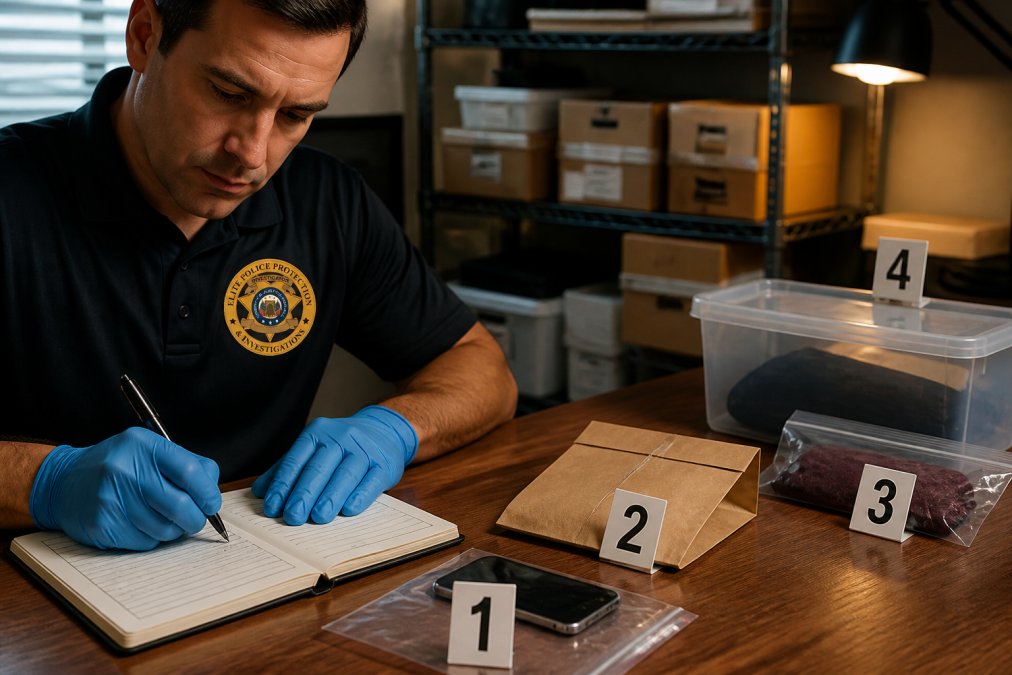
For private investigators, maintaining chain of custody begins the moment evidence is identified. Before touching anything, photograph it in place. Document the date, time, location, and environmental conditions. Then, if you must collect it, use gloves, place it in a labeled container, and record your actions in writing. Every transfer of the evidence to another person must be documented: who received it, when, and under what conditions.
Documentation Requirements
Written records are the backbone of chain of custody. For each piece of evidence, you need:
- Initial discovery log: Date, time, location, description, photographs of evidence in its original state
- Collection notes: Method of collection, tools used, observations about condition or surroundings
- Storage documentation: Where evidence is stored, temperature/humidity if relevant, access restrictions
- Transfer records: Every person who handled the evidence, including date, time, purpose, and signature
- Final condition report: Description of evidence when delivered to attorney or court, comparison to initial state
These records don't need to be elaborate. A simple notebook entry with date, time, and action taken is legally sufficient. What matters is consistency and completeness. Gaps in documentation create reasonable doubt.
Digital documentation is increasingly important. Photographs with metadata (date, time, location embedded in the file) provide strong evidence of authenticity. Video recordings of evidence collection are even better.
Maintaining Integrity Throughout Collection
Once evidence is collected, it must be protected from contamination, alteration, or loss. For physical evidence, storage should be secure and temperature-controlled where relevant. Only authorized personnel should access the evidence, and each access must be logged.
Digital evidence requires different handling. Files must be copied and hashed (a cryptographic fingerprint that proves the file hasn't been modified). The original file should never be altered; investigators work from copies. Metadata must be preserved. Deleted files require forensic recovery by qualified experts.
How to Document Evidence for Court
Documentation transforms raw evidence into courtroom-ready material. A photograph taken casually is just a picture. A photograph taken with proper technique, labeled with metadata, stored securely, and accompanied by a detailed affidavit becomes evidence.
The documentation process has three phases: collection, analysis, and presentation. During collection, you're capturing the evidence as it exists. During analysis, you're examining it and drawing conclusions. During presentation, you're explaining to the court what the evidence is and why it matters.
Photographic and Video Documentation
Photographs and video are the most common forms of evidence. They're also frequently challenged because opposing counsel can argue the images are misleading, out of context, or altered.
To make photographs admissible:
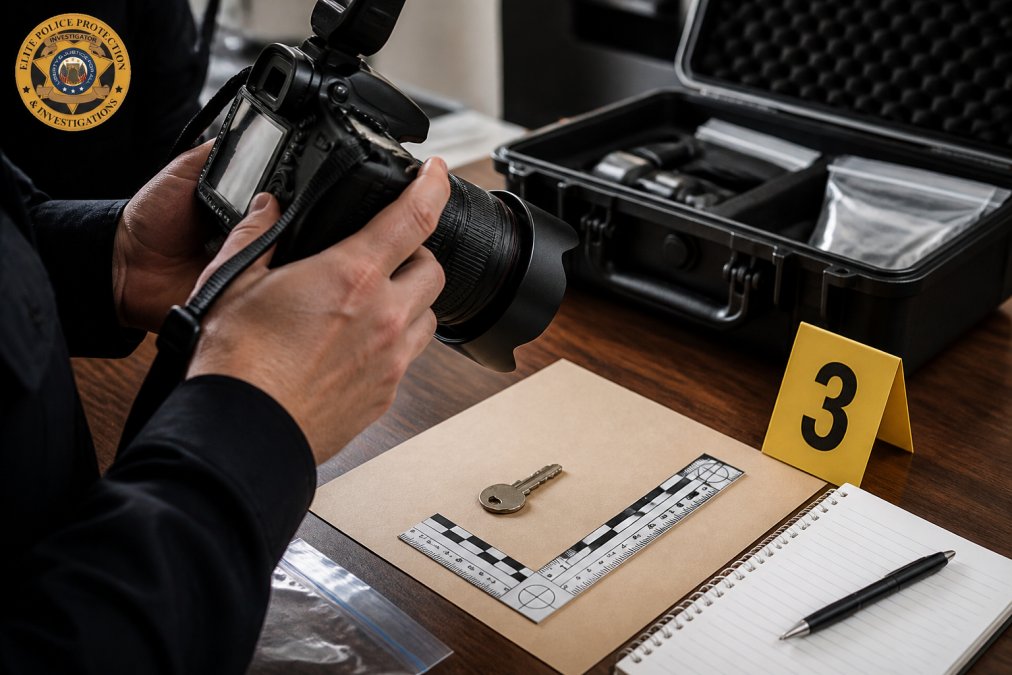
- Use a consistent method. Photograph evidence from multiple angles, including wide shots showing context and close-ups showing detail. Include a scale reference (a ruler, coin, or standard object) in close-up photos.
- Document the camera and settings. Note the camera model, lens, lighting conditions, and any filters or adjustments.
- Preserve metadata. Don't crop, edit, or filter photographs for court. If editing is necessary, disclose it and explain why.
- Create a photo log. For each photograph, record the date, time, location, subject, and photographer's name.
Video surveillance captures events in real time but raises questions about editing and completeness. Document the camera type, recording duration, whether audio is present, and how the video was stored. Disclose any editing and explain the reason.
Written Records and Affidavits
An affidavit is a written statement made under oath, signed and notarized. In many cases, an affidavit from the investigator is the only way the evidence gets explained to the court.
An affidavit should include:
- Your credentials. Name, title, years of experience, relevant training or certifications.
- How the evidence was obtained. Date, time, location, method, and any permissions or legal authority used.
- What you observed. Describe the evidence in detail without interpretation.
- Chain of custody. Explain how the evidence was collected, stored, and handled.
- Your conclusions. Explain what the evidence means and connect it to the case facts.
The affidavit must be truthful and complete. Omitting relevant details or overstating conclusions weakens your credibility and may result in evidence exclusion.
Legal Methods for Evidence Collection
Not all evidence collection methods are legal. Private investigators operate under strict limits. The fundamental rule: you cannot trespass, commit fraud, or violate privacy laws to collect evidence.
Surveillance Footage and Privacy Laws
Surveillance is a primary investigative tool, but it's heavily regulated. The key distinction is between recording in public and recording in private.
Public spaces, streets, parking lots, storefronts, public parks, generally have no reasonable expectation of privacy. Recording someone in public is legal in most circumstances. However, you cannot enter private property without permission to conduct surveillance, record through windows into homes or offices, use long-range equipment to capture conversations inside buildings, or record in bathrooms or changing rooms.
Private spaces, homes, offices, hotel rooms, private clubs, have strong privacy protection. Recording in these spaces without consent is illegal in most states. Some states require all-party consent for audio recording; others use one-party consent. Know your state's rules before recording any conversation.
Workplace surveillance is a gray area. Employers generally can monitor work spaces and equipment, but they cannot monitor bathrooms or break rooms. Clarify with the client what spaces they own and control.
Witness Statements and Interviews
Interviews are legal and often essential. You cannot impersonate a law enforcement officer, lie about your identity or purpose, coerce or threaten a witness, record a conversation without proper consent, or misrepresent that a conversation is off the record.
Be honest about who you are and why you're asking questions. Written statements from witnesses are powerful evidence. Have the witness write out what they observed, sign and date it, and consider having it notarized.
The Fruit of the Poisonous Tree Doctrine
The "fruit of the poisonous tree" doctrine excludes evidence obtained through illegal or unconstitutional means, even if the evidence itself is relevant and reliable. If you illegally obtained evidence through trespassing, wiretapping, hacking, or deceiving, the court will exclude that evidence and anything derived from it.
For private investigators, this doctrine is a constant constraint. You cannot break the law to gather evidence, even if you believe it's crucial. The remedy for illegal evidence is exclusion, not a fine or warning.
The doctrine has narrow exceptions. If evidence is discovered through an independent source, a lead from lawful investigation, it may be admissible. These exceptions are rare and require strong legal argument.
The practical implication: stay within the law. If a collection method feels legally risky, don't do it. Consult with an attorney. The time spent on legal advice is far cheaper than losing a case because evidence was excluded.
Common Pitfalls That Invalidate Evidence
Investigators often make preventable mistakes that render evidence inadmissible.
Broken chain of custody. A gap in documentation gives opposing counsel an opening to argue the evidence could have been altered. Solution: document every step, every transfer, every access.
Lack of authentication. Evidence must be proven to be what it claims to be. A photograph needs testimony that it accurately depicts the subject. A recording needs testimony that it's the original, unedited file. Solution: prepare an affidavit explaining how the evidence was created and why it's reliable.
Hearsay. An out-of-court statement offered to prove the truth of what was said is hearsay. If a witness tells you "John told me he saw the accident," and you use that as proof of what John saw, it's inadmissible. Solution: focus on what you personally observed.
Violation of privacy laws. Recording without consent, entering private property without permission, or accessing private records illegally taints evidence. Solution: know the privacy laws in your jurisdiction and respect them strictly.
Improper storage or handling. If evidence is stored in conditions that could damage it, opposing counsel can argue it's unreliable. Solution: store evidence in secure, climate-controlled environments and document storage conditions.
Lack of expert qualifications. If you're offering an opinion on forensic evidence, you need demonstrated expertise. Solution: maintain certifications, training records, and prior case experience.
Private Investigator Cost Per Hour 2026
Private investigator rates vary widely based on location, experience, case complexity, and specialization. Experienced investigators in major metropolitan areas typically charge premium rates that reflect their expertise and overhead. Specialized investigations, digital forensics, background checks, and surveillance often command higher rates because they require advanced training or equipment.
When evaluating investigator costs, consider what you're paying for: not just the investigator's time, but their experience, training, insurance, and legal knowledge. A cheaper investigator who cuts corners on evidence handling will cost far more when evidence is excluded from court.
Elite Police Protection employs investigators with law enforcement backgrounds who understand evidence standards and courtroom procedures. This expertise ensures that evidence is collected properly and documented thoroughly, reducing the risk of exclusion and strengthening your case.
Ensuring Your Investigation Holds Up in Court
The ultimate test of an investigation is whether its evidence survives in court. An investigation that produces findings but generates inadmissible evidence has failed.
To ensure your investigation holds up:
Plan for admissibility from the start. Before collecting evidence, think about how it will be presented in court. What questions will opposing counsel ask? What documentation will you need?
Maintain meticulous records. Document everything: dates, times, locations, methods, observations, and every transfer of evidence.
Respect legal boundaries. Don't trespass, don't hack, don't record without consent where required. If you're unsure about a collection method, ask an attorney.
Use proper photography and recording techniques. Invest in decent equipment and learn how to use it. Metadata and consistent technique strengthen authenticity.
Prepare detailed affidavits. Your written testimony is often the only chance to educate the court about what was found and how it was collected.
Understand your jurisdiction's rules. Evidence standards vary by state and court. Know the Federal Rules of Evidence and your state's specific rules.
An investigation is only as strong as the evidence it produces, and evidence is only as strong as its admissibility. Courts don't care how hard you worked or how compelling your findings seem if the evidence was collected or handled improperly. Elite Police Protection's investigative team brings law enforcement expertise to private investigation, ensuring that evidence is collected, documented, and presented in ways that withstand judicial scrutiny. When your case goes to court, your evidence will be there to support it.
Frequently Asked Questions
What makes evidence admissible in court when collected by a private investigator?
Evidence admissibility depends on relevance, authenticity, and lawful collection methods. The Federal Rules of Evidence govern what courts accept. Evidence must be obtained without violating privacy laws, trespassing, or illegal wiretapping. A complete chain of custody demonstrating how evidence was collected, handled, and preserved is essential. Investigators must follow investigative protocols and document every step. Without proper procedures, even relevant evidence can be excluded, which is why working with experienced investigators who understand evidentiary standards is critical.
Can evidence gathered by a private investigator be thrown out of court?
Yes. Evidence can be excluded if the investigator violated laws during collection, failed to maintain chain of custody, or obtained it through trespassing, illegal surveillance, or consent violations. The 'Fruit of the Poisonous Tree' doctrine means that evidence obtained through illegal methods, and any evidence derived from it, becomes inadmissible. Courts also exclude evidence lacking proper authentication or documentation. This is why private investigators must understand legal requirements and maintain meticulous records. Admissibility standards exist to protect due process and ensure only reliable evidence reaches trial.
What is chain of custody for private investigator evidence?
Chain of custody is the documented record of who collected, handled, stored, and transferred evidence. It must show every person who touched the evidence, when they handled it, why, and what condition it was in. Each transfer requires signatures, dates, and times. This continuous documentation proves evidence integrity and prevents allegations of tampering or contamination. Without an unbroken chain of custody, courts may exclude evidence entirely, regardless of its relevance. Proper chain of custody documentation is one of the most critical elements ensuring evidence admissibility in legal proceedings.
How do private investigator costs relate to evidence admissibility standards?
Experienced investigators who understand admissibility standards charge rates reflecting their expertise in legal compliance and proper evidence handling. Costs vary based on investigation complexity, location, and investigator credentials. Hiring qualified investigators familiar with evidentiary standards, chain of custody requirements, and jurisdiction-specific rules ensures evidence will hold up in court. While pricing depends on the specific investigation, investing in qualified professionals prevents costly mistakes that render evidence inadmissible. Request investigators who can explain their protocols and document compliance with legal standards.
This article was written using GrandRanker