
 how-to
How to Secure Retail Shopping Centers: 7 Proven Steps
Table of Contents
- Step 1: Conduct a Security Risk Assessment and Security Audit
- Step 2: Build Layered Security Infrastructure with Surveillance and Access Control
- Step 3: Deploy Off-Duty Police for Retail Security
- Step 4: Implement Parking Lot Security Strategies
- Step 5: Apply Retail Security Best Practices for Staff and Operations
- Step 6: Integrate Cybersecurity and AI-Driven Analytics into Your Security Plan
- Step 7: Address Liability, Insurance, and Sustainability in Retail Security
- Conclusion: Building a Security Plan That Works
- Frequently Asked Questions
Last Updated: September 17, 2026
Step 1: Conduct a Security Risk Assessment and Security Audit
Learning how to secure retail shopping centers starts with one step most operators skip: a real risk assessment. A security risk assessment is a structured review that identifies where your property is exposed, how likely each threat is, and what it would cost you.
What a Proper Risk Assessment Covers
A useful assessment walks the whole property, not just the front entrance. It should document:
- Entry and exit points, including loading docks and fire doors
- Lighting levels in parking areas and walkways
- Camera coverage and blind spots
- Previous incident reports and police call logs
- Tenant mix and peak traffic hours
Step 2: Build Layered Security Infrastructure with Surveillance and Access Control
Layered security means no single failure opens the whole property. A shopper should pass through several controls before reaching a storefront: cameras, locked service doors, and monitored access points.
| Layer | What It Does | Where It Goes |
|---|---|---|
| Perimeter | Detects approach | Fencing, bollards, signage |
| Parking | Watches vehicles | Cameras, lighting, call stations |
| Entry points | Controls access | Card readers, staff doors |
| Interior | Monitors activity | Cameras, patrols, alarms |
Video Surveillance and Access Control Integration
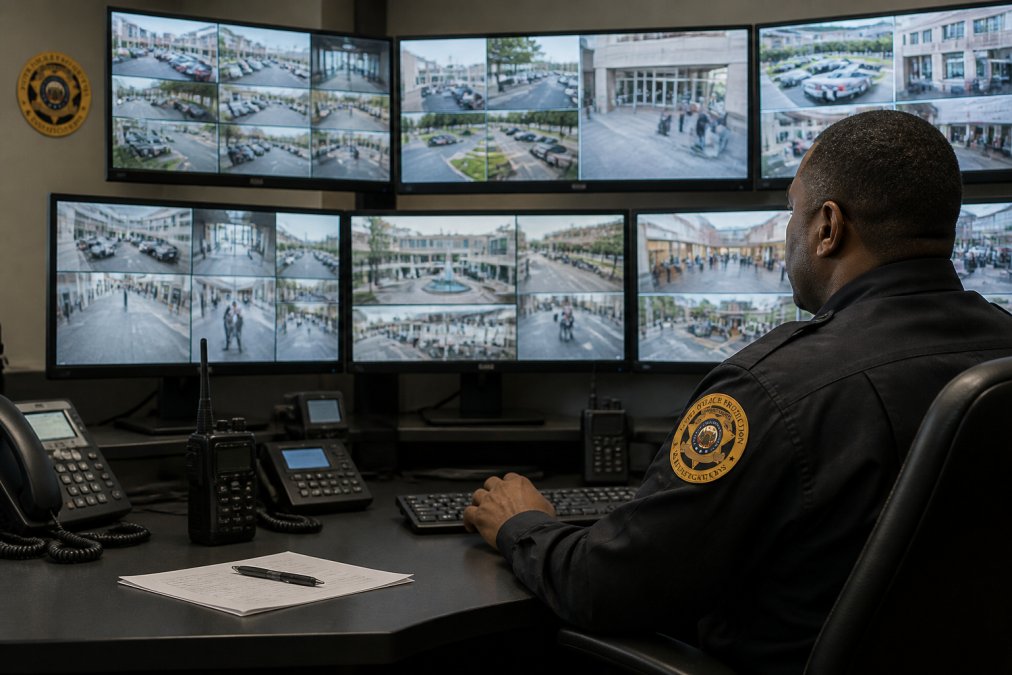
Surveillance systems and access control work best when they talk to each other. A badge swipe that fails three times at a service door should trigger a camera view for your monitoring team. That is the difference between watching footage later and stopping a problem now.
Step 3: Deploy Off-Duty Police for Retail Security
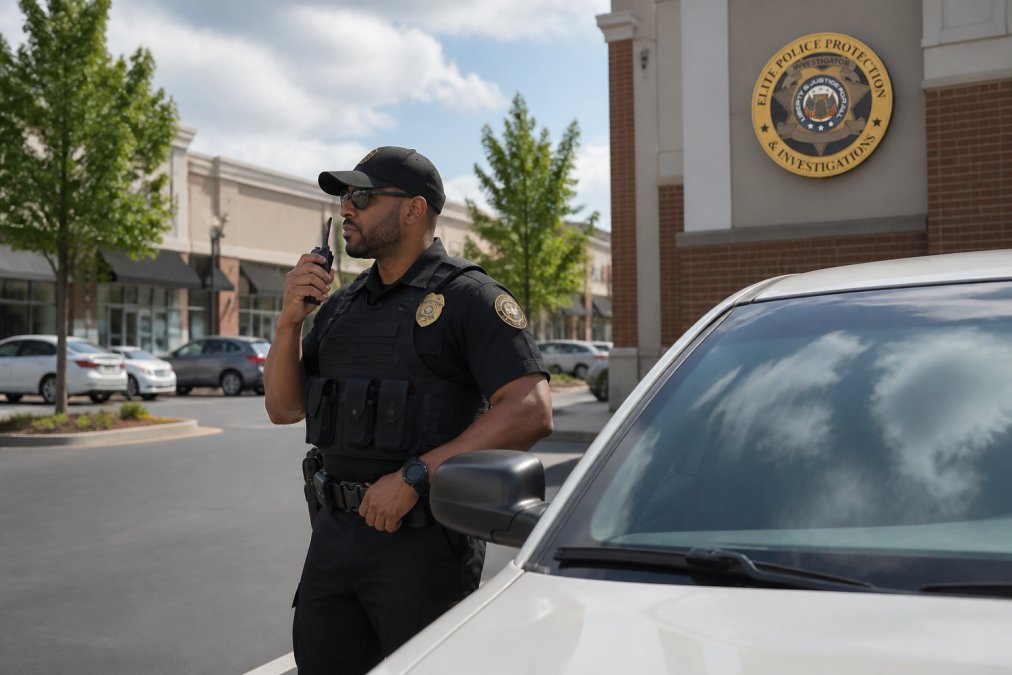
Off-duty police for retail security brings sworn officers onto your property in a visible, deterring role. These officers carry full arrest powers and training that a standard guard often lacks. A marked presence near entrances and trouble spots changes how people behave.
Step 4: Implement Parking Lot Security Strategies
Parking lot security strategies matter because most incidents at shopping centers start outside the building. A shopper walking to a dark car is more exposed than anyone inside. Your lot is where prevention pays off fastest, and where most guides stop at "add more lights."
Lighting That Actually Meets a Standard
"Well lit" is not a specification. Most practitioners design lot lighting to the Illuminating Engineering Society's recommended practice for parking facilities, which sets target horizontal illuminance and uniformity ratios rather than a single brightness number. Two things matter more than raw output:
- Uniformity, a bright pole next to a dark aisle creates the contrast that hides an attacker. Aim for even coverage across every aisle and walkway, not just at entrances.
- Color rendering, LED fixtures with higher color rendering index make faces and clothing easier to identify on camera and in person. Older high-pressure sodium washes everything orange and defeats identification.
CPTED: Designing Out the Opportunity
Crime Prevention Through Environmental Design (CPTED) is the framework most security consultants apply to lots, and it comes down to four moves:
- Natural surveillance, trim landscaping to keep sightlines under about three feet at ground level and above about six feet at canopy height, so shrubs never create a hiding pocket.
- Territorial reinforcement, clear signage, pavement markings, and visible cameras signal that the lot is managed and watched.
- Access control, limit the number of vehicle and pedestrian entry points so traffic funnels past cameras and staff rather than dispersing across the whole perimeter.
- Maintenance, burned-out lights, broken gates, and graffiti signal neglect and invite more of the same.
Patrols, Call Stations, and the Coverage Gap
Fixed cameras cannot see behind a parked SUV or around a column. That is the coverage gap, and it is where patrols earn their cost:
- Foot and vehicle patrols during peak shopping hours, with a documented route and check-in log
- Emergency call stations placed at the far ends of aisles and at stairwells and elevator banks, not clustered near the main entrance where people already feel safe
- A posted patrol schedule that flexes with your traffic data, not a fixed shift
Where the Lot Meets the Building
The transition zones, vestibules, employee exits, loading docks, and the walk from the last parking row to the door, are where most lot incidents actually occur. Treat them as their own layer: light them to the same standard as the lot, cover them with dedicated cameras, and route patrols through them on every pass.
Step 5: Apply Retail Security Best Practices for Staff and Operations
Retail security best practices only work when your people follow them. Staff are your first observers, and their response sets the tone for everything else.
Employee Training, Incident Reporting, and Security Drills
Start with training that covers what to watch for and what not to do. Employees should never chase a shoplifter. They should report and let trained personnel respond.
- Run security drills at least twice a year
- Keep a simple incident reporting form for every event
- Review reports weekly to spot patterns
- Post security policies where staff can see them
Step 6: Integrate Cybersecurity and AI-Driven Analytics into Your Security Plan
Most guides on securing a shopping center treat physical and digital security as separate problems. They are not. Your cameras, access readers, alarm panels, intercoms, and HVAC and lighting controls increasingly sit on the same network, and that network is the single point of failure an attacker will look for first. A shopping center that hardens its doors but leaves its camera network on a shared, default-password VLAN has not secured anything; it has just moved the front door.
The Threat Model for a Retail Property
Retail networks attract a specific set of attackers, and knowing who they are shapes your defenses:
- Ransomware crews, they target the point-of-sale and back-office network, not the cameras, but a flat network lets them reach both. A payment outage during peak season is a direct revenue hit.
- Insiders, a departing employee or contractor with lingering credentials to the camera or access-control system can disable coverage or grant themselves entry.
- Physical-digital hybrids, someone who cuts a camera cable or jams a wireless reader is doing physical reconnaissance to find the network's weak point.
- Opportunistic actors, default credentials on IP cameras and DVRs remain one of the most common exposures, because installers often leave factory logins in place.
Hardening the Security Network
The controls that matter most are unglamorous and cheap:
- Network segmentation, put cameras, access control, and building systems on their own VLAN, isolated from the point-of-sale and public Wi-Fi. If a camera is compromised, it should not be able to reach the payment network.
- Credential hygiene, change every default password at install, enforce unique credentials per device, and revoke access the day a contractor or employee leaves.
- Firmware discipline, camera and NVR vendors publish security patches; schedule updates the same way you schedule lighting maintenance.
- Encryption and remote access, encrypt video in transit and at rest, and require multi-factor authentication for any remote viewing portal.
- Logging and retention, keep access-control and camera-access logs long enough to reconstruct an incident. A common pattern is that operators keep video for 30 days but keep no record of who viewed it or exported it.
The NIST Cybersecurity Framework is the recognized organizing structure here, identify, protect, detect, respond, recover, and it maps cleanly onto a physical security program. The NIST Cybersecurity Framework is a reasonable starting reference for a property that has never formalized its network controls.
What AI Analytics Actually Does, and What It Does Not
AI-driven video analytics has moved past marketing hype, but the honest picture matters more than the pitch:
- What works well: loitering detection, crowd-density alerts, person-down detection, line-crossing at restricted doors, and object-left-behind alerts. These are pattern-recognition tasks where the software reliably beats a human watching a wall of monitors.
- What is harder: facial recognition and behavioral intent prediction. Accuracy varies with lighting, camera angle, and demographics, and several jurisdictions have restricted or banned facial recognition in public accommodations. Before deploying it, check your state and local rules, a system that is legal in one market may be prohibited in another.
- The real value: analytics triage. Instead of one monitor watching 40 feeds, the system surfaces the three events that need a human decision. That is a staffing multiplier, not a replacement for staff.
Where Physical and Digital Meet
The strongest programs treat the security operations center as a single function. A badge-swipe failure at a service door should trigger a camera view and a patrol dispatch from the same platform. A camera going offline should raise a network alert, not just a blank tile. When physical and digital signals feed one dashboard, your team sees a coherent picture instead of two disconnected ones.
Step 7: Address Liability, Insurance, and Sustainability in Retail Security
Liability and insurance implications should shape your security plan from day one. If an incident happens on your property, your documentation decides how the claim plays out. Good records protect you. Missing records do not.
Conclusion: Building a Security Plan That Works
Securing a shopping center is a system, not a purchase. The operators who get it right assess first, layer their defenses, and keep records that hold up when something goes wrong. That is where a partner who understands off-duty law enforcement makes the difference.
Frequently Asked Questions
What are the most effective security measures for large retail shopping centers?
The most effective approach combines layered measures: a thorough risk assessment and security audit, video surveillance with real-time monitoring, access control systems, trained security personnel or off-duty police, and clear emergency response protocols. Retail security best practices also include employee training, incident reporting systems, and regular security drills. No single measure works alone. The goal is to create overlapping layers so that if one fails, others compensate.
What role do off-duty law enforcement officers play in shopping center security?
Off-duty police for retail security bring sworn authority, legal knowledge, and advanced situational awareness that standard guards often lack. They can make arrests, conduct investigations, and de-escalate conflicts with training that goes beyond basic security certification. For high-risk retail environments or locations with recurring crime, their visible presence also deters potential offenders. Elite Police Protection provides off-duty, retired, and prior law enforcement professionals for exactly these scenarios.
How do you secure parking lots and common areas in retail environments?
Parking lot security strategies should include improved lighting to eliminate dark zones, visible security signage, regular patrols or camera coverage, and emergency call stations. Common areas need clear sightlines, crowd management plans during peak hours, and coordination between security personnel and local law enforcement. Access control at service entrances and loading docks also reduces unauthorized entry. These measures protect customers from vehicle break-ins, robberies, and personal safety incidents.
How can technology be integrated with physical security guards in retail?
A centralized platform connects surveillance systems, access control, alarm systems, and guard monitoring into one operational view. Video analytics can flag unusual behavior, while guard tour systems confirm patrols are completed on schedule. Real-time monitoring lets guards respond faster to incidents. Elite Police Protection offers an advanced guard monitoring system with client portal access, so property managers can review approved reports and patrol data as they happen.