
 ultimate-guide
Hiring Security for Construction Sites: 2026 Guide
Table of Contents
- Why Construction Sites Are High-Value Targets
- What Hiring Security for Construction Sites Actually Covers
- Building a Construction Site Security Plan
- Why Off-Duty Police for Construction Sites Changes the Equation
- Technology Integration: Beyond the Guard Booth
- Insurance, Liability, and Legal Compliance
- Construction Site Security Cost: What Shapes the Price
- How to Choose the Right Security Partner for Your Job Site
Last Updated: August 23, 2026
Construction sites are among the most consistently targeted locations for theft, vandalism, and unauthorized access. Equipment disappears overnight. Materials get stripped before installation. Injuries happen when unauthorized people access active jobsites. The Elite Police Protection team works with contractors and developers who want a real security strategy, not just a warm body at a gate. This guide breaks down what hiring security for construction sites involves, what it costs, and how to choose a provider who will actually protect your investment.
Why Construction Sites Are High-Value Targets
Construction sites are uniquely exposed to loss. Unlike retail stores or offices, jobsites have no locked doors, no permanent staff around the clock, and no embedded alarm infrastructure. Copper wire, heavy equipment, power tools, and materials sit in the open and are easy to move.
The problem compounds at night and weekends. Most theft and vandalism occurs during long gaps between shifts when sites are empty and perimeter security is minimal. According to the National Equipment Register theft prevention resources, construction equipment theft is a persistent, high-dollar problem with stubbornly low recovery rates.
Unauthorized access also creates serious liability exposure. Trespassers injured on active sites can trigger workers' compensation claims and general liability lawsuits that dwarf security contract costs. Treating jobsite security as an afterthought rather than building it into the project plan from day one is a common mistake.
What Hiring Security for Construction Sites Actually Covers
Hiring security for construction sites means more than posting a guard at the entrance. A comprehensive program integrates access control, surveillance, patrol activity, and incident documentation into a unified system.
Access Control and Perimeter Management
Access control is the foundation of any construction site security plan. Security personnel verify credentials at entry points, log every worker and vendor, and turn away anyone who can't be accounted for. This creates accountability rather than friction.
Perimeter management ensures temporary barriers haven't been compromised overnight. On large sites, this may involve multiple entry points with dedicated personnel. On smaller sites, a single officer handling both patrol and access verification is common. When workers know their entry is logged and vendors understand deliveries require sign-off, accountability becomes the default.
24/7 Surveillance, Mobile Patrols, and Incident Reporting
Round-the-clock monitoring is standard for sites with significant material or equipment value. Security officers conduct mobile patrols on scheduled and randomized intervals, randomization matters because predictable patterns are easy to work around.
Incident reporting separates professional providers from inadequate ones. Security guards must document breaches, suspicious vehicles, and equipment discrepancies accurately and immediately. Vague shift logs don't hold up for insurance claims or legal action. Professional teams produce structured incident reports that are specific, timestamped, and actionable.
Elite Police Protection's advanced guard monitoring system gives clients real-time access to patrol data and approved reports through a client portal, so project managers aren't waiting until Monday morning to learn what happened over the weekend.
Equipment Tracking and Delivery Monitoring
Security personnel verify incoming deliveries against manifests, flag discrepancies, and document what arrives and when. This catches short deliveries before they become disputes and creates a paper trail essential if materials go missing. For high-value equipment, security officers can coordinate with GPS-based asset tracking systems to cross-reference physical presence against digital records.
Building a Construction Site Security Plan
A construction site security plan is a documented strategy that maps specific threats to countermeasures for a given jobsite. Generic plans don't work. A downtown high-rise has entirely different vulnerabilities than a rural pipeline project or suburban residential development.
Site Vulnerability Assessment
The process starts with a site vulnerability assessment. Security professionals walk the site, identify weak points in the perimeter, evaluate lighting, assess asset value and mobility, and review the project timeline for high-risk windows like delivery days or long holiday weekends.
The assessment produces a prioritized list of risks and corresponding countermeasures. Some gaps get addressed with physical security measures; others require personnel solutions like additional patrol coverage during high-risk windows. A vulnerability assessment isn't a one-time exercise, as projects progress, the risk profile changes and the security plan should be reviewed at major milestones.
Security for Remote or Rural Job Sites
Remote and rural job sites present distinct challenges. Response times from local law enforcement can be measured in hours, not minutes. There are no neighbors to call 911, and cellular coverage may be unreliable.
For these environments, security solutions require more self-sufficiency. Mobile command units, satellite-connected surveillance systems, and on-site personnel with genuine law enforcement training become essential. Off-duty or retired law enforcement officers, who bring real-world threat assessment experience, are particularly well-suited to remote environments where judgment calls can't be escalated quickly.
According to OSHA construction site safety guidelines, maintaining safe and controlled site conditions is an employer obligation that extends to preventing unauthorized access, a requirement harder to meet without professional security support on isolated sites.
Why Off-Duty Police for Construction Sites Changes the Equation
Off-duty police for construction sites is fundamentally different from standard guard services. A trained security guard can observe and report. An off-duty law enforcement officer can observe, report, intervene, and, depending on jurisdiction and active status, exercise arrest authority. That capability changes how potential threats assess the risk of targeting a site.
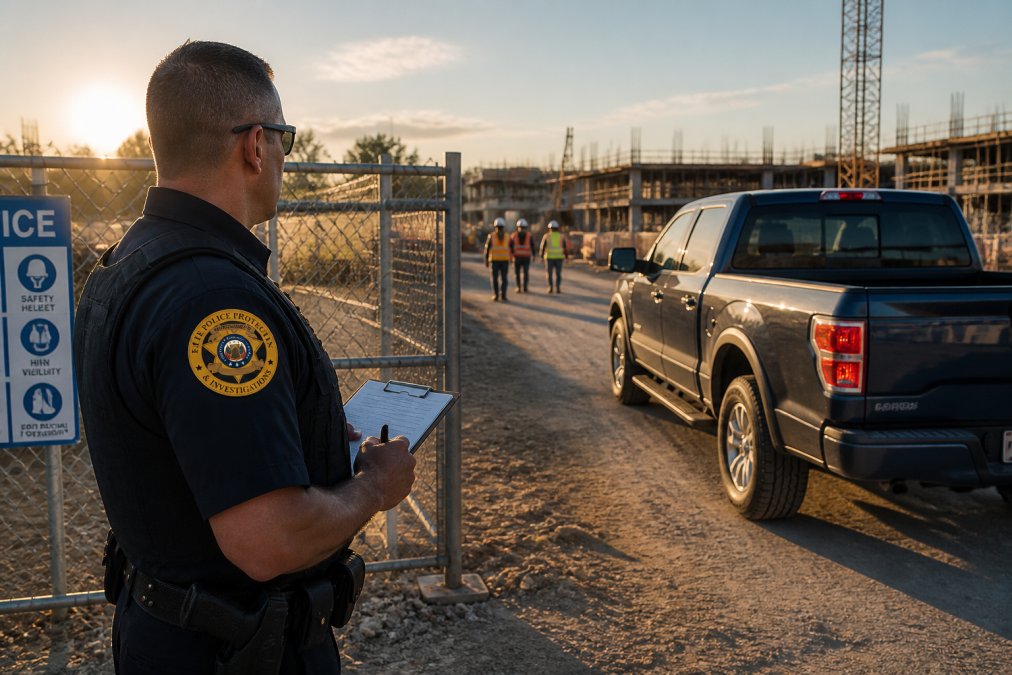
The behavioral deterrence effect is significant. When would-be thieves or vandals see a credentialed law enforcement professional rather than a minimum-wage guard, the calculus shifts. Off-duty officers bring situational awareness and conflict resolution skills from years of real-world experience, not a two-week certification course.
Elite Police Protection specializes in off-duty, retired, and prior law enforcement professionals. For construction companies burned by providers who "send whoever they have available," this distinction is the entire value proposition. When incidents occur on sites staffed by law enforcement professionals, the response is structured, documentation is court-ready, and chain of custody for evidence is maintained correctly.
Technology Integration: Beyond the Guard Booth
Modern construction site security integrates human guards and technology deliberately.
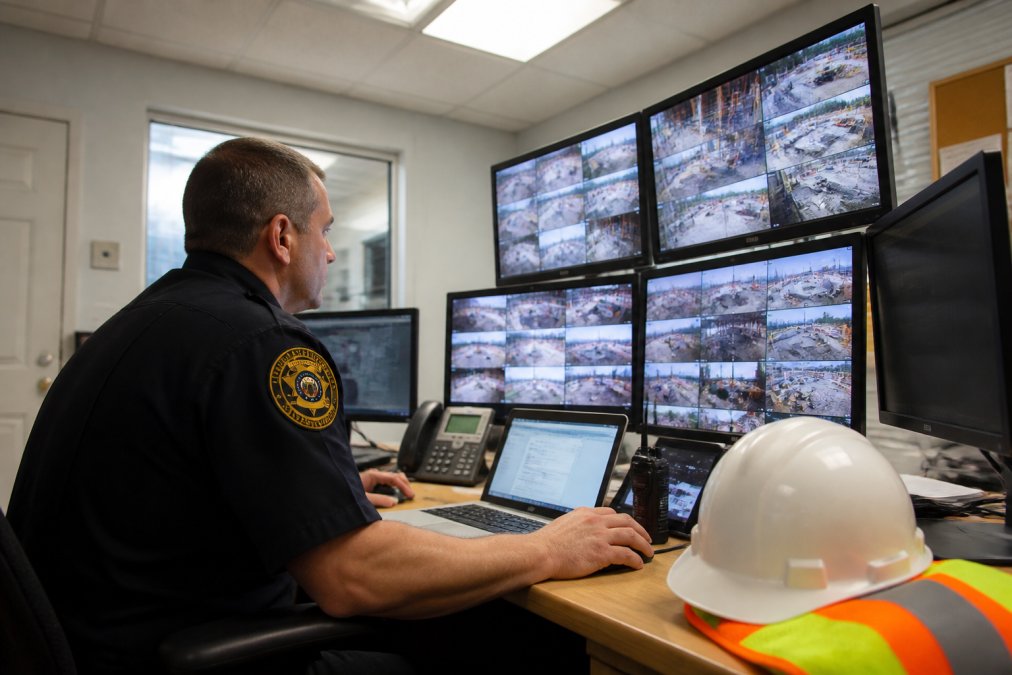
The technology layer includes fixed surveillance cameras with remote monitoring, motion-activated lighting, drone-based perimeter surveys for large sites, GPS asset tracking for major equipment, and access control systems that log entries digitally. These tools extend the reach of on-site personnel and create documentation that human observation alone can't produce.
The guard booth is the command point. Security officers who can pull up live camera feeds, cross-reference equipment logs, and communicate with remote monitoring centers are dramatically more effective than officers operating without that infrastructure. Elite Police Protection's guard monitoring system with client portal access reflects this integration: clients see real-time patrol data, not end-of-shift summaries.
The most common mistake is buying tools without a human process to support them. Cameras nobody watches and GPS trackers nobody checks are theater, not security.
Insurance, Liability, and Legal Compliance
The insurance implications of construction site security are frequently underestimated. Most commercial general liability and builders risk policies include provisions related to site security and unauthorized access. Sites lacking documented security measures may face claim denials or coverage disputes after a loss.
According to Insurance Information Institute guidance on commercial property coverage, documentation of loss prevention measures, including security personnel and surveillance systems, strengthens the insured's position in the event of a claim.
OSHA's construction standards address site safety conditions that overlap with security responsibilities, including perimeter control and prevention of unauthorized access. General contractors bear primary responsibility for site conditions, so security failures can translate directly into OSHA citations and civil liability.
A professional security provider should carry its own liability insurance and provide certificates of insurance naming the project owner as an additional insured.
Construction Site Security Cost: What Shapes the Price
Construction site security cost varies based on factors specific to each project and site.
| Cost Factor | Impact on Price | Notes |
|---|---|---|
| Personnel credentials | Higher for law enforcement | Off-duty officers command premium rates |
| Coverage hours | Scales with shift length | 24/7 coverage costs more than overnight-only |
| Site size and complexity | More officers for larger sites | Multiple entry points require dedicated staffing |
| Technology integration | Adds upfront and ongoing cost | Cameras, monitoring, GPS tracking |
| Location and access | Remote sites cost more | Travel time, limited local labor pool |
| Contract duration | Longer contracts may reduce rate | Project-length agreements vs. month-to-month |
Pricing for professional security services, particularly those staffed by law enforcement professionals, reflects the caliber of personnel and accountability built into the service. Providers competing primarily on price tend to compete on personnel quality as well.
Elite Police Protection does not publish standard rates because the right solution is specific to each site, coverage window, and risk profile. A direct consultation scopes the engagement accurately.
How to Choose the Right Security Partner for Your Job Site
The biggest mistake in choosing a security provider is treating it like a commodity purchase. Guard hours are not interchangeable. The quality of the person at your gate and the system behind them determines whether your security investment actually protects anything.
Here's what to evaluate:
- Personnel credentials: Are officers licensed per state requirements? Do they have law enforcement backgrounds?
- Reliability and accountability: Does the provider have a monitoring system that verifies officer presence and patrol activity? Can you access that data directly?
- Incident documentation: What does a standard incident report look like? Is it structured, timestamped, and court-admissible?
- Insurance: Can the provider supply a certificate of insurance naming your organization as an additional insured?
- Site-specific planning: Does the provider conduct a vulnerability assessment before proposing a solution?
- Scalability: Can coverage be adjusted as the project progresses and risk profile changes?
According to ASIS International security management standards, effective security program design begins with a formal risk assessment tied to specific site conditions, a standard that separates professional security consulting from guard-only staffing.
The difference between a provider who sends "whoever is available" and one who deploys credentialed, trained, accountable professionals is the difference between a liability and an asset.
Construction sites face real, costly threats that don't stop when workers leave for the day. The right security partner assesses vulnerabilities, deploys qualified personnel, and provides the documentation and accountability you need when something goes wrong. Elite Police Protection brings off-duty and prior law enforcement professionals, 24/7 availability, and a client portal that keeps you informed in real time. Get started with Elite Police Protection and put a security plan behind your next project built to the same standard as the structure you're building.
Frequently Asked Questions
What security measures are required for a construction site?
There are no single federal mandates that dictate construction site security staffing, but OSHA regulations require employers to maintain safe worksites, which includes controlling unauthorized access. Beyond compliance, most general contractors and project owners implement perimeter fencing, access control at entry points, lighting, surveillance systems, and on-site security personnel. Your insurance carrier may also impose specific requirements as a condition of coverage. A written site security plan that addresses these elements is the practical baseline.
What is the difference between static guards and mobile patrols for job sites?
Static guards are posted at a fixed point, typically a site entrance, to control access and deter unauthorized entry. Mobile patrols cover the entire perimeter and interior of a site on rotating schedules, making it harder for anyone to predict guard locations. Most construction sites benefit from a combination: static coverage at the main gate during active hours and mobile patrols overnight. Larger or multi-acre sites almost always need patrol coverage because a single fixed post leaves too much ground unmonitored.
How do you determine the number of security guards needed for a project?
Start with the site's total acreage and the number of entry and exit points. Factor in the value of materials and equipment on-site, the project phase (foundation work carries different risks than finish work), operating hours, and whether the site is in an urban or remote location. A formal site vulnerability assessment will map these variables to specific coverage gaps. A qualified security provider should conduct that assessment before recommending staffing levels rather than quoting a flat number without reviewing the site.
What are the benefits of hiring off-duty law enforcement for construction sites?
Off-duty police officers bring arrest authority, advanced de-escalation training, and credibility that standard security guards do not carry. On a construction site, that means trespassers and would-be thieves face a materially different deterrent. Officers also understand how to document incidents in ways that hold up in court, which matters when pursuing theft or vandalism claims. For high-value projects or sites with a history of incidents, the difference in qualifications often justifies the difference in construction site security cost.
This article was written using GrandRanker