
 ultimate-guide
Healthcare Facility Security Best Practices for 2026
Table of Contents
- Building a Hospital Security Risk Assessment Checklist
- Access Control Systems for Medical Facilities: A Practical Guide
- Healthcare Workplace Violence Prevention Strategies That Work
- Visitor Management Procedures for Hospitals and Clinics
- Cyber-Physical Security Convergence in Healthcare
- Budgeting and ROI for Healthcare Facility Security Upgrades
- Frequently Asked Questions
Last Updated: September 15, 2026
Building a Hospital Security Risk Assessment Checklist
Healthcare facility security best practices start with a structured risk assessment, not a hardware purchase. A hospital security risk assessment checklist documents vulnerabilities across people, property, and patient data before you commit budget to fixes. This guide from Elite Police Protection covers the assessment, access control, violence prevention, visitor management, and the cyber-physical gap most hospitals ignore.
Most teams begin with cameras and badge readers. That is backwards. You cannot harden a facility you have not assessed, and the assessment is where insurers, regulators, and accreditation surveyors expect to see your reasoning.
Key Vulnerabilities to Evaluate in Healthcare Settings
Hospitals carry vulnerabilities warehouses and office towers do not. Evaluate these first:
- Multiple uncontrolled entrances, including ambulance bays, loading docks, and staff stairwells
- Open clinical floors where behavioral health patients, visitors, and staff share corridors
- Pharmacy and medication storage, a high-value target for diversion and theft
- Emergency department waiting rooms, the single most common site of workplace violence
- Infant and pediatric units, which need tighter credentialing than general wards
- After-hours access by contractors, vendors, and cleaning crews
The IAHSS Security Design Guidelines for Healthcare Facilities and the CISA ISC Facility Security Plan Guide both provide structured frameworks for this work. CISA's guide is free and government-vetted, which makes it a sensible starting point for security directors who need a defensible process.
Documenting Findings for Compliance and Insurance
Documentation turns a walkthrough into a defensible record. For each finding, capture the location, vulnerability, likelihood and impact, and proposed mitigation. Tie physical safeguards to HIPAA requirements where protected health information is stored or transmitted on site.
Compliance officers and facility managers often use tools like the AccountableHQ physical security checklist to keep audit trails organized. Insurers increasingly ask for evidence of a documented assessment, not just a certificate of insurance.
Access Control Systems for Medical Facilities: A Practical Guide
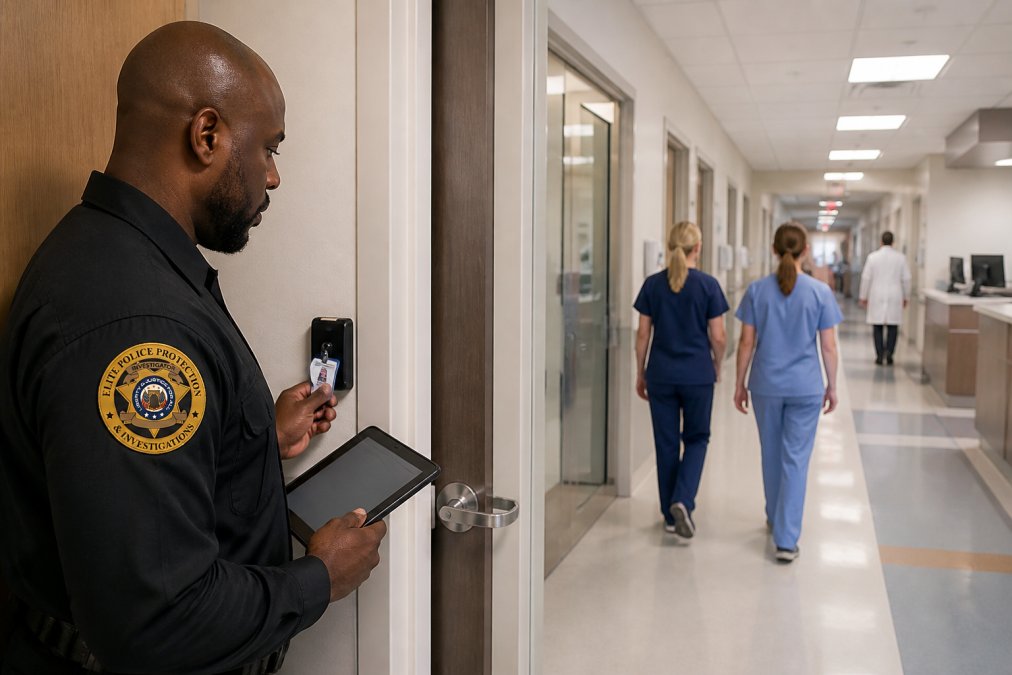
Access control systems for medical facilities must keep patients and families moving freely while restricting areas where they can be harmed or cause harm. That tension defines every design decision, from credential technology to door hardware.
Tiered Zones: The Backbone of Healthcare Access Control
Start with tiered zones rather than a single locked door. A workable four-tier model:
- Tier 0, Public: Lobbies, cafeterias, waiting rooms, main corridors. No credential required. Design for visibility and staff observation, not locks.
- Tier 1, Clinical: Patient floors, treatment areas, staff break rooms. Badge required. This is where most readers live.
- Tier 2, Restricted: Pharmacy, medication rooms, server and IT closets, medical gas storage, labor and delivery, behavioral health units. Badge plus a second factor.
- Tier 3, Critical: Infant and pediatric units, cash-handling areas, security command center, network core. Badge plus second factor plus audit logging and often a staffed checkpoint.
Map every door to a tier before you buy a single reader. The mapping exercise, not the hardware, is what regulators and accreditation surveyors want to see.
Credential Technology: Matching the Reader to the Door
Not every door deserves the same credential. Common options:
- Proximity (125 kHz) cards: Cheap, widely deployed, and easy to clone. Fine for low-risk interior doors, but a poor choice for the pharmacy or infant unit.
- Smart cards (13.56 MHz, MIFARE DESFire or similar): Encrypted, harder to clone, and the current default for healthcare. Use these for Tier 1 and above.
- Mobile credentials: Convenient for staff who already carry a phone, but plan for battery failure and lost-device revocation. Pair with a PIN fallback.
- PIN or keypad: A useful second factor at Tier 2 and Tier 3 doors, and a fallback when a badge is lost.
- Biometrics (fingerprint, iris, palm): Strong authentication for the pharmacy and controlled-substance storage, but throughput is slow and some staff resist enrollment. Reserve for the smallest number of doors possible.
A practical rule: lock by risk, not convenience. Where a zone holds medications, vulnerable patients, or protected data, credentials are non-negotiable. Everywhere else, visibility and staff training do more good than another reader.
Door Hardware and Anti-Passback
The reader is only half the door. Specify hardware that fails safe or fails secure according to risk:
- Fail secure (door locks on power loss) is correct for the pharmacy, server rooms, and infant units.
- Fail safe (door unlocks on power loss) is required by most fire codes for egress paths, so it belongs on corridors and stairwell doors.
Enable anti-passback on Tier 2 and Tier 3 doors so a badge cannot be handed back to let a second person in. Add door-held-open alarms and forced-door alarms so a propped pharmacy door generates a real-time alert, not a log entry nobody reads.
Balancing Open Access With Patient Safety
Patient safety and open access are not opposites, but they require deliberate trade-offs. A locked behavioral health unit protects patients and staff; the same lock on a chemotherapy infusion suite delays care and frustrates families.
Two mechanisms make the trade-off manageable. First, staff badge-in with visitor escort lets a nurse bring a family member through a Tier 1 door without issuing a temporary credential. Second, scheduled unlock windows, for example, a labor and delivery entrance that unlocks for shift change, reduce the friction that pushes staff to prop doors open.
Auditing and Reporting
Access control systems generate the audit trail compliance officers, insurers, and surveyors ask for. Confirm your system can produce, on demand:
- Who entered a Tier 2 or Tier 3 door, and when
- Which credentials have not been used in 90 days (a sign of orphaned accounts)
- Every door-held-open and forced-door event by location
- A termination report showing credentials deactivated the day an employee leaves
Healthcare Workplace Violence Prevention Strategies That Work
A Behavioral Health De-escalation Protocol
Environmental Design That Reduces Violence
Training Cadence and Content
Measuring Whether It Works
Visitor Management Procedures for Hospitals and Clinics
Cyber-Physical Security Convergence in Healthcare
Budgeting and ROI for Healthcare Facility Security Upgrades
Frame each upgrade around what it prevents:
| Upgrade | Primary Risk Addressed | How to Justify It |
|---|---|---|
| Tiered access control | Unauthorized entry to restricted zones | Fewer diversion and theft incidents, cleaner audit trail |
| Visitor management system | Unaccounted visitors in clinical areas | Faster compliance reporting, documented accountability |
| De-escalation training | Workplace violence in the ED | Reduced staff injury and turnover costs |
| Camera and analytics upgrade | Slow threat detection and response | Faster incident response, stronger insurance position |
| Cyber-physical segmentation | Network-to-door compromise | Reduced breach exposure, regulatory alignment |
Frequently Asked Questions
What are the primary security challenges in healthcare facilities?
Healthcare facilities face unique challenges: open public access, 24/7 operations, high-stress environments, and valuable assets like medications and medical equipment. Workplace violence rates are higher than in most industries, and facilities must protect vulnerable patients while maintaining a welcoming atmosphere. Balancing physical safeguards with patient privacy and HIPAA compliance adds complexity. A thorough risk assessment helps prioritize these overlapping concerns.
How do you conduct a security risk assessment for a hospital?
Start by forming a team that includes security, facilities, clinical staff, and compliance. Walk the property to identify vulnerabilities in perimeter security, access points, surveillance coverage, and lighting. Review incident reports and interview staff about their safety concerns. Evaluate existing security protocols and emergency preparedness plans. Document findings and assign risk levels. Reassess annually or after any major incident or renovation.
What role does HIPAA play in physical security for healthcare?
HIPAA's Security Rule requires covered entities to implement physical safeguards to protect electronic protected health information (ePHI). This includes facility access controls, workstation security, and device and media controls. While HIPAA is often associated with cybersecurity, physical security measures like locked server rooms, visitor logs, and restricted access to areas where ePHI is stored are equally important. Non-compliance can result in significant fines.
Why are uniformed security guards essential for healthcare settings?
Uniformed guards provide a visible deterrent and rapid response capability. In healthcare, they help manage aggressive behavior, assist with emergency evacuations, and enforce visitor policies. Off-duty or retired law enforcement officers bring additional training in de-escalation and conflict resolution. Their presence reassures staff and patients while ensuring security protocols are followed consistently.
How can healthcare facilities balance open access with patient safety?
Use a layered approach: keep main entrances welcoming but control after-hours access with electronic locks. Implement visitor management systems that badge and track guests. Restrict access to sensitive areas like pharmacies, NICUs, and behavioral health units using biometric authentication or keycard readers. Train staff to challenge unfamiliar individuals politely. Regular risk assessments help fine-tune the balance between openness and security.
What are the best practices for managing visitor access in hospitals?
Require all visitors to check in at a central desk, present identification, and receive a temporary badge. Use a visitor management system to log entry and exit times. Escort visitors in high-security areas. Enforce visiting hours and limit the number of visitors per patient. Train staff to recognize and report suspicious behavior. After hours, use video intercoms and remote unlocking to verify identity before granting access.