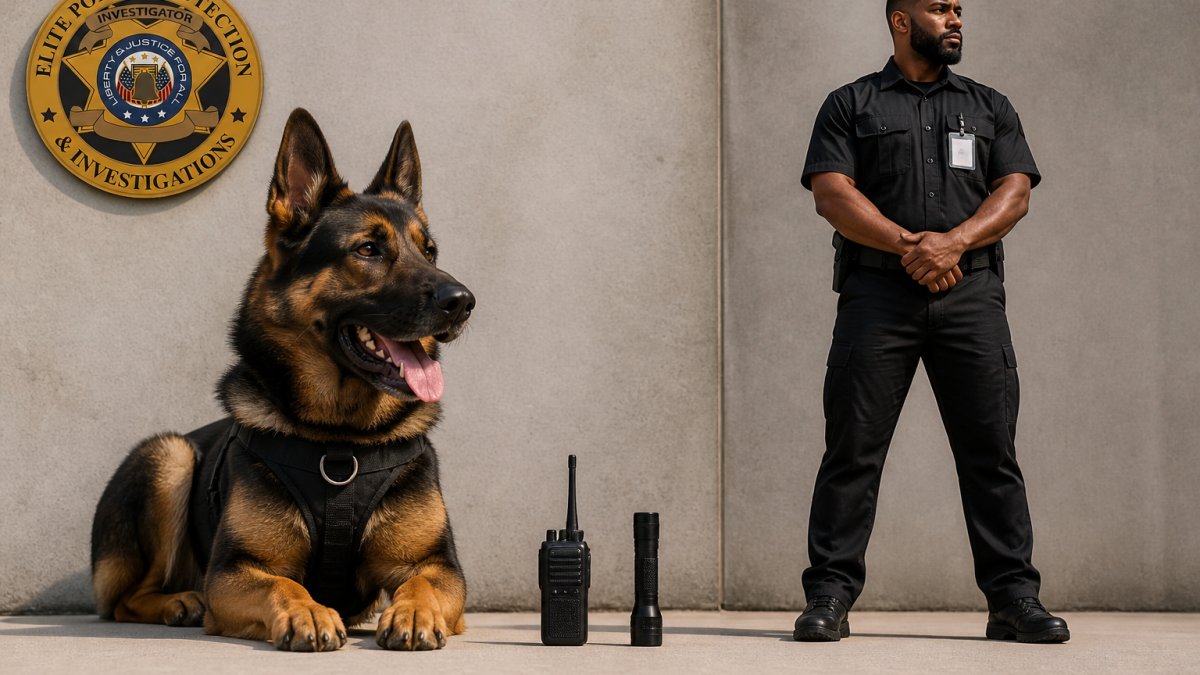
 comparison
Allied Universal Alternatives for Property Management
Table of Contents
- Why Property Managers Seek Allied Universal Alternatives
- Comparison Table: Top Security Providers for Property Management
- Elite Police Protection: Off-Duty Police for Property Security
- Securitas: National Coverage with Electronic Integration
- GardaWorld: Mobile Patrols and Rapid Response
- ADT Security Services: Remote Monitoring and Smart Building Tools
- MSA Security: Specialized Threat Detection and K9 Services
- Private Security Guard Company Vetting Checklist
- Frequently Asked Questions
Last Updated: September 12, 2026
Why Property Managers Seek Allied Universal Alternatives
Property managers looking for Allied Universal alternatives share the same complaint: the service looks fine on the contract and falls apart on the ground floor. A guard no-shows. A patrol log goes missing. A site needing armed coverage gets an unarmed officer. This guide from Elite Police Protection walks through the realistic options and their trade-offs.
The shift away from single-vendor reliance is practical, not ideological. National firms carry deep infrastructure and standardized training, but property managers often need speed, local judgment, and direct accountability more than a logo on a uniform. The alternatives split into three groups: off-duty law enforcement providers, national firms with strong electronic integration, and specialized threat-detection outfits.
Below, we'll show you how to compare them, which contractual red flags to watch for, and how to vet a private security guard company before signing.
Comparison Table: Top Security Providers for Property Management
This table summarizes the five providers covered in this guide. Match your property type to the "Best For" column first, then read the detailed section on each.
| Provider | Coverage Model | Standout Capability | Best For |
|---|---|---|---|
| Elite Police Protection | Off-duty and retired law enforcement | Guard monitoring portal, K9 teams, investigations | Properties needing accountable, experienced officers |
| Securitas | National footprint | Electronic and physical integration | Large multi-site portfolios |
| GardaWorld | Regional branches | Mobile patrol and alarm response | Mixed physical and mobile coverage |
| ADT Security Services | Subscription monitoring | Smart building and access control | Remote monitoring priorities |
| MSA Security | Specialized contracts | Explosive detection K9 and threat assessment | High-profile or high-risk sites |
How to Read This Table
The five providers above are not interchangeable. Before comparing quotes, decide which of three coverage models your property needs.
Physical presence. A uniformed officer on site, on a schedule, with post orders. Right when deterrence, door access control, or documented patrols matter. Most expensive per hour, most visible.
Electronic monitoring. Cameras, access control, intrusion detection, and a monitoring center. Right for visibility across a large footprint, after-hours coverage of multiple entrances, or evidence for incident review. Cheaper per hour, but no person on the ground.
Specialized response. K9 teams, threat assessment, executive protection, and investigative work. Right when a specific, credible risk exists that general guarding does not address.
Most properties need two of the three. A mid-size apartment community typically wants physical presence plus electronic monitoring; a distribution center may want physical presence plus mobile patrol. A high-profile commercial site may want all three, usually meaning more than one vendor unless you pick a firm that bundles them.
National vs. Regional vs. Specialized: What You Are Actually Buying
National firms carry standardized training, centralized reporting, and multi-state coverage under one contract. The trade-off: service quality tracks to the local branch or account manager, not the brand. A national contract does not guarantee national consistency.
Regional firms carry local knowledge, faster decision-making, and direct access to ownership. The trade-off is capacity: a regional firm may not staff a large or spread-out portfolio, and its call-off bench may be thinner.
Specialized firms carry capability general firms do not, such as explosive detection K9 teams or threat assessment. The trade-off is cost and scope: they are not built for routine guard coverage, so hiring one for a standard post overpays for unused capability.
Cost Structure: What Drives the Bill Rate
Bill rates for contract security are built from officer wages, payroll taxes and benefits, training and supervision, insurance, uniforms and equipment, and vendor margin. Two quotes for the same post can differ by 30 percent or more because of wage tier, supervision ratio, and insurance limits, not because one vendor is gouging.
When comparing quotes, ask each vendor to break the rate into wage, burden, and margin. A vendor that won't show that breakdown can't be evaluated on value. The lowest rate is often the lowest wage tier, usually the highest turnover and least consistent coverage.
Contract Length and Scalability
Most contract security agreements run 12 months with auto-renewal. If coverage needs change seasonally, more officers during a retail peak, fewer in a slow quarter, confirm the contract lets post count flex up or down without renegotiating the rate. Vendors that lock post counts make seasonal properties overpay.
State licensing requirements for private security firms
Elite Police Protection: Off-Duty Police for Property Security
Off-duty police for property security means staffing a site with active, retired, or prior law enforcement officers rather than entry-level guards. Elite Police Protection builds its model around that distinction, which matters most when a property needs someone who can read a situation, de-escalate it, and document it correctly.

What separates this approach from standard contract security is accountability. Elite Police Protection provides an advanced guard monitoring system with client portal access, so property managers can pull approved reports and patrol data in real time instead of waiting for a monthly summary. Officers are available 24/7, in uniform or business attire, armed or unarmed by site.
The service also covers executive protection, private investigations, and K9 teams. For an apartment community dealing with repeated trespassing, or a distribution center needing a visible deterrent, that covers more ground than a guard-only contract.
Securitas: National Coverage with Electronic Integration
Securitas is the strongest fit for portfolios stretching across multiple states that need one contract to cover all of them. It pairs on-site guarding with remote video monitoring, access control, and intrusion detection, reducing the vendors a property manager must coordinate.

Where it works well: large commercial properties with existing security infrastructure that want physical and electronic systems managed together. Where it struggles: pricing varies significantly by region and site requirements, so a quote for one property tells you little about the next, making budgeting harder for managers running a dozen locations.
GardaWorld: Mobile Patrols and Rapid Response
GardaWorld's edge is mobility. Mobile patrol and alarm response let one contract cover properties that don't justify a full-time officer, suiting shopping centers, retail strips, and warehouses with irregular activity.

The trade-off is branch dependency. Service quality and availability track to the local branch handling your account, so a manager with sites in three metros may get three different experiences under one contract. Ask for references from properties in your specific area before committing.
ADT Security Services: Remote Monitoring and Smart Building Tools
ADT Security Services is the right answer when electronic monitoring matters more than physical presence. Commercial video surveillance, access control for multi-tenant buildings, and 24/7 monitoring give property managers visibility without staffing a post.
The limitation is structural: ADT is built around systems, not guard staffing. If your property needs a visible officer walking the perimeter at 2 a.m., ADT alone won't deliver it. Many managers pair ADT monitoring with a separate guarding contract, reintroducing the vendor coordination problem they were trying to solve.
MSA Security: Specialized Threat Detection and K9 Services
MSA Security handles the work general guard firms can't. Explosive detection K9 teams, vulnerability analysis, and threat assessment serve high-profile commercial properties, luxury residential complexes, and sites with elevated risk profiles.

The cost sits higher than general-purpose security firms, as expected given the specialization. This is not a fit for a standard apartment community or mid-size retail center, it is for properties where a credible threat exists and a generic guard presence won't address it.
Private Security Guard Company Vetting Checklist
Vetting a private security guard company comes down to five checks: licensing, insurance, training documentation, reporting systems, and references from comparable properties. Run every candidate through the list below before signing.
- Confirm state security guard licensing for every officer assigned to your site, and ask how the firm tracks license expiration and renewal
- Request a certificate of insurance and verify general liability and workers' compensation limits in writing, with your property named as an additional insured where appropriate
- Ask for guard training standards, the curriculum hours behind them, and how completion is documented per officer
- Review a sample incident report and confirm it captures time, location, parties involved, actions taken, and chain-of-custody for evidence
- Test the reporting or management software before the contract starts, including how quickly post orders and site instructions can be updated
- Get three references from properties of similar size, type, and risk profile, and ask specifically about turnover on the account
- Clarify emergency response protocols, escalation contacts, and who can dispatch additional coverage
- Confirm who handles scheduling gaps and no-shows, the guaranteed fill time, and the credit you receive when a post goes unfilled
Contractual Red Flags to Negotiate Before Signing
Most property managers focus on the rate per hour and miss the clauses that determine whether they can exit a bad vendor. Four terms deserve line-by-line review.
Auto-renewal with long notice windows. A contract that renews automatically unless you give 60 or 90 days' written notice locks you in for another term before you have enough performance data to evaluate the first. Push for a 30-day notice window, or renewal requiring affirmative written consent.
"Best efforts" service levels. Language promising the vendor will use "best efforts" to respond to alarms or fill posts is unenforceable. Replace it with measurable commitments: a maximum fill time for call-offs, a maximum on-site response time for alarm activations, and a defined credit when targets are missed.
Termination tied only to cause. If you can only terminate for material breach, you will spend months documenting incidents before you can leave. Ask for a termination-for-convenience clause with a defined notice period, even with a modest wind-down fee. The optionality is usually worth more than the fee.
Indemnification that runs one direction. The vendor should indemnify your property for claims arising from the vendor's negligence or the acts of its officers. If the clause only protects the vendor, or caps liability at a fraction of annual contract value, you are carrying risk you did not price into the deal.
In-House vs. Outsourced: A Cost Framework
Many property managers default to outsourcing without running the numbers, and a few default to in-house without accounting for the full burden. The honest comparison is total cost of coverage per post per year, not hourly wage versus hourly rate.
On the in-house side, the visible cost is wages and payroll taxes. Hidden costs are recruiting and background screening, ongoing training, uniforms and equipment, scheduling and call-off coverage, supervision, workers' compensation and general liability insurance, and management time. When a single officer calls out, an in-house operation has no bench.
On the outsourced side, the visible cost is the hourly bill rate. Hidden costs are vendor management time, the onboarding learning curve, and the risk of inconsistent performance across sites. What you buy is a bench of trained officers, supervisory infrastructure, insurance, and the ability to scale coverage without hiring or laying off.
A common pattern: properties needing fewer than five full-time posts, or with irregular weekly coverage, come out ahead with a well-vetted outsourced provider because in-house fixed overhead cannot be spread across enough hours. Properties with stable, high-volume needs and a strong internal management layer are where in-house math starts to work. Run the comparison on total annual cost per post, not the headline rate.
Transition Logistics: Switching Without Downtime
The operational risk in switching vendors is not the new contract but the gap between the old one ending and the new one being fully briefed. A structured transition protects coverage.
Start 60 to 90 days out. Give written notice per your existing contract's terms and confirm the exact end date in writing. In parallel, finalize the new vendor's start date with at least a one-week overlap if the old contract allows, so the incoming team can shadow post orders and site walkthroughs.
Build a written post-order package before the new vendor's first shift: site maps, access control procedures, key and credential handling, alarm codes and authorized recipients, escalation contacts by hour, known issues or prior incidents, and reporting expectations. Vendors who receive a complete package on day one perform measurably better in the first month than those briefed verbally.
Confirm credential and equipment handoff. Keys, fobs, radios, and property-owned equipment need a documented transfer with signatures. Unreturned credentials are a security exposure, not just an accounting problem.
Schedule a 30-day review with the new vendor to compare actual fill rates, response times, and report quality against the service levels you negotiated. The first month is when problems are cheapest to fix.
Frequently Asked Questions
Who is Allied Universal's biggest competitor?
Allied Universal competes with several national and regional firms. Securitas and GardaWorld are often cited as major competitors due to their global reach and comprehensive service offerings. However, many property managers also consider specialized or boutique firms that provide tailored security solutions, such as off-duty law enforcement professionals, for specific needs like executive protection or high-risk event security.
What should property managers look for when vetting security vendors?
Property managers should use a private security guard company vetting checklist that includes verifying licensing, insurance coverage, training standards, and turnover rates. Ask about site-specific security plans, emergency response protocols, and how incidents are reported. Also review service level agreements and ensure the provider has experience with similar properties. For specialized needs, confirm if they offer off-duty police for property security.
What are the primary benefits of choosing a boutique security firm over a national provider?
Boutique firms often offer more personalized service, flexibility, and specialized expertise. They may provide off-duty law enforcement professionals who bring advanced situational awareness and conflict resolution skills. For commercial properties, benefits include tailored security plans, direct access to management, and potentially lower turnover. However, national firms may offer broader coverage and integrated technology. The choice depends on your specific security requirements and budget.
How do off-duty law enforcement services compare to traditional security guards?
Off-duty law enforcement officers are typically sworn personnel with extensive training in de-escalation, emergency response, and legal procedures. They can make arrests and carry firearms, which may deter crime more effectively. Traditional security guards may have less training and authority. For commercial properties, off-duty officers can enhance safety and liability protection. However, they often cost more, so assess your risk level and budget.
Are there security companies that offer more personalized service than Allied Universal?
Yes, many regional and boutique security companies offer more personalized service. These firms often assign dedicated account managers, create site-specific security plans, and provide direct communication with leadership. They may also specialize in off-duty law enforcement for property security, which can be valuable for high-risk commercial properties. When evaluating alternatives, consider your need for flexibility, responsiveness, and specialized expertise.